In 2024, Bangladesh tested a road made with shredded plastic bags and bottles; during a heat wave, it showed no visible cracking, while other roads showed visible distress
Bangladesh tests plastic-modified asphalt roads that withstand extreme heat, showing no cracks unlike conventional roads. Discover how recycled plastic could revolutionize road construction in hot climates.
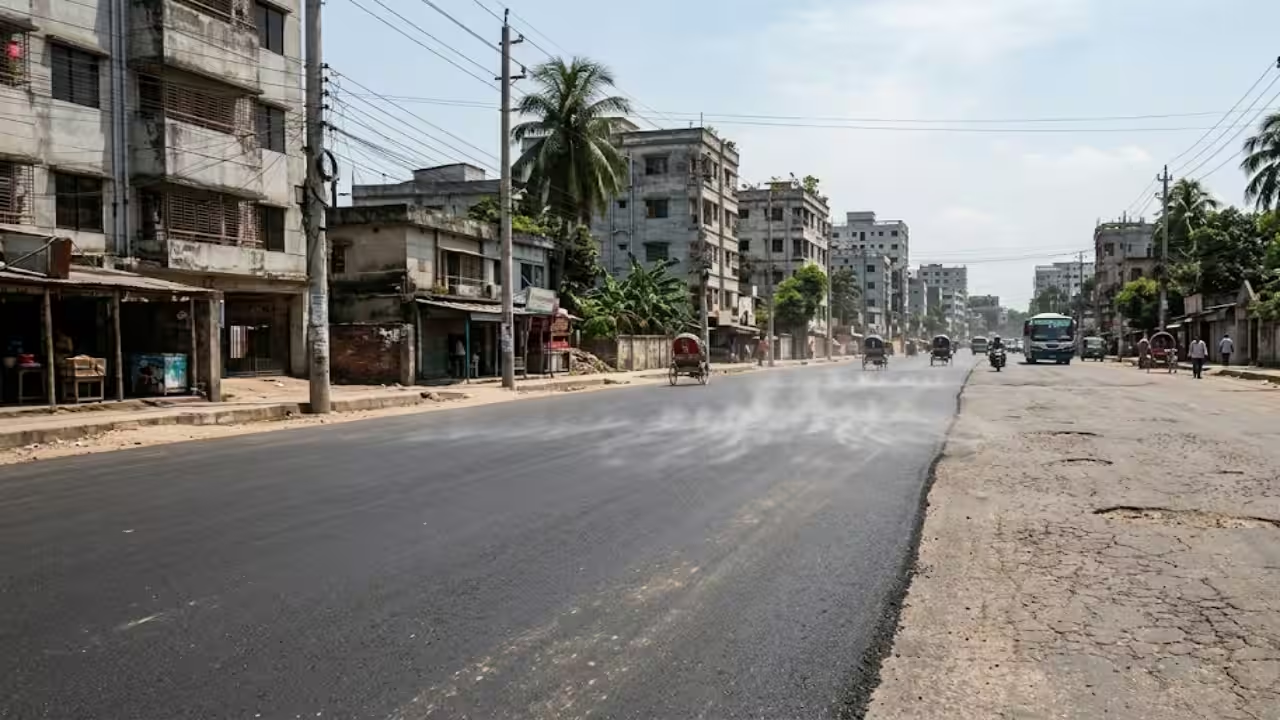
In a hot country, a new road never gets to enjoy its youth. Bitumen is the black binder that glues stone and sand together in asphalt. It softens as temperatures go up, and in high heat it can melt. When heavy traffic, humid air, and monsoon rain are added, cracks and potholes tend to follow soon after a fresh surface is laid. A Dhaka Tribune report noted that roads in Bangladesh's subtropical climate can develop cracks and potholes relatively quickly.April 2024 highlighted the strain caused by extreme heat. The Bangladesh Red Crescent Society, citing Bangladesh Meteorological Department data, reported 24 heatwave days in April, surpassing the previous April record of 23 days in 2019. Temperatures reached 42°C, 16°C above the annual average, and heat-related school closures affected 33 million children, according to Save the Children.One route stood out in Dhaka during that period. Civil engineer Sahadat Hossain of the University of Texas at Arlington said the plastic-modified road showed no visible signs of cracking or distress during the heatwave, while other roads in Bangladesh showed visible cracking and distress. The result still leaves questions about how the road was built, what else was measured and how much confidence the outcome deserves.Manufacture of the plastic roadAsphalt is a mix of stones, sand and bitumen. The Texas and Bangladesh teams replaced around 8% to 10% of the bitumen with melted plastic from everyday products, including single-use bags and bottles. The plastic is cleaned, crushed into small flakes and mixed into the asphalt at high temperatures so it melts and binds with the mix.Hossain compares the concept to putting rebar in concrete. It also reduces the amount of petroleum-based bitumen required. The same research program has also been tested in Texas. In a separate project near Dallas, about 4.5 tons of plastic waste was incorporated into nearly a mile of one-lane pavement.What the Dhaka tests foundThe Dhaka road is a 300-meter pavement at Rayer Bazar constructed in August 2023 and divided into four 75-meter sections, including one conventional control section, according to a 2026 ASCE conference paper. A study from the American Society of Civil Engineers details how the sections blended distinct plastic-modified asphalt and aggregate base layers. Researchers tested them with a lightweight deflectometer, a portable gadget that analyzes how much a pavement flexes when a weight is dumped on it.The plastic sections had a dynamic deflection modulus more than 50% higher than the conventional section. The best performance was achieved by a plastic modified asphalt surface on a cement treated base utilizing plastic aggregate.A later PhD project at the same university tracked the Dhaka road and a second site in Cumilla for three years. The Dhaka mix had 8% high-density polyethylene, while the Cumilla mix contained 8% low density polyethylene and 0.5% polypropylene. Stiffness in the plastic sections decreased more slowly than in the conventional sections. Ride quality showed a similar pattern. After three years, the International Roughness Index increased by 29% on the conventional pavement, while it decreased by 3% to 11% on the plastic-modified sections, according to the 2026 UTA dissertation.What remains unclearThe cracking comparison was a visual assessment made against several roads across Bangladesh rather than one nearby strip, so it is better viewed as an encouraging sign than as a controlled outcome. A pending US patent application for the pavement technology lists Sahadat Hossain, Tanvir Imtiaz and Tahsina Islam as inventors.Not every city has a consistent supply of clean, sorted plastic. Scaling up the feedstock remains a challenge. Microplastic release remains a separate environmental question. A 2024 study in Resources, Conservation and Recycling estimated that microplastic release from recycled-plastic asphalt could be about three orders of magnitude lower than the release of rubber particles from tire wear, while noting that the potential environmental impact still requires assessment.The Dhaka trial showed promising early pavement performance during extreme heat, while later stiffness and ride-quality measurements also favored the plastic-modified sections. Its value still needs to be demonstrated over decades and at the scale of a national road network.You use AI every day. Now get your AI Quotient. Take the AIQ test.
Topics in this story
Gathered from external sources. Rights to this text belong to whoever originally published it.