In 1990, Wisconsin built a test embankment for a gravel road over shredded waste tyres; after a year, inspectors rated its drainage excellent and called it among the better gravel roads
Discover how Wisconsin's use of shredded waste tires in road construction has proven to be effective, showcasing excellent drainage and durability, while providing an eco-friendly solution to tire waste.
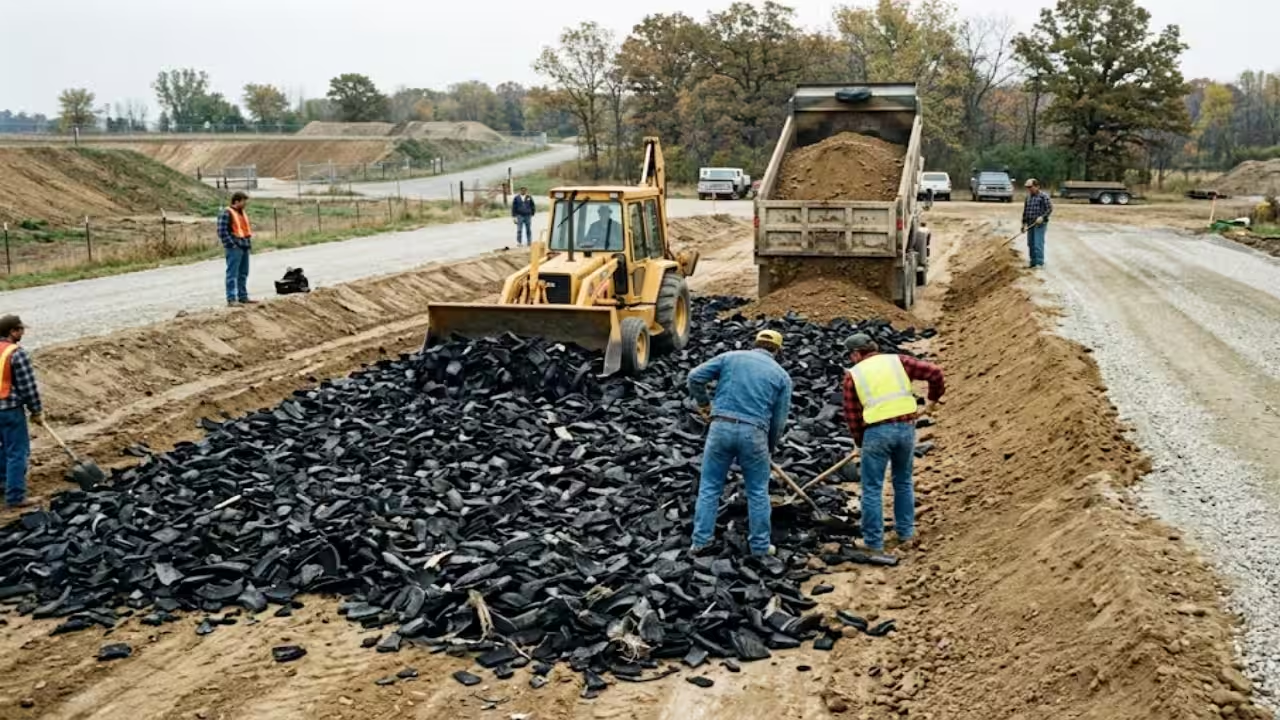
Millions of cars approach the end of their useful life each year, leaving behind an issue that is difficult to ignore. A tyre resists crushing, burns poorly, and does not lie neatly in a landfill because it is a tangle of rubber, synthetic fibre, and steel wire. As whole tyres became difficult to dispose of in sanitary landfills, stockpiles grew. A research paper by the University of Wisconsin–Madison team estimated that Wisconsin had about 20 million waste tyres stockpiled, with another 4 million generated each year. Engineers at the University of Wisconsin–Madison investigated whether shredded tyres could serve as fill beneath roads instead.So they built a test in 1990 to find out. The results, published in Transportation Research Record by Peter J. Bosscher, Tuncer B. Edil and Neil N. Eldin, documented the construction and performance of a gravel road embankment built using shredded waste tyres. After the first year, inspectors gave the embankment a strong assessment for drainage and described its overall performance as comparable to that of many gravel roads. The actual report is more cautious than that title, showing both what tyre chips can do and where they need support.A test embankment built beside a landfillThe test site was a small embankment beside the access road to the Dane County landfill near Madison, Wisconsin. It consisted of eight pieces, each 20 feet (approximately 6 metres) long and towering about 6 feet (1.8 metres) high with a 16-foot (4.9 metre) crest. Six portions behaved differently with tyre chips. Some used pure chips, one used half chips and half sand by volume, and one used alternate layers of chips and sand. Two portions were built of reinforced soil for comparison. The road also had approaches of pure earth.The researchers deliberately chose a severe environment. The embankment was exposed to heavy refuse-truck traffic from the landfill, allowing the researchers to observe how the different sections performed under repeated loading. The researchers obtained tyre chips from Wisconsin shredding plants. The paper reported processing costs of $30 to $65 per ton and noted that a ton of tyres represented approximately 100 tyres, although the exact weight and volume of shredded material varied with tyre size and chip characteristics.The Wisconsin findings are consistent with the broader engineering interest in using shredded tyres as lightweight fill. The Federal Highway Administration has documented their use in embankments and other highway applications, where their low unit weight and drainage properties can be useful. However, their suitability depends on the design, the amount of soil cover and how effectively the chips are confined.What the inspectors discoveredThe first couple of months were hard. Heavy truck traffic damaged the surface within days of opening, prompting crews to add crushed rock and regrade the road. Through the summer, the rutting, potholes, closure and regrading cycle repeated. The west approach, which was soil with no tyre chips at all, was badly damaged. Crews later applied calcium chloride to control dust. The road closed for the winter in December 1990 after a heavy snowfall.A formal inspection took place on 5 April 1991.The PASER system is a visual road-rating method described in a University of Wisconsin manual for gravel roads. The Wisconsin Department of Transportation district maintenance supervisor and university staff employed the PASER system. The writers believed that, following the initial time of adjustment and maintenance, the road was one of the better gravel roads. Because the sections were regraded before the subsequent rating, the perfect scores should be read in the context of that maintenance rather than as evidence that the road surface had remained undamaged throughout the trial.Tire chips provide a natural drainage advantage. Shreds and chips drain nearly as freely as clean gravel, says the Federal Highway Administration, which counts Wisconsin among at least 15 US states that have utilised them as lightweight fill in embankments.What the results tell us and don't tell usThe inspection results need to be interpreted in context because the road included both tyre-chip sections and approaches made from ordinary soil. The overall rating therefore cannot be attributed to the tyre chips alone. The researchers also found that settlement varied with the section's composition and the thickness of its soil cover. The best performers in the settlement measurements were the soil-only and fibre-reinforced sections. The parts with a 3-foot-thick soil cap and the chip and soil mix followed. The pure chip parts with only around 1 foot of cover did worse, perhaps due to the surface chips not being properly contained. The layered section did the worst of all. The authors concluded modestly. Once it has settled in, a gravel road made on tire chips operates like most gravel roads.The environmental outcomes were encouraging. The State Laboratory of Hygiene has tested shredded automobile tires and found no possibility of them becoming hazardous waste. In the lysimeters under the tire parts, the water stayed close to a neutral pH of around 7.5, and the sole elevated measurement was manganese, which the researchers attributed to local geology. They found that the tires probably would not contaminate groundwater.Wisconsin’s finding is in line with experience elsewhere. The Vermont Agency of Transportation reports that a town road in Vermont, built on a layer of tyre chips, is free of the spring muck that had plagued it, with the chip layer shutting off the rise of groundwater. Both situations demonstrate that tyre chips are suitable for roadways if drainage and cost are considerations and loads are regulated.The Wisconsin experiment showed that shredded waste tyres can serve as lightweight, free-draining fill beneath a gravel road, provided engineers contain the material properly and use adequate soil cover. The trial also revealed practical limitations: tyre chips were difficult to compact, exposed steel wires could puncture vehicle tyres, and the road required maintenance under heavy traffic. The findings support the use of shredded tyres in suitable embankment applications, but they do not establish that tyre chips alone produce a superior road surface.You use AI every day. Now get your AI Quotient. Take the AIQ test.
Topics in this story
Gathered from external sources. Rights to this text belong to whoever originally published it.