From Iran to India: How Trump's midterm loss could affect America's foreign policy
US President Donald Trump has faced the blues this midterm election, with Democrats sweeping both the House and Senate.
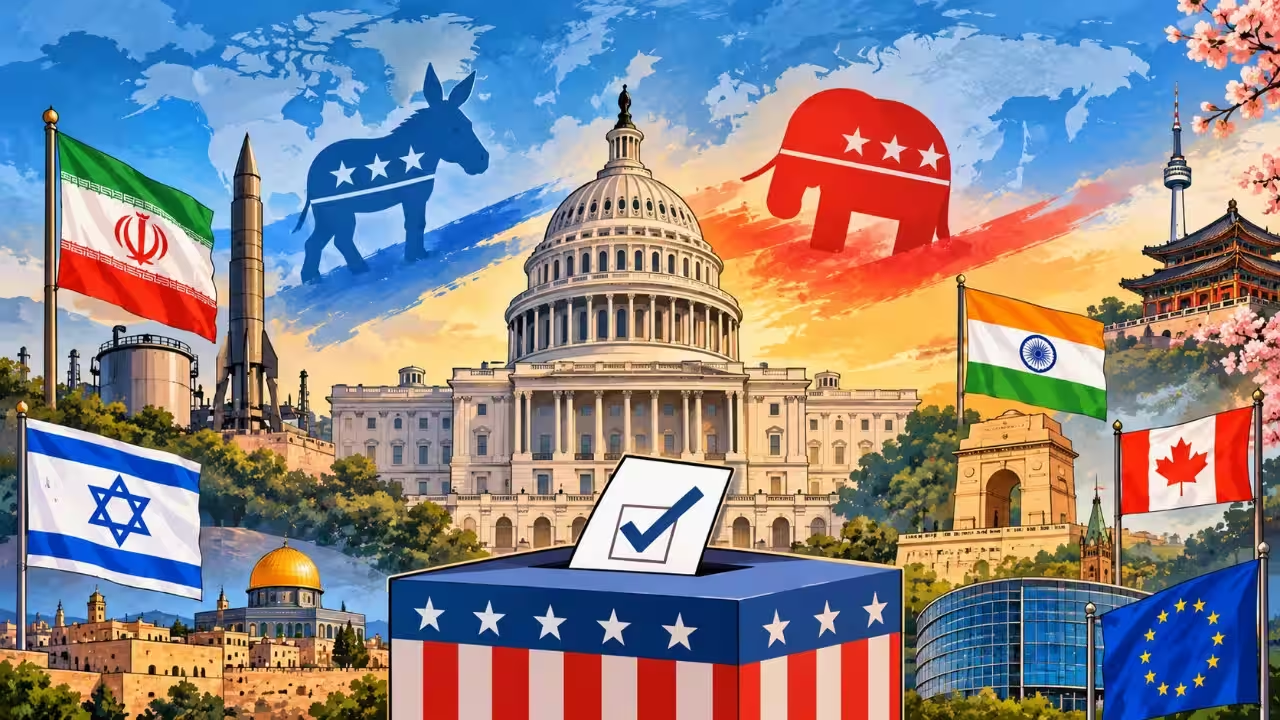
US President Donald Trump has faced the blues this midterm election, with Democrats sweeping both the House and Senate. As the president sees red over his party’s defeat, governments around the world are watching warily, weighing how the shift in congressional power could reshape Washington’s foreign policy and its approach to conflicts and alliances across the globe.Iran: Khamenei says US midterm results will not change Washington’s hostilityIran's Supreme Leader Mojtaba Khamenei said changes in the US political landscape would not alter Washington's hostility towards Tehran, after Republicans suffered setbacks in the midterm elections.“If anyone still hopes for a change in behaviour or a shift between political parties and factions in the system of domination, they are gravely mistaken,” Khamenei said in a written message published on his official website on Wednesday to mark Iran's annual November 4 anti-US commemoration.The message warned against making concessions to Washington, arguing that the US sought Iran's “unconditional surrender” and that any compromise would invite further demands and military attacks. It also portrayed Iran's actions in the Strait of Hormuz and against US military bases in the region as evidence that American military power was not invincible.“Any repetition of aggression will take on far broader dimensions,” the message said.Khamenei has not appeared in public or been heard speaking since the war began on February 28. No video or audio accompanied Wednesday's statement.Also read:How Trump's Iran war triggered 'regime change' at homeIsrael: Democratic victory raises questions over future of US supportThe Democratic takeover of Congress presents Israel with a set of challenges that extend beyond the immediate impact of the midterm elections, with uncertainty over Trump's Iran strategy, growing criticism of Israel within the Democratic Party and the political calculations surrounding the 2028 presidential race all potentially shaping ties between Washington and Jerusalem.The first concern is how Trump responds to the electoral setback and the political costs of the war with Iran. Analysts quoted by the Jerusalem Post suggest there are two possible paths, either one of renewed diplomatic efforts and concessions to Tehran, or a short but intense military operation aimed at declaring victory and scaling back US involvement.The new balance of power in Congress could pose another challenge. Democratic control of both chambers would give the party greater influence over committee leadership, legislative agendas and congressional scrutiny of Israeli policy, including the war in Gaza and US military assistance.The longer-term question is how the midterm results shape the Democratic Party's approach to Israel ahead of the 2028 presidential election. Candidates who have been openly critical of Israel have seen electoral success with Israeli analysts fearing that politicians such as Zohran Mamdani and Abdul El-Sayed, alongside a new generation of Democratic lawmakers, could become reference points for candidates seeking support from the party's base. Even a nominee who does not share the most critical positions may face pressure to take a tougher line towards Israel.India: Weakened Trump could push harder for trade dealIndia could face renewed pressure to conclude a trade agreement with Washington as Donald Trump seeks to demonstrate economic and diplomatic gains following his party's defeat in the midterm elections. While Democratic control of Congress could increase scrutiny of his tariff policies, it may do little to change the administration's broader trade approach.An analysis by the Global Trade Research Initiative (GTRI) suggests that Trump could turn to executive powers to maintain pressure on trading partners, including India, as both Democrats and Republicans increasingly favour economic nationalism, domestic manufacturing and stronger supply chains.For New Delhi, the immediate concern could be the terms of the proposed bilateral trade agreement. GTRI argues that Trump, facing setbacks in his broader foreign policy efforts involving Russia, China and Iran, could seek a quick trade deal with India to demonstrate American influence.The US could push for greater access to India's agricultural and industrial markets, alongside commitments to purchase $500 billion worth of American goods over five years and align certain security and economic policies with Washington.The proposed arrangement has also raised concerns over the possibility of further US tariffs, including additional duties linked to India's purchases of Russian oil.A Democratic-controlled Congress could increase legislative scrutiny of Trump's tariff policies, but businesses may not see immediate relief from existing duties.Also read: Why a 'lame' duck Donald Trump may push for a quick India-US trade dealCanada: Carney sees opening for trade deal with weakened TrumpThe Republican defeat could give Canada greater leverage in its trade negotiations with Washington, with Canadian PM Mark Carney indicating that the Trump administration had already begun softening some of its demands ahead of the midterm results.Speaking to reporters on the sidelines of a Commonwealth leaders' meeting in Antigua on Tuesday, Carney said the White House was “asking less and offering more”, adding that Washington had shifted its position on some of Canada's “red lines”. Canadian federal and provincial officials had been hoping that a Republican setback would strengthen Ottawa's negotiating position, CBC News reported.However, Canada's former ambassador to the US, Kirsten Hillman, cautioned the Carney government against changing course abruptly, saying it should continue constructive discussions if they were moving towards an arrangement acceptable to Canada.The election outcome also raises questions about Trump's ability to advance his domestic agenda. While Democrats will control both chambers of Congress and could pursue legislation on tariffs and other policies, Trump retains significant executive powers and can veto bills passed by lawmakers. A Democratic-led Congress could therefore constrain his agenda through investigations, legislation and scrutiny, but would not automatically be able to reverse his policies.Europe: Democrats may offer a check on Trump, but uncertainty remainsThe Democratic takeover of Congress could give European allies greater room to push back against Trump's approach to Ukraine, Russia and Nato, but it is unlikely to fundamentally alter Washington's foreign policy, with the president retaining considerable authority over diplomacy and military deployments.Since Russia launched its full-scale invasion of Ukraine in February 2022, Democrats have broadly supported military assistance to Kyiv and tougher sanctions against Moscow. A Democratic-controlled Congress could make it harder for Trump to ease sanctions on Russia or pursue policies that weaken support for Ukraine.However, the electoral setback could also push Trump to focus more heavily on foreign policy, where he retains greater executive authority. This could mean renewed efforts to negotiate an end to the war in Ukraine, potentially without adequately accounting for Kyiv's position.The implications extend to European security and Nato. The Pentagon is reviewing the US military presence in Europe, with Trump favouring reductions in the number of American troops stationed on the continent. While Democrats have pledged to oppose troop withdrawals, Congress has limited ability to dictate military deployments, which remain largely within the president's authority.With domestic policy increasingly constrained by a Democratic-led Congress, Trump could turn to foreign policy to pursue his priorities and establish his legacy ahead of the 2028 presidential election.South Korea: Caught between the White House and CongressSeoul could face a more complicated relationship with Washington as it navigates a Trump administration and a Democratic-led Congress with potentially different priorities. Former South Korean foreign vice-minister Choi Jong-kun, speaking to a popular Korean current-affairs show, said the country would have to deal separately with the White House and Congress, making diplomacy more challenging.Choi pointed to President Lee Jae-myung’s efforts to secure fuel supplies for nuclear-powered submarines, warning that a Democratic-led Congress could take a stricter position on non-proliferation and create obstacles to the plan. He also questioned whether North Korean leader Kim Jong-un would have much incentive to resume high-level talks with Trump if the administration could no longer offer substantive concessions.Economic and defence commitments could also come under greater scrutiny. South Korea has pledged $350 billion in investment in US strategic sectors, including shipbuilding and semiconductors, under an agreement signed last year. The Trump administration could also press Seoul to shoulder more of the cost of stationing US troops in the country, with potential tariff threats and troop reductions adding to the pressure, The Financial News reported.China: Beijing seeks to insulate ties with US from midterm resultsChina has reacted cautiously to the Democratic Party's gains in the US midterm elections, describing the polls as an internal American matter while signalling that it would continue working with Washington to implement agreements reached by the two countries' leaders.“The US midterm elections are a domestic affair,” Chinese foreign ministry spokesperson Mao Ning said at a media briefing, responding to a question on Beijing's assessment of the results.Mao said China was willing to continue working with the US to uphold and implement the important common understandings reached by president Xi Jinping and his US counterpart Donald Trump, enhance communication, properly manage differences and expand cooperation.She said Beijing was committed to building a constructive relationship of strategic stability with Washington based on respect, fairness and reciprocity, underscoring China's stated preference for continuity in bilateral ties despite changes in the US political landscape.Xi and Trump held two summits this year, including a meeting during the Chinese president's visit to the US from September 23 to 25. The visit marked their second summit since Trump's trip to Beijing in May, with Beijing describing the meetings as a historic milestone aimed at bringing strategic stability to bilateral relations.You use AI every day. Now get your AI Quotient. Take the AIQ test.
Topics in this story
Gathered from external sources. Rights to this text belong to whoever originally published it.