In 2002, Scotland opened the Falkirk Wheel to lift boats 100 feet between canals, replacing 11 locks with a rotating 1,800-tonne structure
Opened in 2002, the Falkirk Wheel transformed how boats travel between two historic canals in central Scotland.
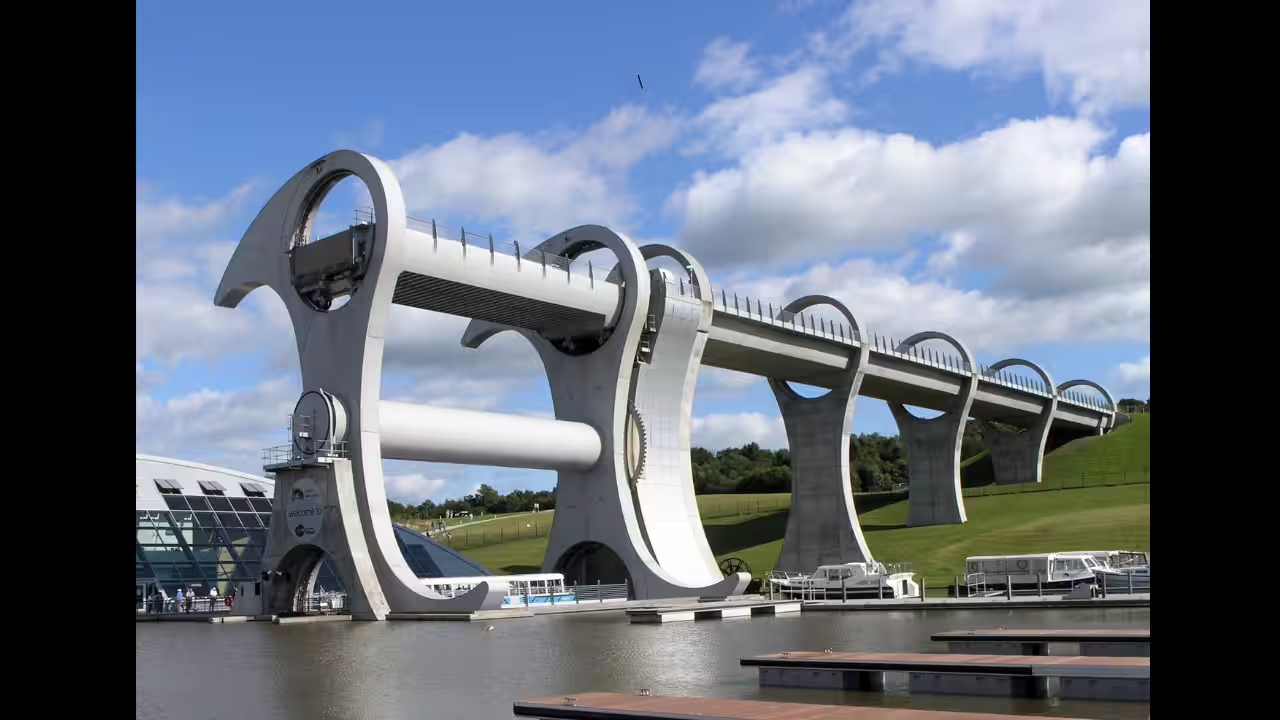
Opened in 2002, the Falkirk Wheel transformed how boats travel between two historic canals in central Scotland. The rotating boat lift connects the Forth and Clyde Canal with the Union Canal, which lies about 100 feet higher. Instead of relying on the former flight of 11 locks, the structure uses two water-filled gondolas that rotate to raise and lower vessels. The system was designed to keep the gondolas balanced, allowing the 1,800-tonne structure to operate using just 1.5 kWh for each rotation, according to Scottish Canals. The energy used is commonly compared with that required to boil eight kettles.How the Falkirk Wheel replaced 11 locks with a rotating boat liftThe Falkirk Wheel was built as part of efforts to restore the Forth and Clyde Canal and the Union Canal. The Forth and Clyde Canal was built in 1790, while the Union Canal opened in 1822. The two waterways had originally been connected at Falkirk through a series of 11 locks, but the locks later became unusable, and the canals were eventually closed.The restoration project sought a new way to connect the waterways rather than simply rebuilding the old staircase of locks. The Linda Hall Library says British Waterways Scotland worked with architectural and engineering firms to develop a unique boat-lift design. The resulting structure uses two gondolas positioned on opposite sides of the rotating wheel, allowing boats to be raised and lowered as the wheel turns.How the Falkirk Wheel raises boats 100 feet between two Scottish canalsEach side of the Falkirk Wheel contains a gondola capable of carrying canal boats. The Linda Hall Library states that each gondola can accommodate up to four canal boats, or one or two larger boats. Once the boats enter, seals are raised to make the gondolas watertight, and the wheel rotates to exchange their positions. Scottish Canals similarly describes the Wheel as connecting the two canals 35 metres above.How the Falkirk Wheel uses 1.5 kWh to rotate its 1,800-tonne structureA central feature of the design is the balance between the two gondolas. The two gondolas, when full of water, weigh the same regardless of how many boats they contain. It attributes this to Archimedes’ principle: when a boat enters a full gondola, it displaces water equal to its own weight, leaving the total weight unchanged.According to Scottish Canals, the structure weighs 1,800 tonnes and uses just 1.5 kWh for each rotation. The Linda Hall Library gives a figure of about 1.5 kilowatt-hours for one half-turn and notes the commonly cited comparison that this is about the same amount of energy required to boil eight kettles of water.How the Falkirk Wheel cut a full-day canal journey to just a few minutesBefore the Wheel was built, vessels travelling between the two canals had to pass through the former flight of 11 locks. Scottish Canals says this meant opening and closing 44 lock gates and could take a full day. The Wheel reduced the canal transfer to a journey of only a few minutes.Since opening, the Falkirk Wheel has also become a major visitor destination. Scottish Canals says it attracts around 500,000 visitors each year and describes it as one of Scotland's busiest tourist attractions. The organisation calls it a "working sculpture" combining modern engineering and technology with principles associated with Archimedes.You use AI every day. Now get your AI Quotient. Take the AIQ test.
Topics in this story
Gathered from external sources. Rights to this text belong to whoever originally published it.