In 2024, a Pennsylvania dairy farmer cut his monthly power bill from $2,500 to $74 by putting solar panels on his barn, whilecontinuing to carefor 300 cows
Discover how Richard Perkoski, a Pennsylvania dairy farmer, dramatically reduced his monthly electricity bill from $2,500 to $74 by installing solar panels on his barn. Supported by a USDA grant, this sustainable energy approach enables him to maintain his farm operations efficiently while considering expansion options.
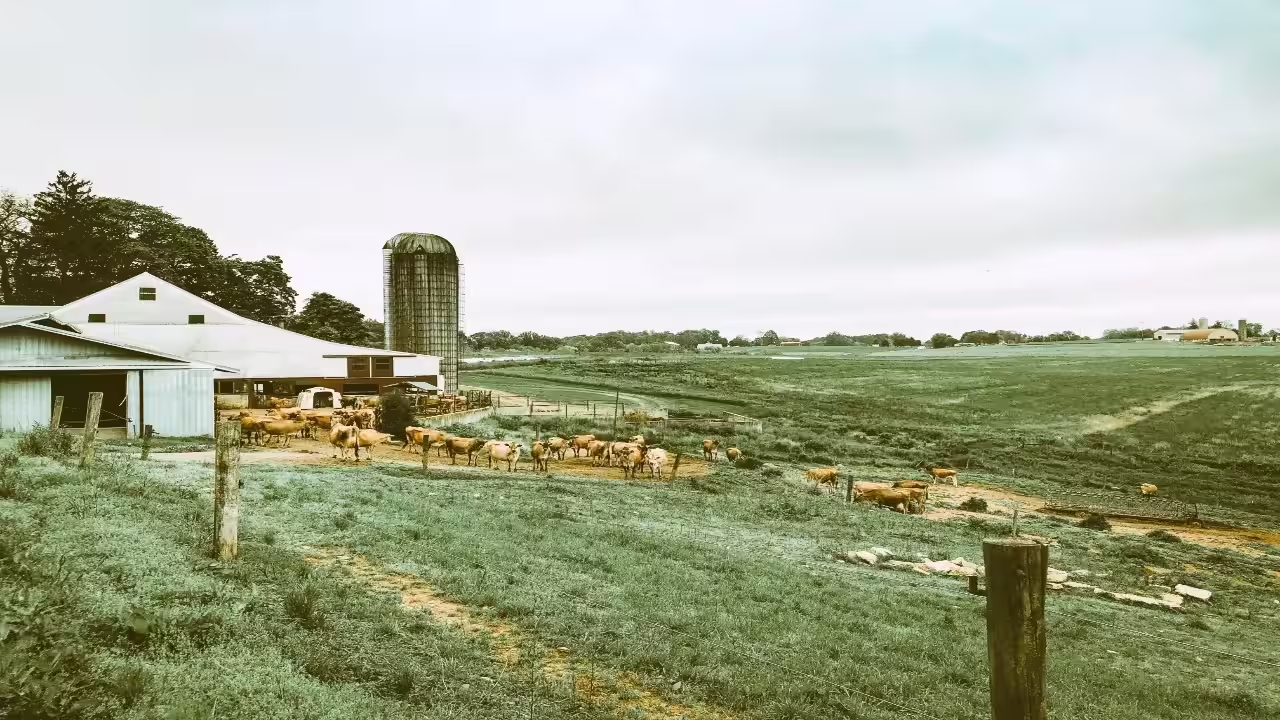
A Pennsylvania dairy farmer says he decreased his monthly electricity bill from $2,500 to $74,following the installation of solar panels on his barn roof. According to the Pittsburgh Post-Gazette, Richard Perkoski, owner of Main Street Milk, said the installation was funded through a grant from the US Department of Agriculture’s Rural Energy for America Program (REAP). The savings have helped him free up money for farm needs while the operation continues to milk cows and grow crops with five people employed in the workforce. The cost for installing the 321 solar panels came to $284,000, of which the USDA grant covered $110,208,while Perkoski paid the remaining $174,000.How the solar panels supply the dairy By generating power on site, the panels have substantially reduced the farm’s electricity costs. Electricity is the backbone of the farm's daily operations; it drives the milking equipment and vacuum pumps. Simultaneously, it keeps the lights on, handles the heating, and powers the massive cooling systems required to keep the milk at the perfect temperature. When the panels generate more electricity than the farm requires, surplus power is returned to the grid in exchange for utility credits. These credits help to reduce electricity drawn from the grid in case the solar production falls.At full capacity, the panels are capable of producing energy for around eight months of the year; conversely, their lower output can last up to four months. Perkoski runs the 590-acre farm with 300 cows, milking 220 of them, while growing corn and hay. With his ongoing savings, he has purchased additional barn lighting and hopes to expand the herd and transition to electric tractors.As per Farm and Dairy, Perkoski’s dairy installation comes from his wider experience with solar energy, which began around 15 years earlier when he installed 200 panels at his home. Later in 2021, he began a separate solar farm on 48 acres with 8,000 ground-mounted panels in Jefferson Hills, Pennsylvania, which supplied electricity to Duquesne Light Company.How USDA funding supports farm energy projects In October 2024, the US Department of Agriculture (USDA) announced an additional $104 million in Rural Energy for America Program (REAP) grants to support more than 300 clean-energy projects across 34 states. The programme's objective was to help agricultural producers and rural small businesses invest in renewable-energy systems and energy-efficiency improvements.REAP was established through the 2008 Farm Bill, which initially received $255 million in funding. Farm and Dairy reported that the Inflation Reduction Act, passed in 2022, subsequently provided more than $2.3 billion in additional investment for the programme. The funding also extends to energy systems that use agricultural waste. The USDA estimates the project could generate 2.7 million kilowatt-hours of electricity annually, equivalent to the power used by 252 homes of electricity annually, equivalent to the power used by 252 homes. Anaerobic digesters process organic material, including farm waste, to produce biogas that can be used for energy. Replacing the engine was intended to support the farm’s ability to generate electricity from this system. These projects show the various ways REAP funding can help farms address energy costs while maintaining equipment that converts agricultural waste into power.You use AI every day. Now get your AI Quotient. Take the AIQ test.
Topics in this story
Gathered from external sources. Rights to this text belong to whoever originally published it.