In 2018, New York researchers buried hot-water loops beneath pavement; a small-scale freeze-chamber test showed they could keep the surface of a test section ice-free
Discover how New York researchers are using heated water loops beneath asphalt to prevent icy roads and reduce environmental impact, improving safety during winter storms.
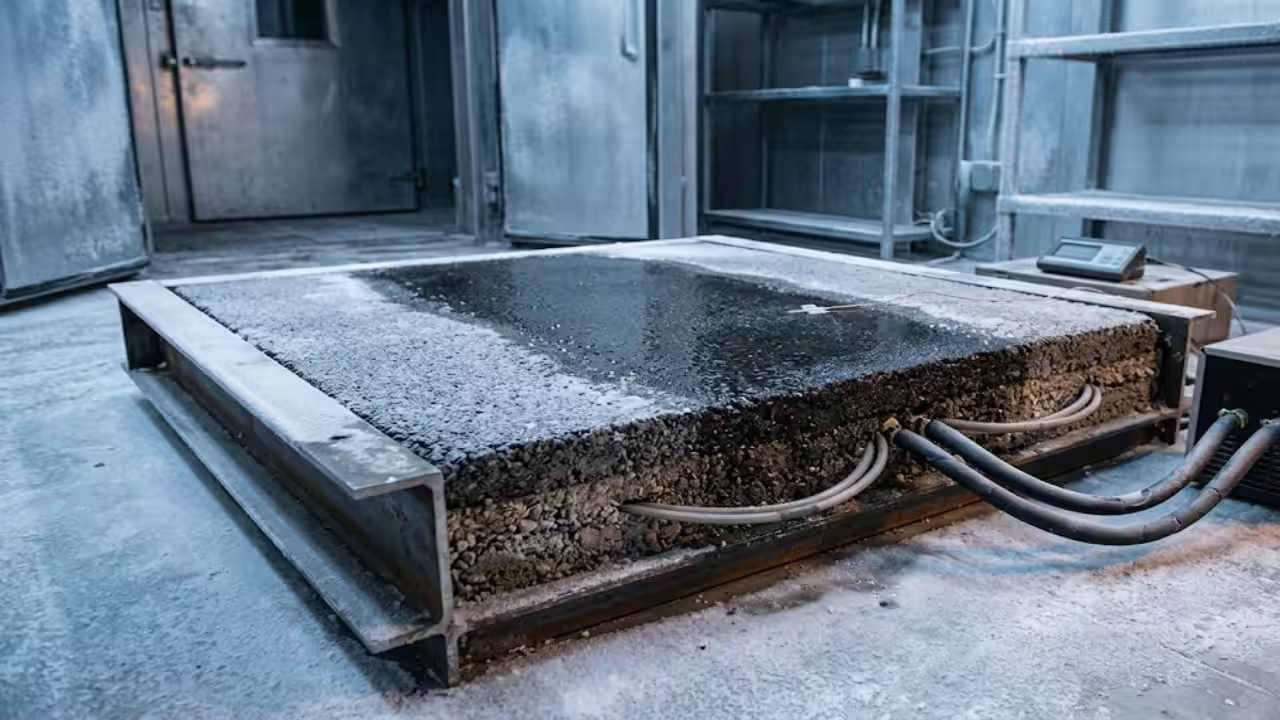
New York uses a lot of salt, the standard solution for snowy roadways. A 2018 report says the salt has pushed chloride levels in the state’s freshwater streams up to about a quarter of the concentration in seawater and that the state spends about $1.6 billion a year on roadway deicing. Salt also chews up pavement. For years, engineers have been searching for a more environmentally friendly way of keeping highways clear.One was tested by researchers at Stony Brook University, in collaboration with partners at Columbia University and Cornell University. They built a small section of pavement with loops of warm fluid buried in the gravel base layer under the asphalt and tested it in a freeze chamber. The loops provided enough heat to keep the surface ice-free, although a considerable share of the heat leaked downward, according to the team’s final report, published in April 2018 and archived by the National Transportation Library.Why put the loops under the asphaltHeated pavement is not a new concept. The Netherlands built a system that circulated geothermal fluid through loops in the asphalt layer, and it kept surfaces ice-free through the winter, the report says. But the Dutch design needed a specially formulated crack-resistant asphalt mix and a plastic geogrid to stop stress around the loops from cracking the surface. That pushed up costs and limited its adoption in the US. The Stony Brook researchers relocated the loops into the aggregate foundation layer, under the asphalt, so they could utilise a traditional thin asphalt surface without those concerns. Their whole proposal combines pavement loops with geothermal ground loops along the roadway, circulation pumps and solar panels to power the pumps, which would allow it to operate in isolated locations distant from the grid.In the freeze chamberColumbia University’s project page puts out the team’s two concerns from the beginning. One was structural: the risk of bumps appearing over the loops because pipes and pavement have varying stiffnesses. The other was thermal: maintaining the surface free of ice in very low temperatures and heavy snow.To test the thermal side, the researchers built a stretch of pavement inside an insulated wooden box about 600 millimetres square, according to the report. From the top down it had 100 millimetres of asphalt, 150 millimetres of base, 150 millimetres of subbase and 300 millimetres of subgrade. A single W-shaped loop ran through the middle of the base. A heating device pushed a 50-50 water and propylene glycol mix through it at 31.5 degrees Celsius, which is a warm bath, not anything scalding. The freeze chamber was held at minus 10 degrees Celsius for 48 hours before the fluid was started, by which time the surface had settled at about minus 7.The report says that after around 11 hours, the surface above the entrance and the middle of the loop crossed freezing as the fluid circulated. The fluid reaches the far end cooler, and the surface above the outlet took about 16 hours to cross freezing. Everything settled at about 24 hours, with the surface about 2.5 degrees Celsius above freezing over the entrance, about 1 degree in the centre and about half a degree near the outlet. In a second trial, the scientists put a 25 mm (about 1 inch) layer of ice cubes on the surface before starting the pump, and the surface still climbed above freezing in roughly 10 hours.What the report foundThe report says about 58% of the heat went up and 42% went down into the earth. The authors propose an insulating layer under the loops to drive more heat to the surface. They then modelled the design for Buffalo, New York City and Washington, DC. In New York City, preventing every freezing event would have required 170 watts per metre of loop. The report recommends capping it at 100 watts per metre, which still raised the lowest predicted winter surface temperature in New York City from about minus 12.5 to about minus 6 degrees Celsius.The report is frank about its limitations. The test segment was modest and constructed using a cold patch asphalt mix purchased from a local store and a PVC loop. The authors say PVC would not suit a real road, where HDPE or metal tubing is preferable. The research also revealed the loops would make little difference to how the surface deforms under a tyre. The authors say the idea now needs a full-scale test on a real road with a thicker layer of asphalt to show whether it can keep a long stretch of highway ice-free through an actual winter.You use AI every day. Now get your AI Quotient. Take the AIQ test.
Topics in this story
Gathered from external sources. Rights to this text belong to whoever originally published it.