Congress must repeal 1992 law hindering growth in the South Caucasus
As conflict escalates in the Strait of Hormuz, Rep. Anna Paulina Luna has introduced legislation to repeal a 34-year-old ban on direct U.S. aid to Azerbaijan to bolster the strategic Middle Corridor energy route.
American drivers are paying more at the pump because Iran has turned the Strait of Hormuz into a war zone, and the safest overland alternative runs straight through a country Congress has punished by an obsolete law for 34 years.
The 1992 Freedom Support Act bars direct U.S. government assistance to Baku, a distinction no other former Soviet state carries. It was written, however, for a war that ended more than 30 years ago, in a 1994 ceasefire. The U.S. plays a whole different ballgame in the South Caucasus, a vital nexus between Europe and Central Asia, and between Russia and the Middle East, that combines energy and geostrategy.
The timing isn’t just about tidying up outdated law; this comes at a time when Iran and the U.S. are at war. China has been carefully tightening its grip on Central Asia, and Armenia and Azerbaijan, after decades of hostility, are closer to a real peace than they have been since the Soviet collapse. It is now up to Congress to back that talk of partnership with actual legislative action.
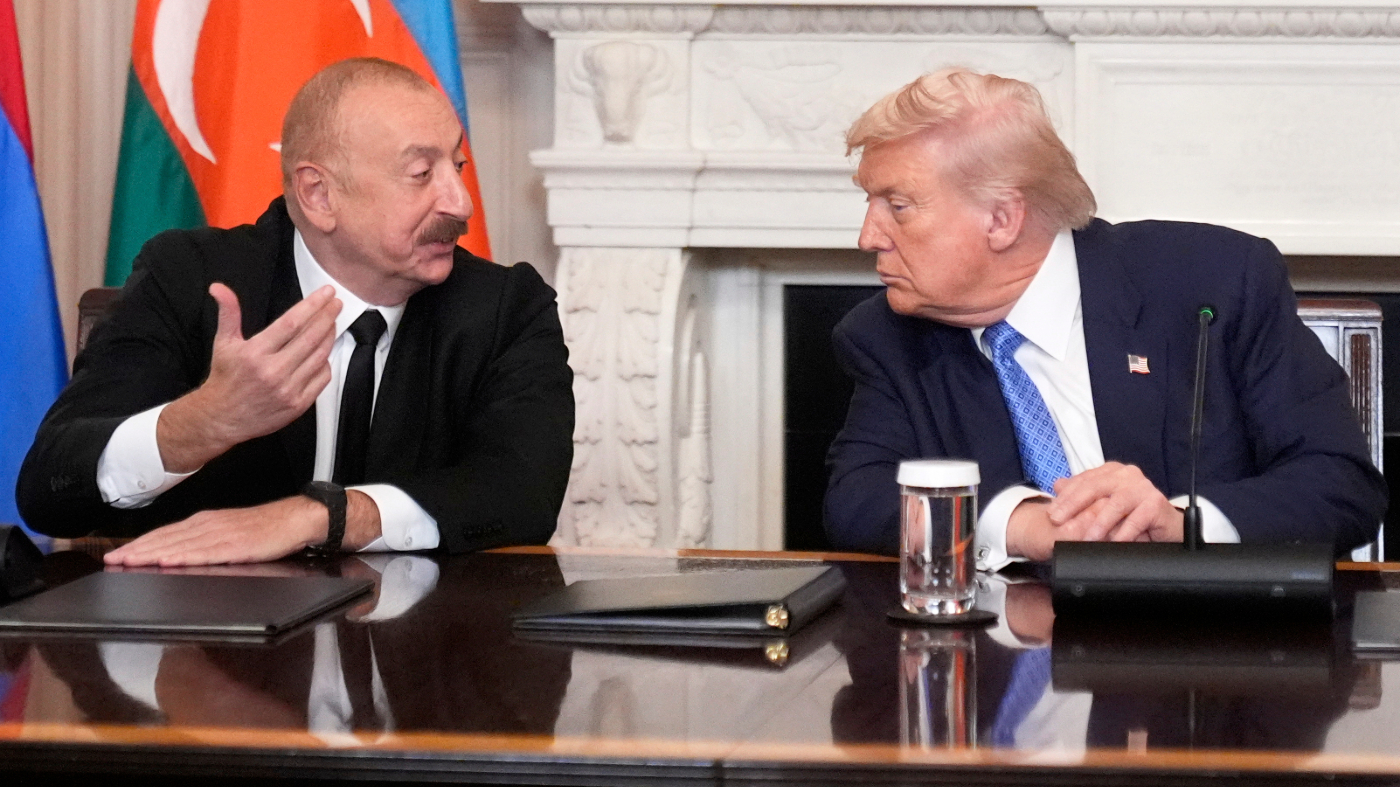
President Trump hosted Azerbaijani President Ilham Aliyev and Armenian Prime Minister Nikol Pashinyan on Aug. 8, 2025. There, the two leaders initialed a peace framework and signed a joint declaration establishing the Trump Route for International Peace and Prosperity or TRIPP, a 27-mile corridor through Armenia’s Syunik province linking Azerbaijan to its Nakhichevan exclave. It was, by any measure, a genuine diplomatic breakthrough after 37 years of hostility.
Pashinyan has now won himself more room to maneuver: His Civil Contract party took 49.75 percent in Armenia’s June 2026 parliamentary vote, defeating Kremlin-backed opposition amid an active Russian disinformation campaign. Pashinyan has the public behind him, but not yet the votes. The U.S. could break the deadlock with a gesture of good faith toward Baku.
This part of the case is not theoretical; it’s happening right now. The U.S. and Iran have been entangled in conflict since Feb. 28, 2026. Traffic through the Strait of Hormuz, which once carried roughly a fifth of the world’s traded oil remains well below normal.
That has turned Azerbaijan’s Middle Corridor, the Iran-bypassing land route linking Central Asia to Europe through the Caspian and the South Caucasus, from a hedge into a necessity. The route carried 17 million tons of freight in 2025; the Baku port is being expanded from 15 to 25 million tons of annual capacity, and the modernized Baku-Tbilisi-Kars railway now runs at 5 million tons. Beijing has already bought into that same infrastructure — China Railway’s container arm joined the Azerbaijani-Georgian-Kazakh joint venture that runs the corridor last year, even as China has moved fast to fill the vacuum left by a weakened Russia across Kazakhstan, Uzbekistan and Turkmenistan.
It is less a way around China than a way to keep options open: a corridor where neither Moscow nor Beijing has the final say. Give the corridor up, and someone else will take over. In the months ahead, this route will matter more. Maintaining a decades-old sanction against the country anchoring its western end does not read as cautious geopolitics in Baku. This reads as Washington being unsure of its goals.
Every president since George W. Bush has waived the sanction against Baku annually, including Trump. He extended the waiver again last August, citing counterterrorism and border-security needs. A statute the executive branch has neutered every year for more than two decades isn’t protecting anyone; it’s an insult that Azerbaijan has learned to live with — a legal loose end that Congress could tie off in a single vote.
Rep. Anna Paulina Luna’s (R-Fla.) bill , which has gathered co-sponsors and is now before the House Foreign Affairs Committee, would repeal the relevant section of the 1992 outright, citing Azerbaijan’s role as “a steadfast ally” and the border agreement already reached with Armenia. With Republican majorities in both chambers and an administration already on record waiving the provision, this is the most favorable environment for repeal since the law was written.
It simply requires Congress to admit that it no longer serves American interests to maintain a 1992 punishment for a conflict whose first phase ended in a 1994 ceasefire and whose military resolution came in 2020-2023, against a country now central to American energy security and an ongoing effort to counter Iran and Russia in the region.
Hollie McKay is a war correspondent and foreign policy analyst who has spent two decades reporting from conflict zones. She is the author of “Only Cry for the Living: Memos From Inside the ISIS Battlefield” and “Afghanistan: The End of the U.S. Footprint and the Rise of the Taliban Rule.”
Topics in this story
Gathered from external sources. Rights to this text belong to whoever originally published it.