Four decades, thousands of test hours and one big milestone: India’s Kaveri engine story
India's homegrown Kaveri dry engine has come through a round of high-altitude and flight trials in Russia, posting a peak dry thrust of 48.5 kilonewtons,
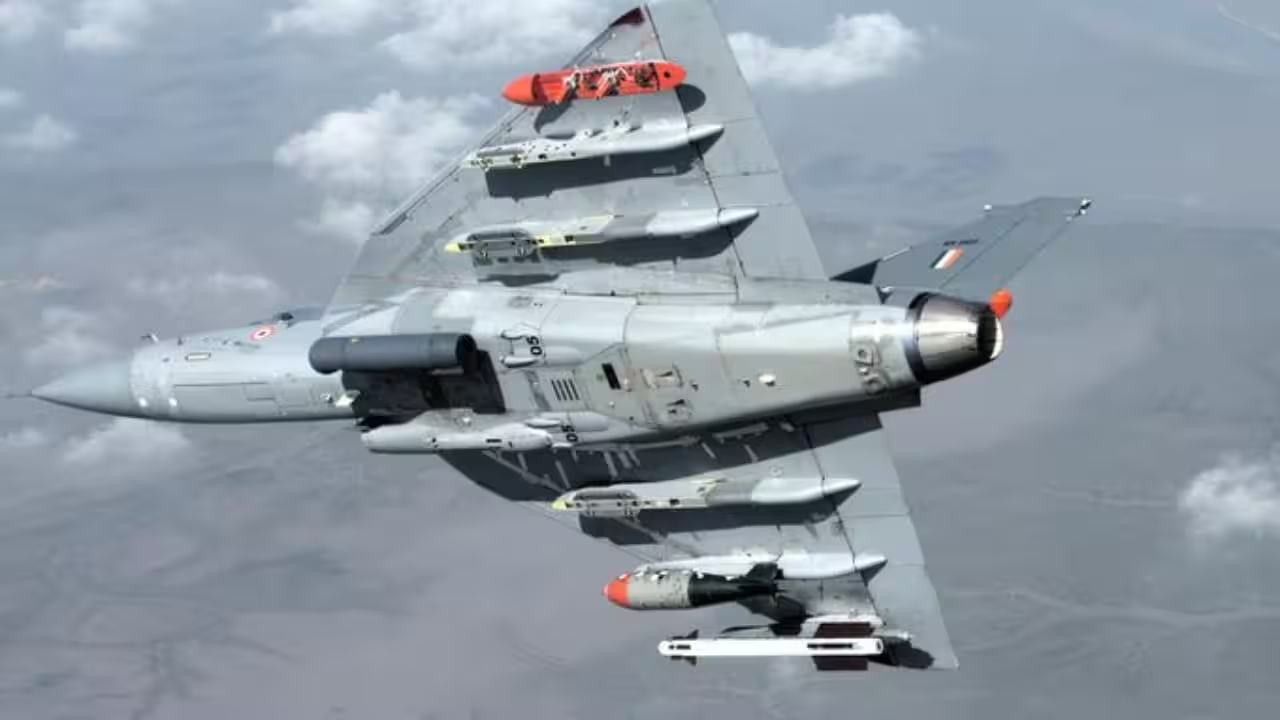
India's homegrown Kaveri dry engine has come through a round of high-altitude and flight trials in Russia, posting a peak dry thrust of 48.5 kilonewtons, well above the roughly 46 kN it was meant to deliver. The engine, built by the Defence Research and Development Organisation's Gas Turbine Research Establishment, is meant to power Ghatak, India's planned stealth unmanned combat aerial vehicle.The Kaveri Derivative Engine is a non-afterburning version of the original Kaveri, built for aircraft that do not need the additional thrust an afterburner provides. Dry thrust simply refers to thrust generated without one. The trials ran at two Russian institutions, the Central Institute of Aviation Motors and the Gromov Flight Research Institute. At the former, the engine was subjected to conditions mimicking high-altitude flight, where air pressure and temperature both drop sharply. Engineers then moved to flight tests using a modified Ilyushin Il-76 flying testbed, with one of its standard engines swapped out for the Kaveri, allowing the new engine to be evaluated in actual flight without being integrated into its final intended aircraft. The team tested it across varying ambient pressures, Mach numbers and thrust demands, partly on the ground and partly in the air.A reading of 48.5 kN against a target of 46 kN suggests the engine now has some margin to spare. The Centre for Military Airworthiness and Certification will examine the test data before granting airworthiness clearance, though certification and integration with the platform still remain before any operational use can be considered.The story of how India got here goes back to 1986, when the Kaveri programme was launched to develop an indigenous powerplant for the Light Combat Aircraft Tejas. Formally sanctioned in 1989 with a completion target of 1996, the project involved building a low-bypass turbofan with an afterburner, along with its compressor, combustion chamber, turbine and control systems.The Kaveri ran into serious developmental trouble almost immediately, struggling with high-temperature materials, turbine blades capable of withstanding extreme internal conditions, compressor development and achieving the required thrust-to-weight ratio. The original Kaveri was designed to produce about 81 kN of thrust but managed only around 70 kN in its earlier configuration, while also exceeding its intended weight target of 1,100 kg. That shortfall, combined with limited domestic testing infrastructure and restricted access to advanced foreign technology, meant the engine could never meet Tejas's requirements, forcing the fighter to adopt foreign powerplants instead.Rather than shelving the programme, DRDO redirected it, pursuing a dry, non-afterburning derivative suited to different propulsion needs, eventually finding a new purpose in the Ghatak UCAV. Along the way, the programme built up substantial indigenous expertise, multiple prototypes, more than 3,200 hours of testing, a qualified Full Authority Digital Engine Control system, and certified high-temperature materials for aero-engine use, all validated through Il-76 flight testing that gave Indian engineers rare hands-on experience operating an indigenous gas-turbine engine in real flight conditions.That expertise is really the point of the exercise. Fighter-engine development demands far more than raw thrust, it requires mastery of compressors, turbines, combustion systems, materials science, engine controls and manufacturing, all of which the Kaveri programme forced India to build from scratch. What started as an attempt to power the country's first indigenous fighter has since evolved into a longer-term foundation for future Indian aircraft engines. The latest 48.5 kN result, then, matters less as an isolated technical milestone and more as evidence that decades of setbacks have left India with a genuine engine-development base, one that now has to be converted into a certified, production-ready powerplant for an aircraft actually waiting to fly.
Topics in this story
Gathered from external sources. Rights to this text belong to whoever originally published it.