In 1916, Florida’s USDA plant station tested Burma reed for erosion control and gardens; it escaped cultivation and is now listed as a Florida noxious weed
Discover the journey of Burma reed, once tested for erosion control by the USDA, now classified as a noxious weed in Florida. Learn how this invasive grass has impacted South Florida's pine rocklands and the measures taken to control its spread.
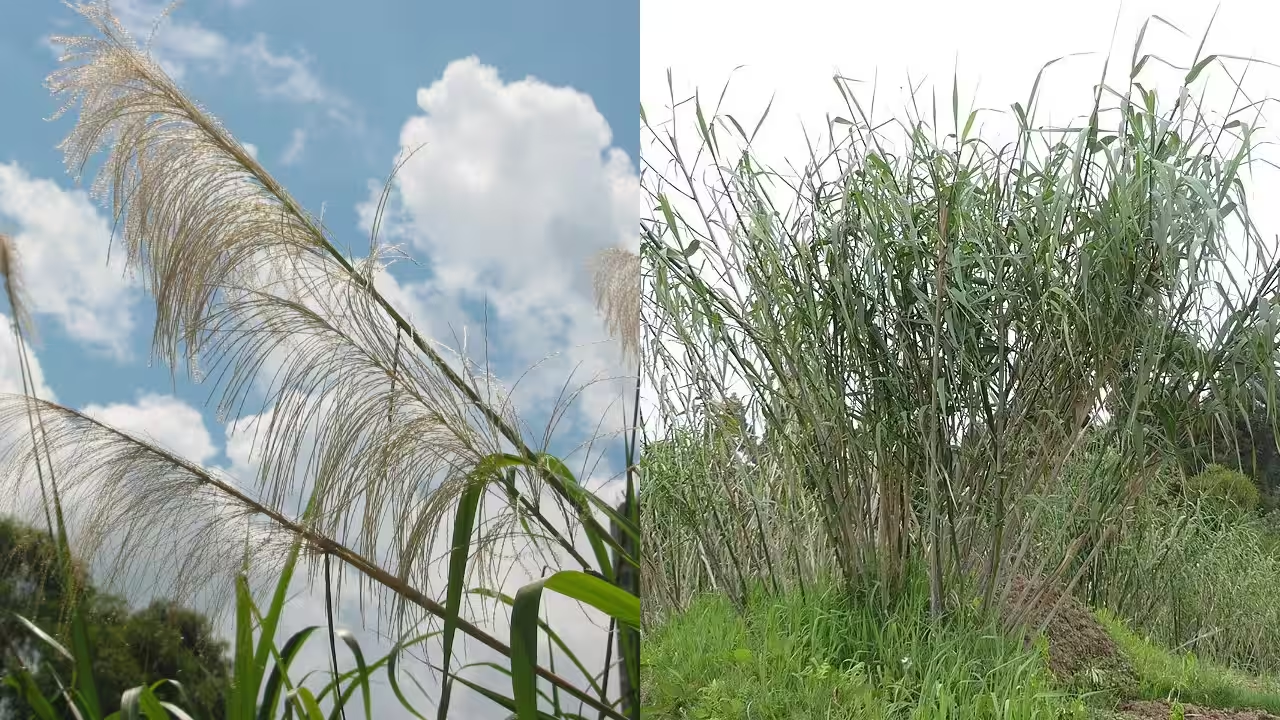
Burma reed was once tested by the U.S. Department of Agriculture in Florida for erosion control and ornamental use, and is now listed as a noxious weed in the state. The grass had invaded nearly 75% of Miami-Dade County's pine rocklands outside Everglades National Park by 1993, according to the Florida Department of Agriculture and Consumer Services.The plant is scientifically known as Neyraudia reynaudiana, and is native to warm regions of Asia, including parts of India, Nepal, Taiwan and Indonesia. It is a perennial grass that can grow as tall as 15 feet and form dense clumps, and its flowering stalks can carry large, feathery plumes.It was tested as a useful plantThe USDA introduced Burma reed to its Plant Introduction Station in Coconut Grove in the early 20th century, and Florida's agriculture department says that the plant was introduced there in 1916 as a potential erosion-control and ornamental species, following which it was subsequently planted at the Florida Botanical Garden and Arboretum. Burma reed tolerates a range of soil, light and moisture conditions, and it can grow particularly well in infertile, rocky, dry locations that are exposed to full sun, according to the Florida Department of Agriculture and Consumer Services.The grass produces large quantities of seeds that are dispersed by wind, while pieces of its underground rhizomes can produce new plants. Florida officials say fragmented rhizomes can be moved by construction equipment and limestone quarrying, and that combination matters in disturbed areas, where soil and plant material are frequently moved. Removing individual plants does not prevent the grass from returning once they become established, because the underground rhizomes can survive.It spread through South Florida's pine rocklandsBurma reed had invaded nearly 75% of the pine rocklands in Miami-Dade County outside Everglades National Park by 1993, according to FDACS, with the University of Florida's Institute of Food and Agricultural Sciences also classifying Burma reed as a Category I invasive species in Florida. Pine rocklands are one of the habitats affected most heavily by the grass, and UF/IFAS says Burma reed can form dense, nearly single-species stands in these ecosystems, which crowd out native plants. The plant also produces substantial leaf litter and can alter the local fire regime. The grass can reach 10 to 15 feet in height, depending on conditions; its stems grow from short, coarse rhizomes, and mature clumps can contain numerous stalks. Florida officials say it flowers throughout the year and produces seeds that can be carried by wind.Florida now treats it as a noxious weedBurma reed is now listed on Florida's Noxious Weed List, and UF/IFAS classifies it as prohibited for use in the state, with its distribution remaining concentrated mainly in South Florida, including Miami-Dade, Broward, Monroe and Collier counties. The USDA Forest Service describes silkreed, which is another common name for Burma reed, as an invasive nonnative grass in Florida. Its review says that the plant can establish first in disturbed sites and later spread into less disturbed habitats. It has been documented along roads, in vacant lots, on limestone spoil piles and in several native plant communities.Burma reed's above-ground growth can be killed by fire, but the plants can resprout from their rhizomes, and UF/IFAS notes that the species can respond quickly after burning, sometimes growing before many native plants have recovered. Florida now restricts the plant that was once tested for erosion control and ornamental use, and state guidance recommends preventing its spread and controlling established populations before they expand into additional habitat.You use AI every day. Now get your AI Quotient. Take the AIQ test.
Topics in this story
Gathered from external sources. Rights to this text belong to whoever originally published it.