In 2013, Paris tested spraying non-drinking water on sun-baked streets; wet pavement was up to 23°F cooler, but the effect faded as the surface dried
Rest of World News: Discover how Paris's innovative pavement watering program significantly reduces street temperatures and offers a temporary cooling solution during heatwaves, alongside historical context and modern implications for urban environments.
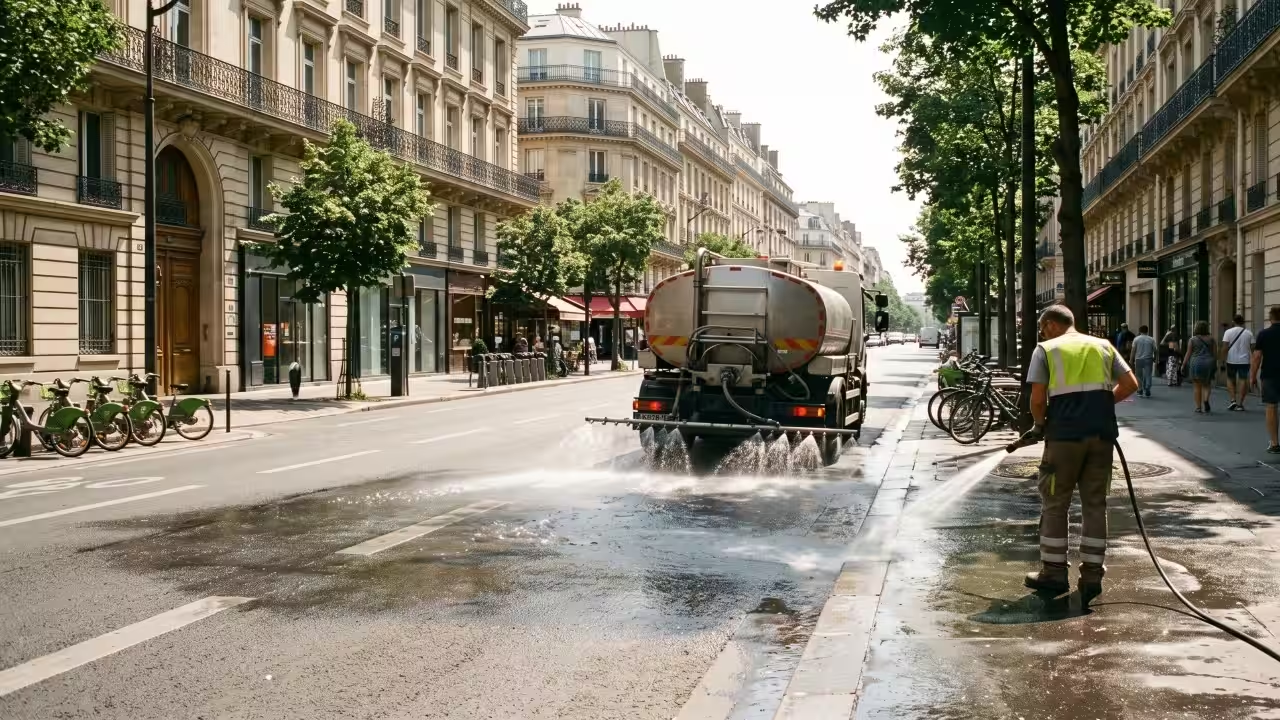
Long before anyone worried about climate change, Parisian street cleaners doused the city's pavements with water every morning, a practice dating back to the late nineteenth century that was originally meant to keep dust down rather than cool anyone off. That habit faded through the twentieth century as cleaning methods changed, and the practice became a historical curiosity. The deadly heatwave that swept across Europe in August 2003, causing tens of thousands of excess deaths across the continent and hitting the Paris region particularly hard, led city planners to rethink almost every tool in their toolbox to keep residents safe during extreme heat, including tools that had quietly fallen out of favour.This rethinking led the City of Paris to test whether spraying non-drinking water onto sunny streets could significantly ease heat stress for people walking in the city during a heatwave, and in the summer of 2013, it launched an experimental pavement watering programme. Their main testing ground was a stretch of Rue du Louvre, a wide, lightly shaded street near Les Halles that is exposed to direct sun for much of the day, but they later expanded their experiments to the Belleville district as well.Cooling of a hot street in real time The process of pavement watering is simple: evaporative cooling, the same principle that makes a person feel cold when stepping out of a swimming pool on a breezy day. When water evaporates, it takes up a massive amount of energy, and if that water is sitting on a sun-baked road surface, the evaporation process pulls heat out of the pavement itself rather than letting it build up and radiate back into the air around it. According to research on the official Ville de Paris website, doctoral research conducted between 2013 and 2015 found that watering could reduce exposed surface temperatures by around fifteen degrees Celsius during sunny periods, while also noticeably lowering how hot pedestrians felt as they walked through treated areas.Field measurements recorded surface-temperature reductions of up to 13 degrees Celsius, or roughly 23 degrees Fahrenheit, during direct sunlight, compared with reductions of up to 4 degrees Celsius when the pavement was shaded. Researchers used infrared cameras to track these changes in close to real time, which let them spot the exact moment a wet patch of road began drying out, since the surface temperature would spike sharply the instant standing water disappeared.Cooling effect that quickly fades away as water evaporatesThis increase in drying was one of the most important findings of the Paris trials. Watering pavement has a powerful but short-lived cooling effect, and researchers found that uninterrupted watering was necessary during periods of direct sunlight to keep the benefit. A study published in the Journal of Sustainable Development of Energy, Water and Environment Systems confirmed this pattern, noting that pavement watering lowered surface temperatures for several hours after each application and reduced how quickly heat was released from the pavement near sunset, but that the cooling effect could not simply be applied once and left to last through the entire afternoon.This pragmatic constraint shaped the way the city refined the programme in summers thereafter. Rather than watering continuously regardless of conditions, engineers sought to optimise the timing and amount of water used. The method relies on a separate non-drinking water network fed from the Seine and the Canal de l'Ourcq, a resource that Paris has maintained since the nineteenth century for uses such as street cleaning and irrigation that do not require treated drinking water.Lessons for other cities looking for a low-tech cooling fixPavement watering will never replace shade, green cover or structural redesign as a long-term strategy for cooling cities, and Paris researchers have been frank that the effect is temporary and resource intensive to maintain across a large area. But its beauty is that it can be deployed rapidly in an acute emergency, using infrastructure that many cities already have, whether that is a dedicated non-potable network such as the one in Paris or even ordinary municipal water trucks. The Paris experience is a useful reminder for cities across South Asia, which are seeing more frequent and severe heatwaves and which often have their own separate non-drinking water systems for irrigation and cleaning, that sometimes the quickest relief available during a dangerous heat spell is also one of the oldest tricks in a city’s toolkit, even if it has to be repeated again and again to keep working.Catch the latest World News and Live updates. Download the TOI app.
Topics in this story
Gathered from external sources. Rights to this text belong to whoever originally published it.