‘Indian Ocean and beyond’: Iran warns war can spread further if US launches fresh attacks
Iran on Thursday warned that any renewed US or Israeli attack could see the conflict expand from the Persian Gulf and Red Sea into the Indian Ocean and
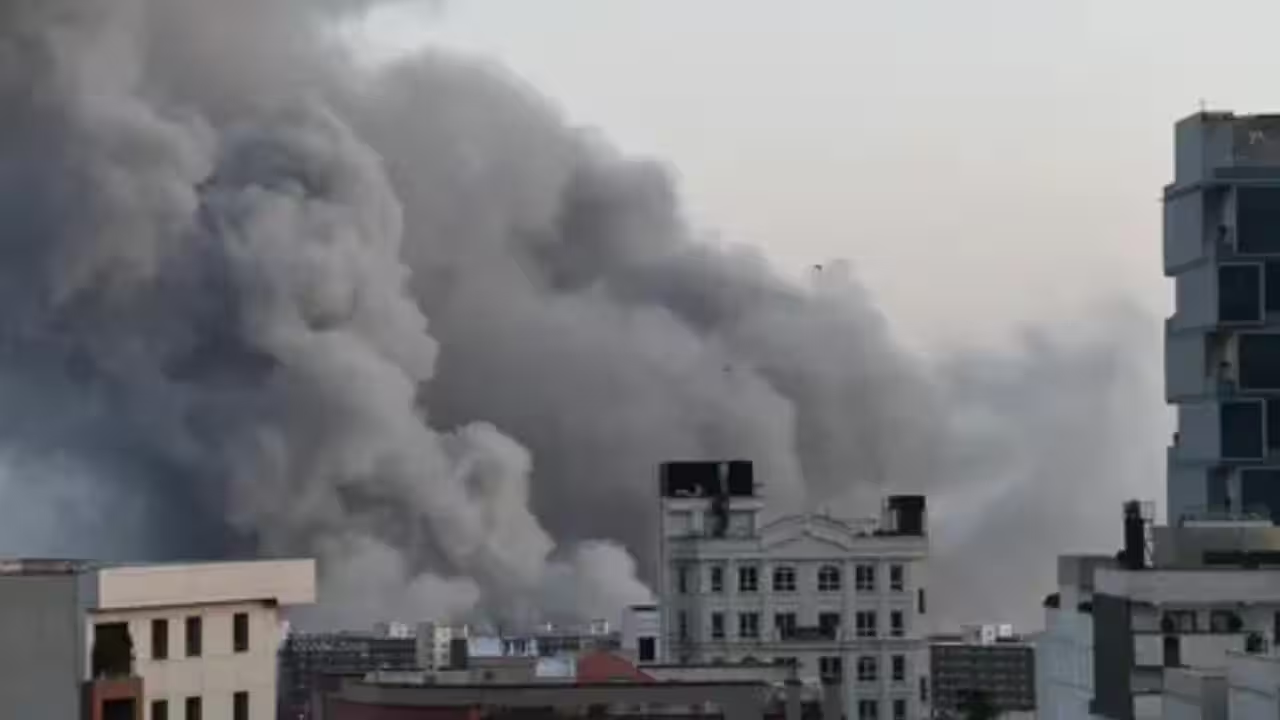
Iran on Thursday warned that any renewed US or Israeli attack could see the conflict expand from the Persian Gulf and Red Sea into the Indian Ocean and potentially beyond, signalling a possible widening of the maritime theatre if hostilities resume.Major-General Yahya Rahim Safavi, a senior military adviser to Supreme Leader Ayatollah Seyyed Mojtaba Khamenei, issued the warning in a video released by Iran's semi-official Fars news agency, as cited Al Jazeera. “Since the conflict has spread from the Persian Gulf and Strait of Hormuz to the Red Sea, it is possible that – in response to more war – the front will expand even further, reaching the Indian Ocean and perhaps beyond,” Safavi said.Safavi also said that Iran's armed forces had prepared for a worst-case scenario in the event of renewed US-Israeli attacks, suggesting Tehran was preparing for a conflict that could extend beyond its immediate waters. He further warned that a new front could emerge around the Red Sea and Bab al-Mandeb Strait, while praising Yemen's Houthis for their role in the region.“I must state here that if the Americans start a new war, a new front centred on the Red Sea and the Bab al-Mandeb Strait may open up before their very eyes,” Safavi added.Safavi had also warned in a telvised interview that Iran was monitoring US naval activity across the region, including in the Indian Ocean. “In the maritime domain, whether in the skies over the Persian Gulf or even in the Indian Ocean, we detect with our radar systems the US naval vessels currently in the region…and determine where they are located,” he said.Follow live updates on Iran warThe former Islamic Revolutionary Guard Corps (IRGC) commander also said Iran had strengthened its missile, drone and air-defence capabilities and was prepared to conduct both defensive and retaliatory operations.“In the missile, air-defense, and territorial-defense sectors, we have reached a level where, God forbid, if they (American forces) intend to land anywhere in Iran, they will certainly be destroyed,” Safavi said.He said Iran had at least 10 million trained Basij personnel who could defend different parts of the country through a distributed approach and asymmetric warfare.“People are the main pillar of the Islamic Republic’s power and national security,” he said.Also read: Iran warns US of new weapons, targetsIRGC warns of new weapons and targetsSafavi's warning follows separate comments from the IRGC on Monday that any renewed escalation with the United States could bring new weapons, military tactics and targets into the conflict.IRGC spokesperson Hossein Mohebbi said Iran was prepared for a prolonged confrontation and that its defensive and counteroffensive operations would undergo “significant changes” if hostilities intensified. “Those changes include a shift in the geography of war, and a shift in weapons and military equipment,” Mohebbi told local media. “We will bring new weapons with new capabilities into the battlefield, and the world will be astonished.”Mohebbi also warned that Iran's targets in a renewed phase of the conflict would not necessarily be the same as those targeted previously.“Our targets are also no longer necessarily the same [as the] previous targets. We have new targets that have not yet been struck,” he said.In an interview with Al-Alam News Network, Mohebbi said the IRGC had prepared for a “long-term war”, adding that the conflict could pass through different stages but was not over. He also claimed that the US, Israel and their allies had failed to achieve their objectives, pointing to the Strait of Hormuz and arguing that the US had been unable to reopen the strategic waterway despite its military presence in the region.Iran links Hormuz reopening to US concessionsSafavi separately said reopening the Strait of Hormuz would depend on the lifting of what he described as an illegal US naval blockade and on Washington accepting Iranian conditions.“The Strait of Hormuz will not be reopened through US military pressure. It is Iran and Oman that can establish the mechanism for this. We are in contact with the Omanis, although public reporting indicates that the United States is preventing this,” he said.“The reopening of the Strait of Hormuz is conditional on [the US’s] accepting Iran’s terms.”Safavi said Iran wanted to establish a regional security framework with Persian Gulf states without US involvement.“Our objective is to permanently remove the threat to the Iranian people and, together with the countries of the region, establish lasting security and sustainable development in the Persian Gulf without the presence of the United States,” he said.The warnings come as Washington and Tehran remain locked in a tense military and diplomatic standoff. Iran has said it is ready to reopen the Strait of Hormuz if the US eases military pressure and lifts its blockade, while Trump said on September 22 that talks with Tehran were continuing and that he believed a settlement could eventually be reached. Meanwhile, tensions around Hormuz and the Red Sea remain high, with Iran and the Iran-aligned Houthis exerting pressure on key maritime routes.You use AI every day. Now get your AI Quotient. Take the AIQ test.
Topics in this story
Gathered from external sources. Rights to this text belong to whoever originally published it.