In 1891, Red Cross founder Clara Barton received part of an 80-acre Maryland gift; today her home anchors a 22-acre National Park Service landscape
US News: Explore the legacy of Clara Barton, founder of the Red Cross, at her historic home in Glen Echo, Maryland, now part of a 22-acre National Park. Learn about the house's transformation from a relief warehouse to her residence and its journey to becoming a National Historic Site.
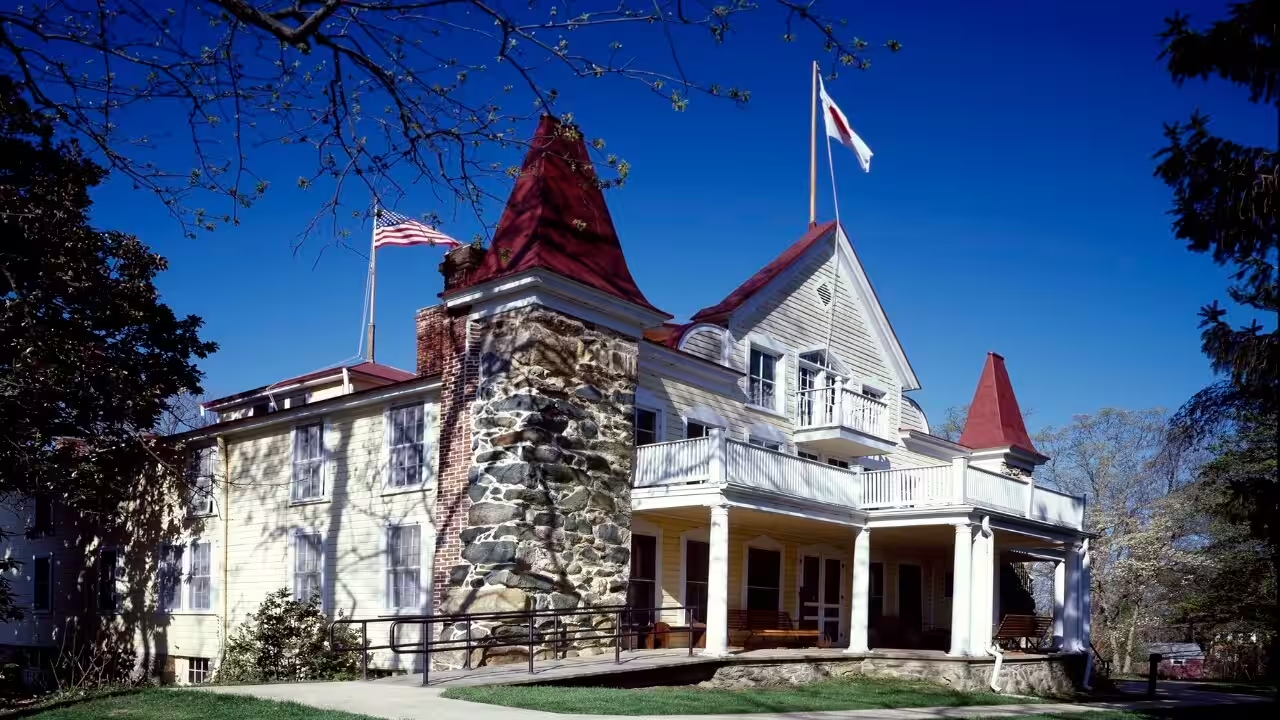
In the late nineteenth century, the Baltzley brothers in Maryland bought land alongside the Potomac River, hoping to turn the area into a cultural retreat in the style of the Chautauqua movement. But to make their unproven venture look respectable, the brothers needed a name that people were already familiar with. So they turned to Clara Barton, the founder of the American Red Cross, and gave her part of the land they had acquired.The gift that built a homeThe Baltzleys called the land the National Chautauqua of Glen Echo, and Barton later built her home there. According to a landscape history published by the National Park Service, the 22 acre cultural landscape that survives today sits in Montgomery County and combines two separate National Park Service units, Glen Echo Park and the Clara Barton National Historic Site. The property includes part of the 80 acres that Edward and Edwin Baltzley donated in 1891 to establish the Chautauqua, and they gifted a portion of that land to Barton, the founder of the American Red Cross, while also supplying the labour and materials used to build her house. The same history traces how the site shifted from an educational campus into an amusement park once the Chautauqua idea struggled to take hold, with Edwin Baltzley renting the grounds out to vaudeville acts and the first amusement park structures going up by 1899. Barton needed a base from which to run relief operations, and the house built for her was no ordinary cottage. It grew to thirty rooms across several floors, with enough space built in to double as storage and office space whenever disaster relief work demanded it.From warehouse to residenceBarton's relationship with the house was not as simple as moving in and staying put. She lived there briefly in 1891, not long after it was completed, then left for several years before returning in 1897 once the trolley line reached Glen Echo and made the location far easier to reach day to day. During that gap, the house served as an American Red Cross warehouse, storing supplies and equipment the organisation needed for the floods, fires and other disasters it responded to. Once Barton moved back in for good, the house also became the Red Cross's national headquarters, a role it held from 1897 until 1904. She spent the final fifteen years of her life running the organisation from those same rooms, which had once held nothing but crates of relief supplies.Guides who lead tours through the property still point out small details that reveal her frugal habits, and the National Park Service notes that some of the interior walls and ceilings are covered in muslin, the same material used in field bandages, rather than plaster. The house also carried the Red Cross emblem worked into its stained glass windows, a detail that quietly tied her home to the organisation she had spent decades building.A landscape preserved decades laterThe historical recognition of the property’s value took too long to arrive. Barton’s house passed into private hands after her death and stayed that way for roughly fifty years before a group called Friends of Clara Barton bought it in the 1960s specifically to preserve it. A marker placed at the site, recorded by the Historical Marker Database, notes that the house was built in 1891 by Edward and Edwin Baltzley as part of the National Chautauqua at Glen Echo and that it later became a National Historic Site under the National Park Service. Congress declared the house a National Historic Landmark in January 1965, and legislation passed in 1974 established it as the Clara Barton National Historic Site, the first such site in the country dedicated to the achievements of a woman. The National Park Service formally acquired the property the following year, in April 1975, through a donation from the Friends of Clara Barton.What fascinates the visitors and what they encounter now extends well beyond the house alone. Barton’s home sits within a broader stretch of land estimated at 22 acres in total. The National Park Service manages together with the adjoining Glen Echo Park, a former amusement park that operated on neighbouring ground until the late 1960s. The two properties share a cultural landscape designation, linking Barton’s story to the wider history of the land. More than a century later, it is Barton’s story, not theirs, that draws people to Glen Echo.Catch the latest World News and Live updates. Download the TOI app.
Topics in this story
Gathered from external sources. Rights to this text belong to whoever originally published it.