Swinney asks prime minister for legal mechanism for independence vote
Scotland's first minister has written to Andy Burnham, asking for a meeting to discuss how another independence vote might be triggered.
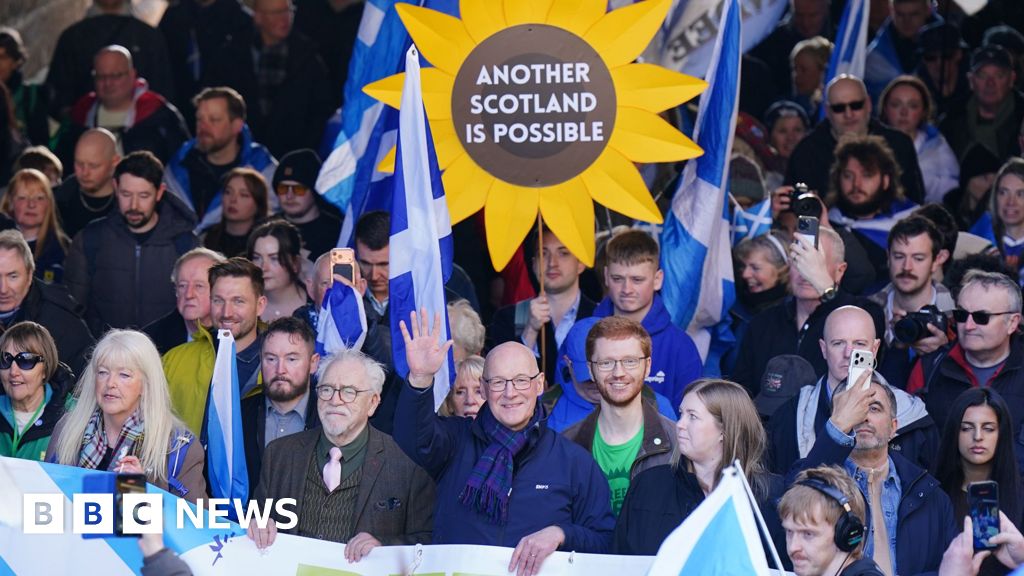
First Minister John Swinney has written to the prime minister inviting him to meet and consider the constitutional future of Scotland.
Swinney's letter calls for a legal mechanism to be established for triggering an independence vote following comments from Andy Burnham which some have interpreted as a softening of his stance on the issue.
Burnham told MPs on Wednesday that both in Scotland and Northern Ireland, a border poll would be considered if public opinion had changed and there was a clear consensus.
But he added that he did not believe that had happened, and Downing Street later insisted there was no change in his position that such a vote was currently "off limits".
In his letter Swinney welcomed Burnham's remarks , claiming it signalled an acceptance that majority support for independence in Scotland should trigger a new referendum.
He said it was a "long-overdue acceptance of the reality that the people of Scotland will decide their own future".
He concluded: "Now that you have agreed the principle that Scotland should have a referendum when it is likely that people would vote for independence, it is important for us to meet to discuss how we turn that principle into an agreed legal mechanism, as exists in Northern Ireland."
Burnham was responding to a question at Prime Minister's Questions from Dundee SNP MP Chris Law.
Law noted that Burnham had said he would stick 100% to the terms of the Good Friday Agreement in Northern Ireland and noted that the agreement includes a provision on what would trigger a referendum on leaving the UK.
He then asked whether the conditions for initiating a similar referendum in Scotland should also be set out in law.
Burnham replied that the Good Friday Agreement said a border poll "be considered by the Northern Ireland Secretary when there is clear consensus in the country—when public opinion has changed to the point at which the call has to be considered".
He continued: "I would say that it is exactly the same situation in Scotland. I am not aware that there is majority public support for another referendum, and until that changes, there will not be one."
A referendum on Scottish independence in September 2014 saw the country vote to remain part of the UK by a margin of 55% to 45%.
In July, in his first meeting with Swinney after becoming prime minister, Burnham said another such vote was "off limits" because it would take the focus away from priorities like growing the economy and helping families cope with the cost of living.
How much support is there for independence?
Sir John Curtice, professor of politics at Strathclyde University, said recent opinion polls suggested there is currently a very small majority in favour of independence.
But, given the small margins, any claim that this means Scotland is "likely" to vote to leave the UK is something that would be challenged, he told BBC Radio Scotland Breakfast.
He said it was "probably possible to make a reasonable case" that the probability of a vote for independence is currently greater than zero, but that polling falls far short of suggesting it is "pretty damn certain".
He said there had previously been acknowledgement by some within the nationalist community that a referendum should be held when opinion polls consistently indicate about 60% in favour.
The SNP, when making the case for another referendum frequently cites the record number of pro-independence MSPs returned to Holyrood in the May election.
Between them the SNP and Scottish Greens ended up with 73 MSPs, increasing the pro-independence majority by one.
However, the proportion of the electorate voting for pro-independence parties fell significantly to about 41%, down from about 50% in 2021.
The mismatch between vote share and MSP total was explained by the pro-union vote becoming more fragmented, driven by the rise of Reform UK.
"The difficulty is that both sides in the argument can point to evidence to substantiate their case," said Curtice.
What have previous prime ministers said?
David Cameron was the prime minister who reached an agreement with then SNP leader Alex Salmond that a referendum could be held in 2014.
On the eve of the vote, he declared it was a "once and for all decision" and that there could be "no going back" and "no re-run".
He stuck to that view afterwards, saying the debate had been "settled for a generation"
Salmond had previously spoken of it being a "once in a lifetime, perhaps once in a lifetime opportunity" in his opinion, and had indicated that by "political generation" he meant something like the 18-year gap between previous constitutional referendums.
Salmond's successor as first minister, Nicola Sturgeon, later argued that the 2016 Brexit vote, where the UK as a whole voted to leave the EU while a majority of Scots voted to stay, represented a "material change of circumstances" which put another indyref vote back "on the table".
Cameron resigned after the Brexit vote, replaced by Theresa May , who repeatedly declared that "now is not the time" for another referendum.
One of her arguments was that it was too early because the Scottish people did not yet know what the outcome of leaving the EU would be.
When Boris Johnson entered Number 10 in 2019, he also rejected the call, harking back to the "once in a generation" description of the earlier vote.
During her brief tenure as prime minister in 2022, Liz Truss described Sturgeon as an "attention seeker" who she planned to ignore.
Rishi Sunak had taken over by the time the UK Supreme Court ruled that the Scottish government did not have the power to hold an independence referendum without the consent of the UK government.
And he argued that there were "more pressing issues" that the Scottish people wanted politicians to focus on.
After Labour came to power at Westminster in 2024, Sir Keir Starmer took a similar line, saying it was "not a priority" and he could not envisage one happening while he was prime minister.
What, if anything, has changed? The answer is both very little and a lot.
A lot because UK prime ministers tend to brush off calls for another independence referendum with a "now is not the time" sort of answer.
They usually stress that there are more important things to deal with at this point.
Andy Burnham has previously been more emphatic in telling John Swinney that the issue was "off limits".
Then in a brief exchange at prime minister's questions by drawing a parallel with Northern Ireland, he has appeared to open the door to further discussion about a formal agreement on the circumstances in which a further referendum could be considered.
I cannot remember any previous prime minister speaking in similar terms.
That's the difference but it changes very little in reality.
Andy Burnham is unlikely to agree to discussing a formal mechanism for another independence referendum in Scotland.
It was already clear that driving up support for such a course and the likelihood of a "yes" outcome is what the SNP and other independence supporters would need to achieve.
Andy Burnham has simply acknowledged that to be the case and inadvertently given nationalists a some encouragement in the process.
PM would consider independence referendum if 'clear consensus' emerges
Burnham tells Swinney independence is 'off limits' at Commonwealth Games meeting
Why independence is still a political dividing line in Scotland
Topics in this story
Gathered from external sources. Rights to this text belong to whoever originally published it.