In 1935, Pennsylvania saw crown vetch survive on 10 acres of poor soil, so officials pushed it for erosion control and mine reclamation; it later spread to 46 states
Discover the journey of crown vetch from a resilient ground cover discovered in Pennsylvania to a widely used erosion control plant, and its troubling transformation into a nonnative invasive species across 46 states.
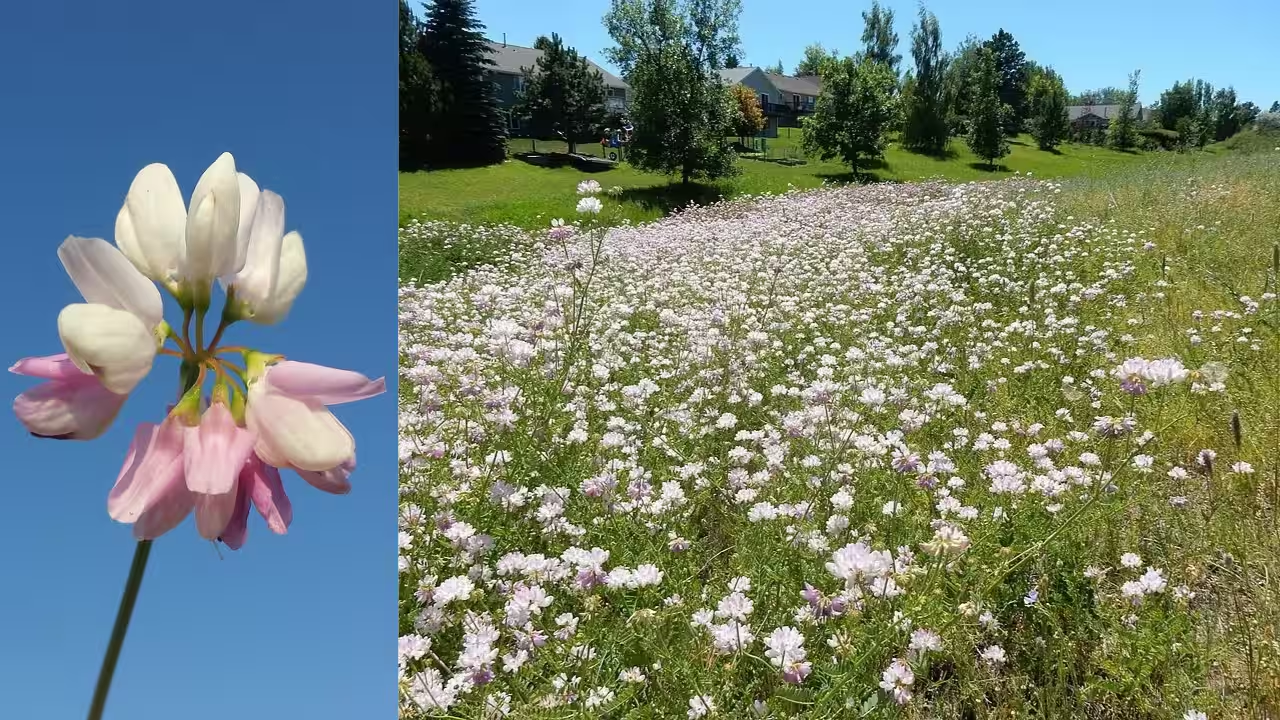
Pennsylvania extension agronomist Fred Grau came across crown vetch that was across more than 10 acres of poor-quality soil in 1935. The plant had survived in an area little else could grow, with Grau beginning to study it as a possible ground cover, and within two decades, crown vetch was being planted extensively for erosion control and revegetation across North America.The discovery happened near Reading, Pennsylvania, where Grau found the plant growing on harsh cinder and shale soil. The Pennsylvania State University account says that the plant apparently entered the country as a contaminant in European alfalfa seed, and the farmer who owned the land called it “dot veed” because it kept returning after cultivation. Grau collected seed and took it back to Penn State, where he and colleagues identified the plant as crown vetch, and his work eventually produced the Penngift variety, which was named using “Penn” for Pennsylvania and “Gift” for farmer Robert Gift. Penn State records list the release of Penngift crown vetch in 1953.Highways became one of its biggest usesCrown vetch was particularly suited to the steep, infertile slopes that were created by road construction, and spreads through creeping stems and can establish on soils that have relatively low fertility, which makes it useful where it was difficult to maintain conventional grass cover. Penn State's roadside vegetation research says that crown vetch was first used on Pennsylvania roadsides in 1948, and wider operational use began in the 1950s. Thousands of acres were eventually planted during construction of the interstate highway system, and on Interstate 80 alone, Penn State estimates that almost 6,500 acres were planted with crown vetch.The plant was also used on mine sites, railroad embankments, and other disturbed ground, with the USDA Forest Service saying that crown vetch was widely used for roadside cuts and mining sites and became abundant in the eastern United States by the 1960s. Federal reclamation requirements later increased demand for fast-growing perennial ground cover on abandoned mine lands. Its usefulness came from its ability to establish quickly and persist under difficult conditions, but that same persistence eventually created problems.The ground cover did not always stay where it was plantedCrown vetch is now classified by the USDA Forest Service as a nonnative invasive plant, and it occurs throughout the contiguous United States and in southern Canada, although its distribution is especially concentrated around places where it was planted. The Forest Service records several examples of the plant spreading beyond its original planting areas, such as in Indiana, where a 10-foot stretch of roadside that is seeded with crown vetch expanded to about 75 feet within 10 years, and in Michigan's Ottawa National Forest, where the plant occupied 0.4 acres across four sites in 2003. Two years later, it was present on 14 sites covering 11 acres.Penn State researchers later documented another problem, which was that the crown vetch planted along roads could spread when soil was moved during construction and maintenance. Its hard seeds can remain viable for years, while its creeping root system can expand outward from established plants. The Forest Service now notes that dense crown vetch can limit the establishment of native herbs, shrubs and trees. Crown vetch went from trace amounts in 2003 to covering 46% of the area by 2005 on one Iowa restoration site, and the restoration project was abandoned. The Pennsylvania discovery had begun with a plant that could survive where other vegetation struggled, and the same characteristic that made crown vetch useful for erosion control later made it difficult to contain once it moved beyond the places where people had planted it.You use AI every day. Now get your AI Quotient. Take the AIQ test.
Topics in this story
Gathered from external sources. Rights to this text belong to whoever originally published it.