The Backstory: 10 years of surgical strikes, the 10 days after Uri
NEW DELHI: Ten years ago, on the night of September 28-29, 2016, Indian Army commandos crossed the Line of Control and carried out surgical strikes on
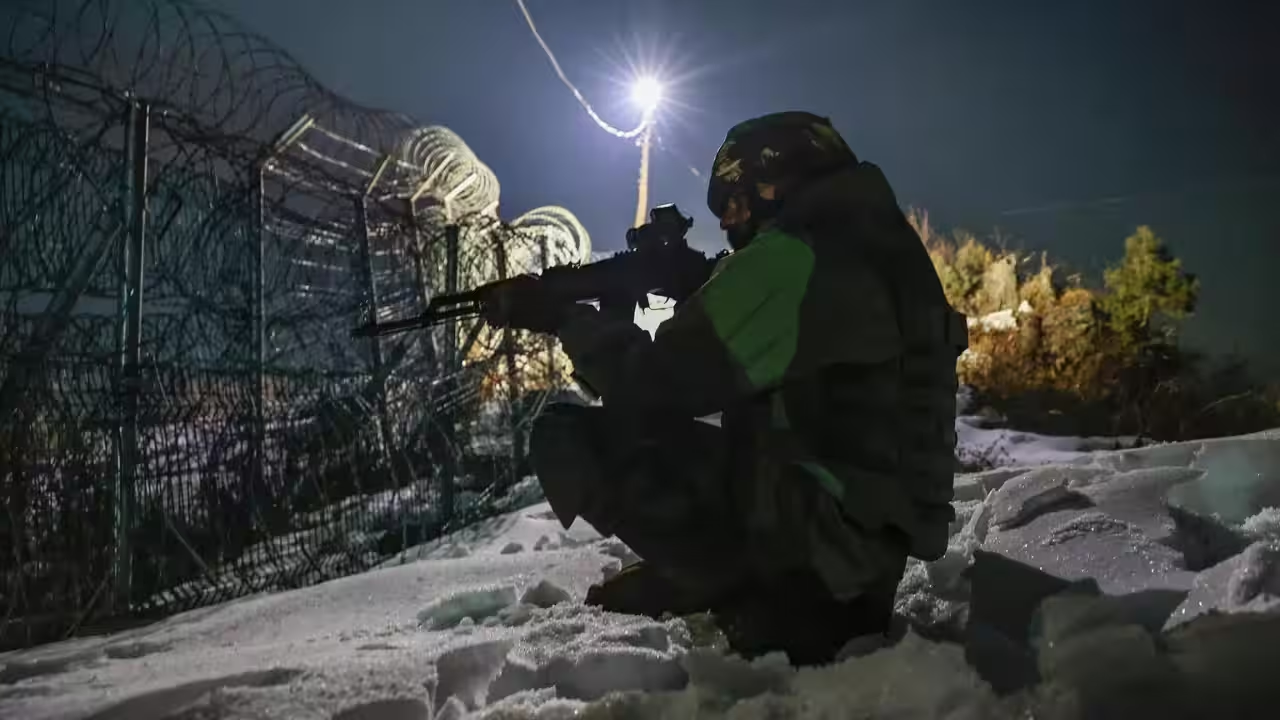
NEW DELHI: Ten years ago, on the night of September 28-29, 2016, Indian Army commandos crossed the Line of Control and carried out surgical strikes on terrorist launch pads in Pakistan-occupied Kashmir.The operation, carried out in response to the Pakistan-sponsored Uri terror attack, marked a hard-hitting response to Pakistan for sheltering and cultivating terror on its soil.It was the first time India responded not with a traditional full-fledged war, but with a calibrated and deliberate military operation against Islamabad-backed terror infrastructure across the border.It was also a demonstration of the more assertive counter-terrorism approach that the Modi government would later associate with its “New India” and “zero tolerance” messaging.But the story of the surgical strikes did not begin on the night of September 28.It began 10 days earlier, in a burning Army camp in Uri.ALSO READ: 18: When Uri came under attackAt around 5.30am on September 18, four heavily armed terrorists attacked the Army's 12th Brigade headquarters in Jammu and Kashmir's Uri, close to the Line of Control.The attack was on a rear administrative camp next to the brigade headquarters.The timing was particularly devastating. Troops were in the middle of a changeover, with an advance party of the incoming 6 Bihar unit in the process of replacing the outgoing 10 Dogra unit.Many soldiers were housed in temporary tents. Explosions and gunfire triggered a fire that spread through the camp.Seventeen soldiers were killed in the initial attack. Two others later succumbed to their injuries, taking the toll to 19.The four attackers were killed then and there.For the families, however, the numbers told only part of the story.In Rajasthan, Havaldar Nimb Singh Rawat's family was preparing to receive his body on what would have been his 48th birthday. A member of 6 Bihar, Rawat had routinely spent his birthdays on duty because his family lived away in Rajsamand district. He left behind his wife, four daughters and a young son.In Samba, 10-year-old Vansh, the son of Havildar Ravi Paul Salotra of 10 Dogra, said he wanted to fulfil his father's dream of becoming an Army doctor.The attack had suddenly turned a distant security crisis into funerals, grieving families and children asking questions.The first response: 'Will not go unpunished'Prime Minister Narendra Modi's first response came within hours.“We strongly condemn the cowardly terror attack in Uri. I assure the nation that those behind this despicable attack will not go unpunished,” PM Modi said.He also said the country saluted those martyred and that their service would always be remembered.The government began examining the attack, including the identity and possible origins of the attackers.Then-home minister Rajnath Singh cancelled a planned visit to Russia and the US and convened a security review in Delhi.“Pakistan is a terrorist state and it should be identified and isolated as such,” Rajnath Singh said on September 18, adding that there were indications that the attackers were highly trained, heavily armed and specially equipped.However, the public anger and government's rhetoric did not immediately translate into military strike.September 19: The question of retaliationWithin 24 hours, the government had begun examining possible responses.National security adviser Ajit Doval chaired a meeting of senior intelligence and military officials, according to contemporary reports, with options being prepared for the Prime Minister.One line attributed to the discussions captured the government's thinking: India would avenge the deaths, but “at a time of our choosing”.Outside the government, the demand for retaliation was growing.BJP general secretary Ram Madhav wrote on Facebook: “For one tooth, the complete jaw.”The expression reflected the anger after Uri. But inside the security establishment, the calculations were more complicated.Pakistan had heightened its alert along the LoC and an immediate strike risked escalation.This was the first crucial decision of the 10-day story.India would respond.But it would decide when, where and how.September 20-22: From anger to optionsThe government began weighing its choices.Diplomatic pressure was one part of the response. Within hours of the Uri attack, Indian missions abroad were asked to mobilise international condemnation of the attack.Then-external affairs mnister Sushma Swaraj would subsequently use the UN platform to attack Pakistan's support for terrorism.But the military option was also being examined.The Army was already monitoring terrorist infrastructure across the LoC. The DGMO would later say that almost 20 infiltration attempts had been foiled by the Army at or close to the LoC during 2016. India had also recovered GPS devices and other material that it said pointed to Pakistan as the source of the infiltration network.The question was no longer simply whether India could strike.It was whether it could strike in a way that was precise, limited and militarily useful.September 23: The plan takes shapeBy the third week of September, the military option was becoming more concrete.The targets were terrorist launch pads close to the LoC, where India believed militants were preparing to infiltrate Jammu and Kashmir.The proposed operation was not conceived as a conventional attack on Pakistan.The intended targets were terrorist infrastructure. The troops would cross the LoC, strike the launch pads and withdraw.The political leadership had to weigh the possibility that Pakistan would retaliate. The military had to work out routes, timings, surveillance and extraction.It was a narrow window between sending a message and triggering something much bigger. There was also a risk of indulging in a war with nuclear-armed neighbour.September 24: PM Modi's warningOn September 24, PM Narendra Modi met the chiefs of the Army and Air Force and the vice chief of the Navy, with NSA Ajit Doval also present, as discussions focused on the security situation and India’s response to the Uri attack.Later that day, speaking at a BJP rally in Kerala's Kozhikode, he addressed the families of the soldiers killed in Uri.India will never forget the sacrifices of our soldiers.PM warned that those responsible would be held accountable.The signal was becoming unmistakable. But the military operation remained secret.That evening, there was still no public indication that Indian Special Forces were preparing to cross the LoC.September 25-27: Preparing the menThe next few days were quieter in public, but crucial behind the scenes.According to Manohar Parrikar Institute under defence ministry, the Special Forces contingent selected for the operation was divided into smaller groups and moved towards the LoC, close to the Army’s forward positions. Later accounts of the operation said the teams moved after last light, crossed gaps in their own minefields and began closing in on the identified targets.The terrain itself was a challenge. The minefields ahead of Indian defences remained a constant danger, with mines sometimes shifting because of heavy rains and landslides. As the teams moved closer, the target areas were kept under watch for any changes that could affect the mission.At the designated hour, the teams struck.They then began their withdrawal, moving back towards their positions before daybreak.For the soldiers preparing to cross the LoC, this was no longer about speeches in Delhi.It was about moving through difficult terrain in darkness, reaching the targets, completing the mission and making it back safely.The Army would later say the operation was based on “very credible and specific information” about terrorist teams positioned at launch pads along the LoC and preparing to infiltrate and carry out attacks.The political leadership, meanwhile, kept the circle of people aware of the operation tightly controlled.September 28: The night India crossed the LoCAs darkness fell on September 28, the operation entered its final phase.Special Forces teams moved towards their designated targets.In the early hours of September 29, they crossed the Line of Control and entered the areas under Pakistan's illegal occupation where the Army had identified terrorist launch pads.The Army later said the teams struck several launch pads across multiple sectors along the LoC. After completing their mission, they began withdrawing before dawn.The operation was over.Then came the second, equally important decision. India would tell the world what it had done.September 29: 'Surgical strikes'The announcement came that morning.Then-DGMO Lt Gen Ranbir Singh appeared before the media and said the Army had conducted “surgical strikes” at several launch pads.The decision, he said, followed “very credible and specific information” that terrorist teams had positioned themselves at launch pads along the LoC with the aim of infiltrating Jammu and Kashmir and carrying out terrorist strikes in India.The Army said the strikes had caused “significant casualties” to terrorists and those supporting them.Singh also made clear that the operation had ended, saying there were no plans for further continuation of the strikes.India was not merely signalling that it had retaliated. It was publicly acknowledging that its forces had crossed the LoC and struck what it described as terrorist launch pads.Pakistan rejected India's account of a surgical strike and said its soldiers had come under fire.For the Union government, however, the operation had acquired a significance beyond the battlefield.It had chosen to publicly own the operation and put its account of the events on record.What made 2016 differentCross-LoC raids were not unprecedented.Indian troops had conducted tactical operations across the LoC before. What changed in 2016 was the combination of political authorisation, the scale of the operation and, above all, the decision to publicly acknowledge it.The government did not leave the operation as an unconfirmed military action.The then-DGMO briefed the country.The term “surgical strikes” entered India's national-security vocabulary.And the PM Modi-led government presented the operation as a calibrated response to terrorism, rather than the opening move in a conventional war.That distinction was crucial.India had chosen to hit terrorist infrastructure without declaring war on Pakistan.From Uri to BalakotHowever, the September 2016 strikes did not end Pakistan-manufactured terrorism.In February 2019, a Jaish-e-Mohammed suicide bomber attacked a CRPF convoy in Pulwama, killing 40 personnel.Twelve days later, on February 26, the Indian Air Force carried out an air strike on a Jaish-e-Mohammed facility at Balakot in mainland Pakistan.The response had now moved beyond the LoC as Balakot is close to international border and situated in Khyber Pakhtunkhwa province.India had demonstrated that air power, too, could be used against terrorist infrastructure across the border.The 2016 template had evolved.Then came Operation SindoorIn 2025, the response was broader still.Following the April 22 Pahalgam terror attack, which killed 26 people, India launched Operation Sindoor on May 7.The government said the armed forces struck nine terrorist infrastructure sites in Pakistan and Pakistan-occupied Jammu and Kashmir. It described the initial strikes as "focused and measured".The strikes were not limited to terrorist infrastructure. After Pakistan launched waves of drones and missiles towards Indian territory, New Delhi expanded its response to include military targets.India then struck Pakistani military installations, targeting 11 airbases as part of the broader operation.The confrontation subsequently expanded, involving missiles, drones, air-defence systems and attacks on military targets before the Pakistani side pleaded India for a ceasefire on land, air and water.On Pakistan DGMO's request, India announced ceasefire on May 10.The technology and scale were vastly different from 2016.But the sequence was familiar.A decade later: What changed?The Army's counterterrorism architecture has now evolved.The response now relies heavily on intelligence-led operations, surveillance, drones, satellite imagery, counter-infiltration measures and precision weapons.A decade later, the battlefield is increasingly shaped by sensors, drones, precision weapons and real-time intelligence.Get the latest India News and Live updates. Download the TOI app.
Topics in this story
Gathered from external sources. Rights to this text belong to whoever originally published it.