By 2009, seeking a low-impact countryside life in Wales, Simon Dale built a straw-insulated woodland “Hobbit house” with his family in three months for £3,000
Discover how Simon Dale and his family built an eco-friendly \"Hobbit house\" in Wales for just £3,000 using sustainable materials and techniques. Learn about the construction process, insulation effectiveness of straw, and the development of the Lammas ecovillage.
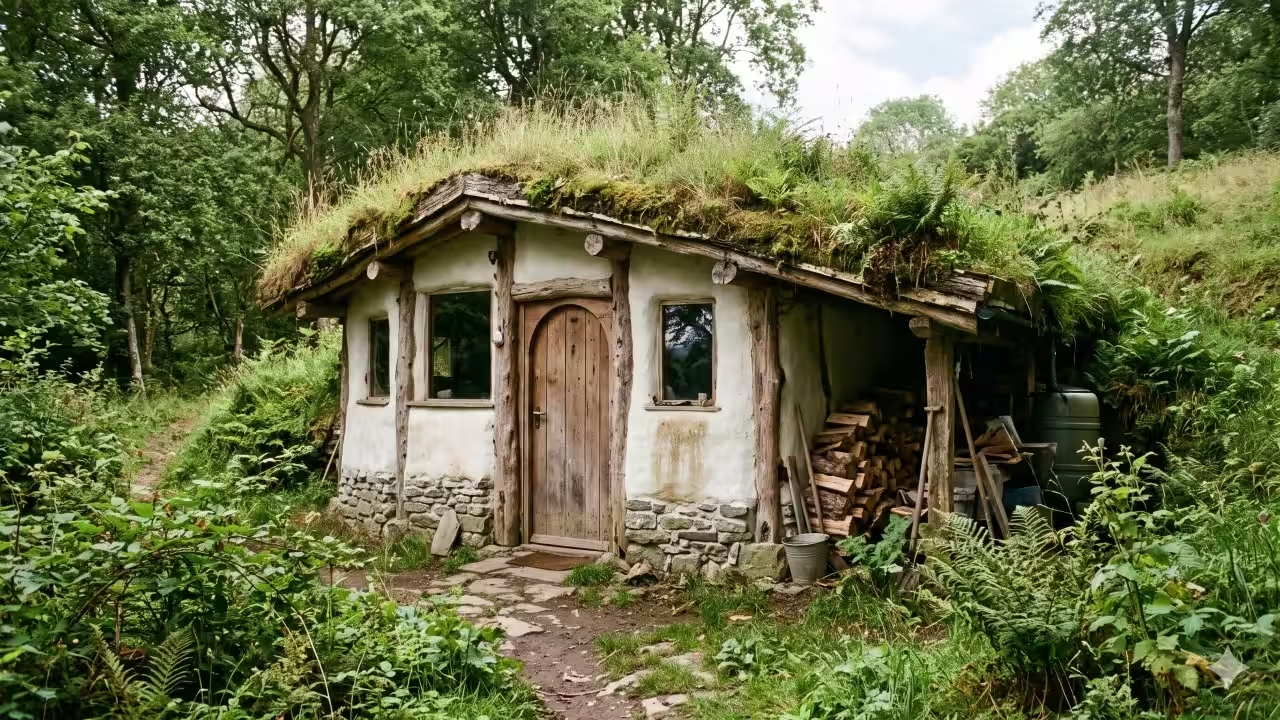
Many families cannot afford a country home, and renting can mean decades of payments with little to show for it. In response, some people raise doubts about the entire construction process. Rather than placing an order for bricks and cement, they question what a house might look like if it were built on nearby land, cost very little, and left virtually no environmental damage.Simon Dale approached the problem by building a woodland home in west Wales that resembles a house from Tolkien's Shire. With help from his father-in-law, friends and passersby, he used straw bales for insulation and local or reclaimed materials to reduce the need for new building supplies. By 2009, Dale was also involved in the Lammas ecovillage in Pembrokeshire, which received planning permission on appeal that year.Dale's own account says the family moved in four months after work began. He estimated that the project had taken 1,000 to 1,500 hours of labour and cost about £3,000 at that stage, excluding labour. The fun part about the project is the open-endedness of the numbers. The £3,000 number doesn’t cover everything, and a look at how the house was built, whether straw really insulates and how one hillside home evolved into a town illustrates what it does cover.Building the woodland homeEarth is the starting point of the design. Dale built into a hillside to provide shelter and reduce the house's visual impact. He used stone and mud from the excavation in the retaining walls and foundations, and made the frame from oak thinnings from nearby woodland. Reclaimed wood supplied the floors and fittings. A waterproof plastic sheet lies beneath the mud and turf roof. The house therefore combines natural and reclaimed materials with a synthetic waterproof layer. Inside, lime plaster provides a breathable finish and requires less energy to produce than cement.Most of the work was done with simple tools. Dale described using a chainsaw, a hammer and a one-inch chisel, with his father-in-law and visiting friends doing much of the heavy lifting. He put the cost at roughly £60 per square metre, not counting labour. A wood burner heats the house, and a solar panel provides power. Reports on the project also describe a fridge cooled by underground airflow and a composting toilet.The purpose for developing this manner was as much lifestyle as it was architectural. Dale describes how the house allowed his family to live close to nature, carrying out sustainable woodland management and creating a forest garden, tasks that would have been impossible with a regular rent or mortgage to pay.Does straw really insulate?Straw often raises questions, so it is worth looking at what the research says. A 2019 laboratory study published in Sustainability measured average thermal conductivity of 0.0573 watts per metre kelvin for dry wheat straw at a density of roughly 80 kilograms per cubic metre. For comparison, the study measured 0.041 for expanded polystyrene. The authors suggested increasing the straw figure by about 20%, to roughly 0.07, to account for moisture and ageing in actual buildings.In the study's comparison, the straw wall had a U value of 0.281 with a thickness of 20 centimetres, close to the Italian standard limit of 0.29. The polystyrene wall achieved 0.181. This 20 centimetre comparison should not be treated as representative of typical straw bale construction, where walls are usually much thicker, around 450 to 500 millimetres. The report states that such walls often achieve U values between 0.13 and 0.19. The straw walls also blocked sound more effectively than the polystyrene walls, although their thermal mass may not prevent overheating during hot, sunny weather.Moisture is the real risk. The paper cites work showing that straw stays sound below 20 per cent moisture content and begins to decompose above 30%, so breathable finishes matter. That is exactly the role of Dale’s lime plaster. The embodied energy of straw is also low. One estimate cited in the study puts it at about 28 megajoules per square metre of wall, against 488 for fired bricks and 169 for concrete blocks.From one house to a community projectDale's house was not the only low-impact project in the area. The Lammas ecovillage went through a lengthy planning process before receiving permission on appeal in 2009. Lowimpact.org has described the site as having nine households, about 15 structures and thousands of planted trees. These are approximate figures describing a collection of smallholdings, rather than a large town.A wider policy for similar projects followed. Wales introduced the One Planet Development policy through Technical Advice Note 6 in July 2010. Under the guidance, developments must demonstrate within five years that residents can meet their basic needs through land-based activities. Established developments are expected to achieve an ecological footprint of 2.4 global hectares per person, with a clear path towards 1.88. The policy also calls for buildings with zero-carbon construction and use. Lammas estimates that the land-based income requirement works out at about £3,000 per adult each year.The model still demands considerable effort. Residents must build and maintain their homes, meet basic needs through land-based activities and raise their families. One Lammas resident described the demands as exhausting and said the lifestyle would not suit everyone. Dale's estimate of £3,000 represented the amount spent at that stage, excluding labour. It should not be treated as the total cost of a typical home, since land, planning, infrastructure and unpaid work can add substantially to the effort and expense. Dale's project depended on local and reclaimed materials and help from family, friends and passersby. It is an example of one family's self-built home, not a universal £3,000 housing model.You use AI every day. Now get your AI Quotient. Take the AIQ test.
Topics in this story
Gathered from external sources. Rights to this text belong to whoever originally published it.