In 2024, more than 350,000 solar panels in Germany’s Gottesgabe park stood above 68 plant species, endangered grasshoppers and a red-listed skylark population
The Gottesgabe solar park in Germany showcases biodiversity with 68 plant species and endangered wildlife, proving that solar farms can coexist with nature while generating renewable energy for thousands of homes.
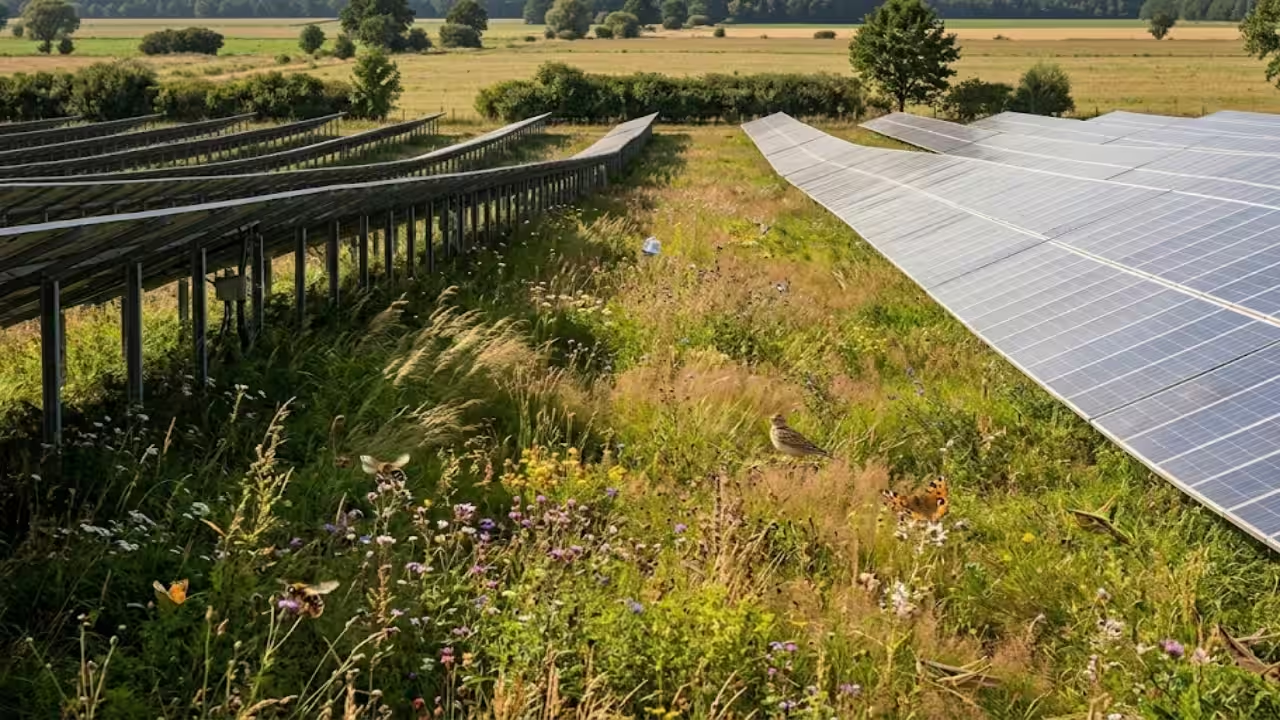
In rural areas, large solar farms can divide opinion. Farmers may fear losing agricultural land, while some residents see the installations as industrial additions to the countryside. What happens to biodiversity after the panels are installed is a separate question that German ecologists have begun examining. Gottesgabe, a solar park near Neuhardenberg in Brandenburg, began operating in 2022 with more than 350,000 solar modules and has been closely studied for its effects on biodiversity. 68 plant species, an endangered blue-winged sandgrouse, and skylarks that are on Brandenburg's Red List were discovered during a survey conducted in 2024 by biologist Tim Peschel. The park demonstrates that wildlife and panels can coexist on land, but only when the location is carefully thought out.Gottesgabe covers an area equivalent to 190 football pitches and is described by TÜV NORD as one of the largest and most powerful solar installations in Germany. The park supplies around 44,000 households with green electricity and stores surplus energy in large battery systems for operational and nighttime use. Whatever else that size means for the landscape, it also means a very vast region that is no longer treated with pesticides.What dwells below the panelsIn his inspection, Peschel found flowering plants that attract wild bees and butterflies. Among the chirping grasshoppers in the vegetation is the blue-winged sand grasshopper, a species listed as endangered. Insects do better in places without pesticides, and that’s beneficial for reptiles and birds, too. The skylark, which is listed as endangered in Brandenburg, has found a home in the park. Peschel also reported regular visits by kestrels and buzzards, drawn by the profusion of tiny animals on the site.Hedges and trees were also planted around the edge of Gottesgabe, and little biotopes were constructed. The figure comes from the compensatory measures required during the permitting process to offset the environmental impacts of construction.One park among 31Gottesgabe was one of 31 sites that Peschel and his colleague Rolf Peschel examined in a field study commissioned by the German Association of the New Energy Industry, known as BNE. The researchers surveyed 30 solar parks in 10 German states, plus one tracking installation in Denmark, covering plants, birds, butterflies, grasshoppers, bats and reptiles and, where ponds were present, amphibians and dragonflies. The study draws on more than 100 individual surveys, and BNE describes it as the world's most comprehensive study of biodiversity in solar parks on former agricultural land.The numbers are staggering. The researchers recorded 385 plant species, 30 grasshopper species and 36 butterfly species across the sites, as well as three reptile species, 32 nesting bird species, 63 additional bird species that came to feed and 13 bat species. Ponds and marshes surrounding the panels were home to 13 dragonfly species and eight amphibian species, including the critically endangered yellow-bellied toad. Reporting on the findings, Trade Magazine PV Europe noticed that skylarks were observed at three-quarters of the installations. Peschel's conclusion is more measured. Well-built solar parks on former farmland bring substantial value for species compared to what there was before. Proper upkeep is one of the key criteria. The details start to matter on that last point, upkeep.Design and upkeepNot every solar park on the ground becomes a biodiversity booster, said Elke Hietel, professor of landscape conservation at the University of Applied Sciences Bingen, to TÜV NORD. She suggests at least 3.5 metres of sunlight on the ground between rows of modules and no more than 40 per cent of the total surface covered with panels, because many species require light. Sheep grazing is often an effective way to keep vegetation in check, as it is softer than mowing; the animals carry seeds in their wool, while their hooves create patches of bare ground that can provide space for less competitive plants and wild bees. If a park is mowed, the cuttings should be removed, because they feed the soil and allow coarse grasses to crowd out other plants if left as mulch.Hietel and two colleagues developed a manual at the Technical University of Applied Sciences Bingen that lists 30 measures in the fields of design, construction, operation and monitoring. The manual was financed by a state environment ministry. The manual also recommends fences raised 15–20 cm above the ground to allow small animals to pass, along with no fertilisers or pesticides. It also recommends surveys two and four years after construction rather than a single survey.The science is more advanced than the rules. Germany’s 2024 renewable-energy reforms, known as Solar Package I, introduced five biodiversity measures for solar parks, but operators need to implement only three of them, and the requirements apply only to subsidised plants. Hietel said over a third of new solar park capacity installed in 2024 was subsidy-free. Conservation groups such as NABU have called for mandatory minimum standards for all parks.A large park left unsprayed, planted with native hedges and managed carefully can support many species on former farmland. Gottesgabe, with its 68 plant species, sand grasshoppers and Red List skylarks, is a working illustration of that philosophy, and the next test is whether additional parks and the rules controlling them will follow suit.You use AI every day. Now get your AI Quotient. Take the AIQ test.
Topics in this story
Gathered from external sources. Rights to this text belong to whoever originally published it.