Not an alliance, but a strategic web: How India and Japan are tightening the net on China
India and Japan sit on opposite sides of China, separated by the vast expanse of its landmass.
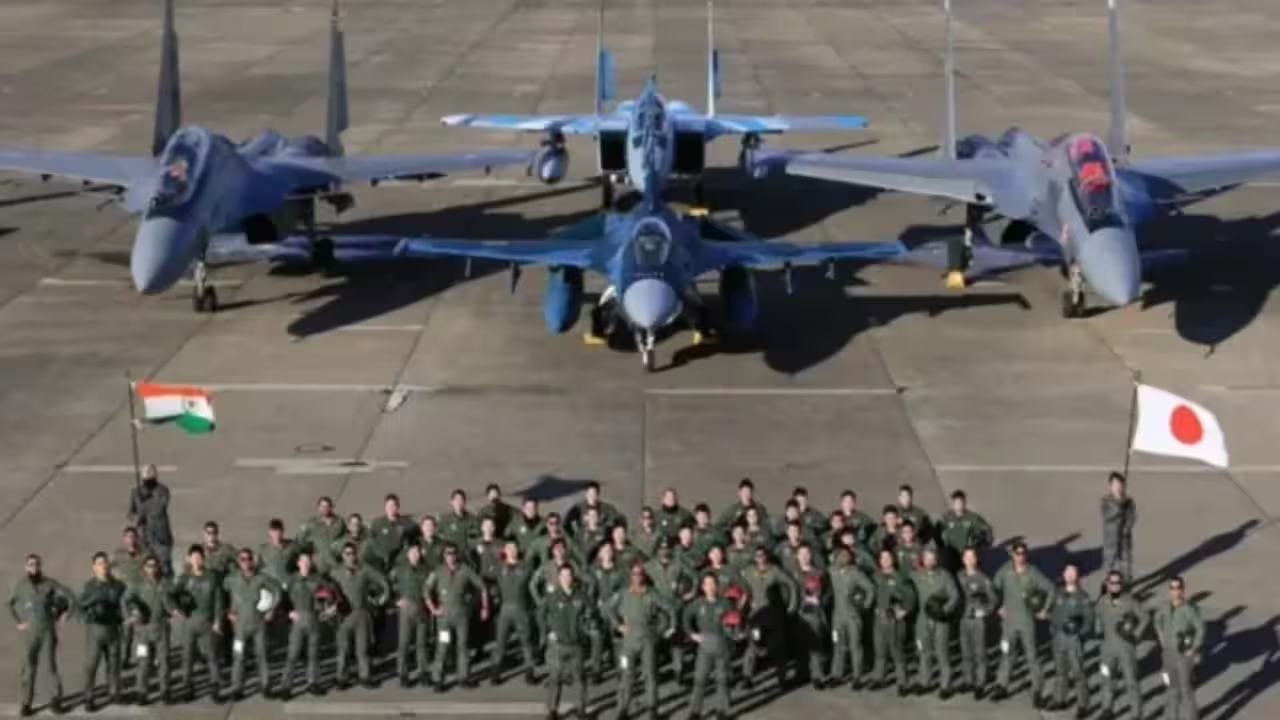
India and Japan sit on opposite sides of China, separated by the vast expanse of its landmass. Yet an increasingly assertive and expansionist Beijing has given both countries a common strategic challenge. Each is independently building military capabilities and investing in defence preparedness to deter China from pursuing its territorial ambitions. Though geographically distant from each other, New Delhi and Tokyo are united by a shared apprehension: that China's growing military power could threaten their territorial integrity and undermine the regional balance.Now, the two countries are taking their cooperation a step further. On November 19, at the fourth India-Japan 2+2 meeting of foreign and defence ministers in Tokyo, the two sides signed a Letter of Intent that will allow Japanese forces to use Indian military ranges for live-fire exercises for the first time, including firing missiles. It is perhaps the clearest indication yet that the India-Japan strategic partnership is moving beyond diplomatic declarations and into tangible military cooperation.Why the two countries are drawing closerChina's military modernisation, expanding naval presence, long-range missile capabilities and increasingly assertive territorial claims have reshaped the Indo-Pacific security landscape. India and Japan experience this pressure in different theatres, but face a common strategic challenge.For India, the pressure is concentrated along the Himalayan frontier, particularly since the 2020 Galwan Valley clash and the subsequent military standoff in eastern Ladakh. Chinese military deployments, expanded airfields and missile capabilities in Tibet and Xinjiang, coupled with Beijing's close military partnership with Pakistan, have created the prospect of a two-front challenge for New Delhi.For Japan, the concerns are centred on the maritime domain and the islands of the western Pacific. Chinese Coast Guard vessels operate regularly around the Senkaku Islands, administered by Japan but claimed by China as the Diaoyu Islands. Tokyo is also increasingly concerned about Chinese military activity around Taiwan, which lies close to Japan's southwestern island chain.The geography may be different, but the underlying challenge is the same: a stronger China increasingly willing to use its military weight and strategic influence to advance its interests. Neither government describes the partnership as an alliance directed against Beijing. Both instead emphasise their commitment to a free, open and rules-based Indo-Pacific. Yet their efforts to deepen interoperability, logistics, maritime surveillance and defence-industrial cooperation have an unmistakable deterrent dimension: strengthening their own capabilities while raising the costs of any attempt to alter the regional status quo by force.How the relationship was builtIndia-Japan ties have historical roots stretching back to the sixth century, but their security dimension is relatively recent. The two countries signed a peace treaty and established diplomatic relations on April 28, 1952. A Global Partnership followed in 2000, which was elevated to a Strategic and Global Partnership in 2006.The Joint Declaration on Security Cooperation, signed in October 2008, provided the first formal framework for defence exchanges, maritime security and counterterrorism cooperation. In September 2014, Prime Minister Narendra Modi and then Japanese Prime Minister Shinzo Abe elevated the relationship to a Special Strategic and Global Partnership.A series of agreements subsequently gave this partnership greater institutional and operational depth. A 2014 memorandum provided for defence exchanges and training, while two agreements signed in 2015 covered defence equipment and technology transfer, and the protection of classified military information.In 2018, an arrangement between the Indian Navy and the Japan Maritime Self-Defense Force (JMSDF) further strengthened naval cooperation. One of the most consequential agreements has been the Acquisition and Cross-Servicing Agreement (ACSA), signed on September 9, 2020, and brought into force on July 11, 2021. It allows the two militaries to provide each other with supplies and services, including fuel, food, transportation, maintenance and medical support. This logistical framework makes prolonged exercises and military deployments considerably easier.The maritime coreMaritime security remains the area where India's and Japan's strategic interests overlap most directly. Both countries depend heavily on uninterrupted shipping through the Indian Ocean and the Malacca Strait, while keeping a close watch on China's expanding naval presence, submarine deployments and network of port facilities across the region.On August 20, during Japanese Defence Minister Shinjiro Koizumi's visit to New Delhi, Defence Minister Rajnath Singh and Koizumi signed a Memorandum of Arrangement on Maritime Security Cooperation.The agreement provides for greater information-sharing on maritime domain awareness, search and rescue, disaster relief, the protection of sea lines of communication, ship visits and logistics support. It also covers mine countermeasures, joint naval design and shipbuilding, and the use of each other's shipyards for repairs.A working group at the level of Joint Secretary or Director General will oversee its implementation. The November 19 meeting in Tokyo reaffirmed the importance of this framework and the need to take the cooperation forward.Training togetherJoint military exercises are the most visible manifestation of the growing relationship. They also provide an opportunity for the two forces to familiarise themselves with each other's operating procedures, tactics and equipment.Dharma Guardian, the annual exercise between the Indian Army and the Japan Ground Self-Defense Force, has been held since 2018, alternating between the two countries. Its seventh edition took place from February 24 to March 9 at Chaubattia in Uttarakhand, with 120 personnel from each side. Japan deployed troops from its 32nd Infantry Regiment, while India was represented by the Ladakh Scouts. The exercise focused on counterterrorism operations and combat in semi-urban environments.At sea, the bilateral naval exercise JIMEX, now referred to as JAIMEX in official statements, began in 2012. It covers a range of operational areas, including anti-submarine and surface warfare, air defence, maritime surveillance and search and rescue.Air force cooperation has also gained momentum. The first Veer Guardian exercise was held in January 2023 at Hyakuri Air Base in Japan, with Indian Su-30MKI fighters operating alongside Japanese F-2 and F-15 aircraft. Veer Guardian 26, scheduled for this year, will mark another milestone, with Japanese Air Self-Defense Force fighters visiting India for the first time.Both countries also participate in the multilateral Malabar naval exercise. Originally launched as an India-US exercise in 1992, it became a permanent four-nation engagement with Japan joining in 2015 and Australia returning in 2020, completing the Quad format. This year, INS Sahyadri and JS Mogami participated in Malabar 2026 off the Japanese coast.The live-fire stepThe Letter of Intent signed in Tokyo marks a significant expansion of this military cooperation. It opens the way for Japan's Self-Defense Forces to conduct live-fire training at Indian firing ranges, including exercises involving surface-to-ship missiles.For Japan, which has limited space at home for large-scale missile training, access to Indian ranges would offer valuable additional room to train. For India, the arrangement demonstrates a degree of strategic trust and allows it to extend its military infrastructure to a key partner.However, the distinction between intent and implementation is important. The document is a Letter of Intent, and the two defence establishments have been asked to expedite the necessary arrangements. It does not mean Japanese missile units have already fired weapons in India, or that Japan has been granted unrestricted access to Indian military ranges. The precise scope, procedures and modalities of the arrangement still need to be worked out.Nevertheless, the significance is hard to miss. Cooperation that was once largely confined to dialogue, port visits and joint exercises is now moving towards more substantive military access and training arrangements.From exercises to industryPerhaps the more consequential development is the growing emphasis on joint defence technology and industrial cooperation. The clearest example is UNICORN, an integrated communications antenna mast developed by Japan. Instead of having several separate antennas on a warship, the system consolidates them into a single structure, reducing electromagnetic interference and the vessel's radar signature.In November 2024, the two countries signed a Memorandum of Implementation to co-develop UNICORN masts for Indian Navy warships, with Bharat Electronics Limited working alongside Japanese partners. Following the Tokyo meeting, the joint statement said India expects acceptance of necessity for the related arrangements by February 2027. This indicates that the project is progressing through the acquisition process, although the system is not yet in service.The Defence Research and Development Organisation (DRDO) and Japan's Acquisition, Technology and Logistics Agency (ATLA) are also expected to begin joint research on missiles and other advanced technologies. Robotics and unmanned ground vehicles have emerged as additional areas of interest, although publicly available information does not yet indicate a fully established joint development programme in these fields.Japan's gradual relaxation of its defence equipment and technology transfer restrictions has helped create opportunities for such cooperation. India, meanwhile, offers a large defence market, manufacturing capacity and the possibility of developing production partnerships that extend beyond the two countries."At the fourth India-Japan 2+2 Foreign and Defence Ministerial Meeting in Tokyo on 19 November 2026, the two sides signed a Letter of Intent enabling Japan’s Self-Defence Forces to conduct live-fire training on Indian ranges for the first time, including surface-to-ship missiles developed to counter Chinese maritime pressure," Sriparna Pathak, professor of China Studies, and the founding Director of the Centre for Northeast Asian Studies at O.P. Jindal Global University, told TOI."India and Japan simultaneously agreed to accelerate cooperation in underwater, missile and niche technologies, finalise reciprocal naval ship-repair access, and advance transfer of Japan’s UNICORN stealth antenna system to the Indian Navy under the 'Design with Japan, Make in India' framework. These steps build on the August 2026 Memorandum of Arrangement on Maritime Security Cooperation, which is now being translated into practical collaboration on maritime and air domain awareness, mine countermeasures and information sharing between the Indian Navy and Japan Maritime Self-Defence Force. India and Japan’s rapidly maturing partnership is forcing Beijing to reassess its room for manoeuvre across the Indo-Pacific by combining operational military depth with economic de-risking. They simultaneously agreed to accelerate cooperation in underwater, missile and niche technologies, finalise reciprocal naval ship-repair access, and advance transfer of Japan’s UNICORN stealth antenna system to the Indian Navy under the 'Design with Japan, Make in India' framework."Partnership, not allianceDespite the growing scope of cooperation, India and Japan remain some distance away from a formal military alliance. Neither has a mutual defence treaty obligating it to come to the other's aid in the event of an attack. India continues to place a premium on strategic autonomy, while Japan's postwar pacifist Constitution, particularly Article 9, continues to shape the limits and character of its military role.Their threat perceptions, too, are not identical. India's primary security concerns lie along the Himalayan frontier and across the Indian Ocean, while Japan's are concentrated in the East China Sea, around Taiwan and across the western Pacific. Both countries also maintain substantial economic ties with China. There is no joint military command or integrated operational plan between them.What they are building instead is a strategic network rather than an alliance. Greater maritime awareness, reciprocal logistics support, regular military exercises, defence technology partnerships and cooperation through the Quad are gradually creating a more interconnected security architecture in the Indo-Pacific.The objective is not necessarily to confront China militarily, but to make coercion more difficult and costly. By strengthening their individual capabilities and expanding the areas in which they can work together, India and Japan are seeking to deter Beijing without committing themselves to an automatic military response.How far this partnership ultimately goes will depend on whether the political understanding, military exercises and technology agreements translate into sustained operational capabilities. For now, however, the direction is unmistakable: India and Japan are building a strategic web that could significantly complicate China's calculations across the Indo-Pacific.
Topics in this story
Gathered from external sources. Rights to this text belong to whoever originally published it.