Everyone can have a giant diamond now. What's a celebrity to do?
As lab-grown diamonds make big stones more accessible, celebrities are redefining the engagement-ring flex through extreme size, rarity and distinctive desig...
There is, apparently, no such thing as too big of a diamond.
At least according to Christy Lee , who recently became engaged to Post Malone and is now the owner — or perhaps caretaker — of a 20-plus-carat oval natural diamond . In Vogue , Lee recalled that before proposing, Post asked her whether there was such a thing as a ring that was "too big," to which Lee said no. Well, of course. If your tattooed, 18-time Grammy-nominated, multi-hyphenate rapper-singer-producer of a boyfriend asks whether you would like a diamond visible from space, you don't ask him to exercise restraint.
One photo of that ring on her finger sent the internet into a spiral (me, a longtime Posty lover, included). Many were mesmerized by the stone , commenting, "Legendary," "Exquisite" and "What dreams are made of." Though there was another camp who weren't fans, calling the ring "tacky," "gaudy and hideous," and "overkill."
It used to be that the giant celebrity engagement ring operated according to a fairly simple equation: the bigger the diamond, the bigger the flex. Post's meteor of a stone, reportedly worth up to $2 million, still abides by that logic.
But something strange happened as lab-grown diamonds have come onto the scene, making enormous stones available at a fraction of the cost. A 10-carat stunner on someone's hand no longer necessarily tells you what it once did. And that raises funny questions for celebrities still committed to the bigger-is-better school of engagement rings.
Is bigger actually better in this day and age? And what does an absolutely enormous honker of a ring say about status, wealth and power if everyone — including those without Post's bank account — can have one?
If big no longer automatically means expensive, how big do you have to go before everybody knows you mean it?
Celebrities have been playing the big-rock game for decades. Elizabeth Taylor famously wore the 33.19-carat Krupp Diamond given to her by Richard Burton, at a time when there was little ambiguity about what a diamond of that magnitude represented — glitz and glamour, even if not eternal love.
Today's celebrities are still carrying on the tradition, albeit in a very different diamond market. Soccer star Cristiano Ronaldo nearly broke the internet when he debuted the approximately 37-carat diamond ring he proposed to his now-wife Georgina Rodríguez with last year, pushing the limits of what can reasonably be attached to a human finger. And the nearly 30-carat stone Amazon founder Jeff Bezos gave Lauren Sánchez Bezos left people dizzy.
In their cases, the message is the same. Those rings are headline-generating gambits that attract attention and signal status. Nobody looks at Sánchez Bezos's finger and wonders whether the rock is real. We know the lifestyle. We know the bank account. The diamond is a natural fit.
But take the celebrity out of the equation and that same visual shorthand gets a lot murkier.
Lab-grown diamonds didn't enter the commercial jewelry market in significant quantities until the mid-2010s, according to the Gemological Institute of America (GIA) . They aren't imitations like cubic zirconia or moissanite, as they have essentially the same chemical, physical and optical properties as natural diamonds. The key difference is their origin — natural diamonds form beneath the Earth over billions of years, while lab-grown stones are produced i n a matter of weeks (hence the greater accessibility).
According to The Knot's 2026 Real Weddings Study , which surveyed more than 10,000 U.S. couples married in 2025, lab-grown diamonds accounted for 61% of engagement ring center stones purchased — a 239% increase since 2020. The average lab-grown stone was 1.9 carats, with couples spending an average of $4,300 on the ring.
"Ten years ago if you saw a 10 or 20-carat diamond, you could fairly safely assume there was significant value behind it," Megan Kothari , founder and designer of luxury jewelry brand AARYAH, tells Yahoo. "Today, the size of someone's diamond alone tells you almost nothing," because lab-grown diamonds have completely scrambled the visual math.
A 10-carat lab-grown diamond can sell for a few thousand dollars. A 10-carat natural diamond, depending on its characteristics, could cost as much as $500,000, Kothari says.
Lab-grown diamonds are so ubiquitous and easy to acquire that there are live auctions on TikTok, where the price of manmade stones hover between $100 and $500 . It's so easy, people are procuring diamonds "accidentally."
"If I see a huge diamond now and the lifestyle doesn't match the size of the stone, I automatically assume it's lab-grown," says Kothari. The diamond used to tell us something about the person wearing it. Now, apparently, we need to know something about the person to understand the diamond.
If even just five and 10 carats don't necessarily scream extraordinary wealth anymore, what's a celebrity to do? Some of them have decided to go even bigger.
It might seem nonsensical or even borderline tacky to common folk but, according to Pinar Yildirim , a marketing professor at the Wharton School who studies consumer behavior, it actually makes sense.
For something to function as a status symbol, Yildirim says, it generally needs to be both recognizable and difficult to attain. And when a familiar status signal becomes easier for other people to replicate, there are a few ways to respond. "One of those strategies is going full-blown maximalist signaling," she tells Yahoo.
If someone else can approximate one version of your luxury item, you make the total display so extreme that they can't easily approximate yours. Suddenly, Post's diamond visible from space starts to feel almost logical. He isn't just doing big. He's doing big-big — pushing the flex into territory most people still can't follow.
But what if you don't want to go bigger?
There is another way to own something other people can't easily get. You can get harder to copy.
While Post, Ronaldo and Bezos are pushing diamonds toward their physical limits, Kothari is seeing another kind of flex emerge among her clients. It's not necessarily shrinking the stone — "Girls still want a five-carat diamond," she assures me — but making sure size isn't the only interesting thing about it.
"If someone is spending significant money on a natural diamond, they want the size, but they also want rarity, character and something that feels special," says Kothari.
When she first entered the industry, "it was really all rounds and ovals," that people desired. Now, clients are asking for elongated antique-style cushion cuts, true antique diamonds, long skinny ovals and stones with more color, from warmer browns and butter yellows to fancy yellows. They're also more willing to embrace unusual proportions and diamonds that aren't traditionally considered "perfect."
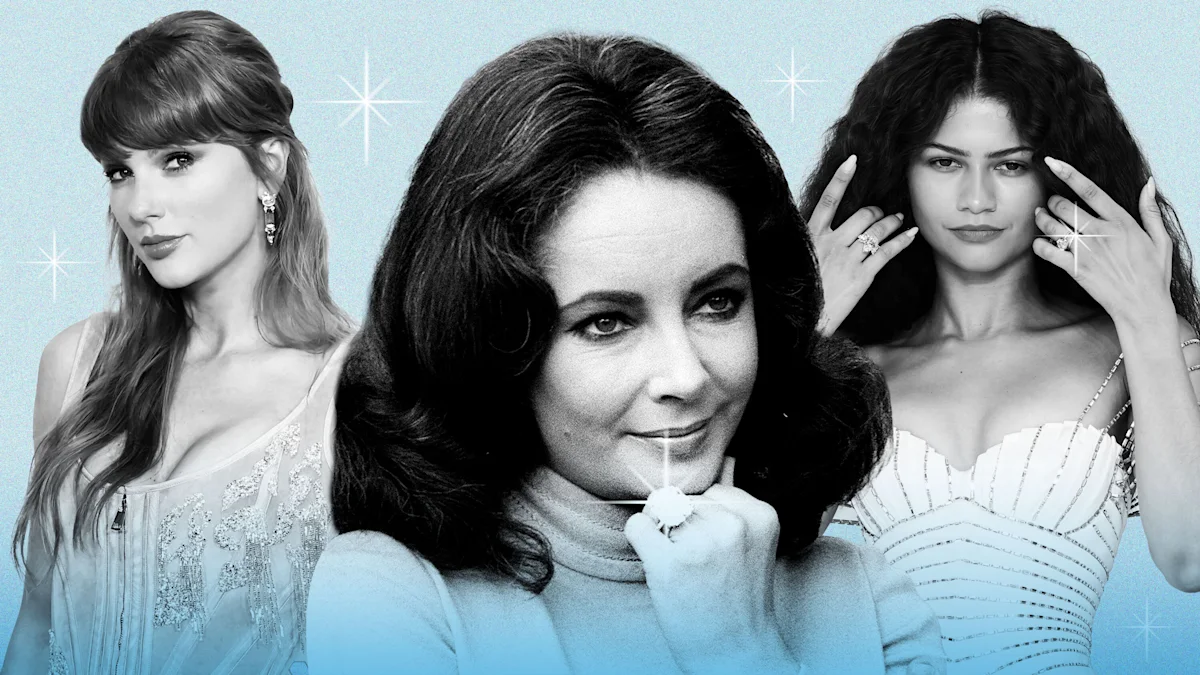
Taylor Swift's engagement ring from Travis Kelce is perhaps the most famous recent example. Her estimated eight-to-10-carat antique elongated cushion is still big by most any account, but its appeal goes beyond size. Jeweler Stephanie Gottlieb previously told Yahoo it offers "character you can't replicate."
Zendaya's engagement ring from Tom Holland offers another version of the same idea. She debuted the stone, estimated to be around five carats , at the 2025 Golden Globe Awards. Rather than competing in the celebrity carat arms race, the ring stands out for its distinctive design elements: The cushion-cut diamond is set east-west with a Georgian button back .
Neither woman is exactly wearing a modest diamond. That's because the alternative to the mega-ring isn't necessarily small. It's specific.
Kothari says a one-carat natural pink diamond can be worth significantly more than a five-carat natural white diamond. The five-carat stone might get more attention across a restaurant, but the one-carat pink might make the jeweler sitting two tables over choke on her martini.
"You can manufacture size," says Kothari. "You can't manufacture rarity."
For some people, being harder to spot is actually the point — it's the same philosophy undergirding quiet luxury . As people become more established in their status, the audience they're trying to impress can get smaller, according to Yildirim. "You're no longer trying to use signals that are recognizable by everyone, but recognizable by only a small group of people who really know things," she says.
I asked Kothari whether there is, in fact, a point at which a diamond becomes too big. I was thinking about Lee putting on a sweater, grocery shopping or even doing dishes.
"It really depends on your lifestyle," says Kothari. "If you're flying private, have security and live in circles where people are regularly wearing major jewelry, then big-big can absolutely work."
That's when I realized I had been evaluating Lee's enormous stone according to the practical requirements of my life, which is perhaps not the intended operating environment for double-digit carats. Lee — who's marrying a man with a $1.6 million diamond-fanged smile , mind you — doesn't need her engagement ring to be appropriate for subway transit. I do.
Maybe that's what the celebrity mega-ring still proves. Not simply that you can afford an enormous diamond, but that you occupy the kind of world where an enormous diamond makes sense. Lab-grown diamonds may have made looking wildly bejeweled more accessible, but they haven't made private planes, personal security and a lifestyle built for major jewelry any more attainable.
"Honestly, if Post Malone is giving you a 20-plus-carat natural diamond, I think you wear the 20-plus-carat natural diamond," says Kothari.
Topics in this story
Gathered from external sources. Rights to this text belong to whoever originally published it.