In 1987, Mississippi rebuilt 1.5 miles of State Route 15 with pond ash from a coal plant; after three years, its stronger ash sections bent far less than the ordinary control road
Discover how Mississippi utilized coal ash to rebuild State Route 15 in 1987, showcasing its impact on road durability and performance over three years.
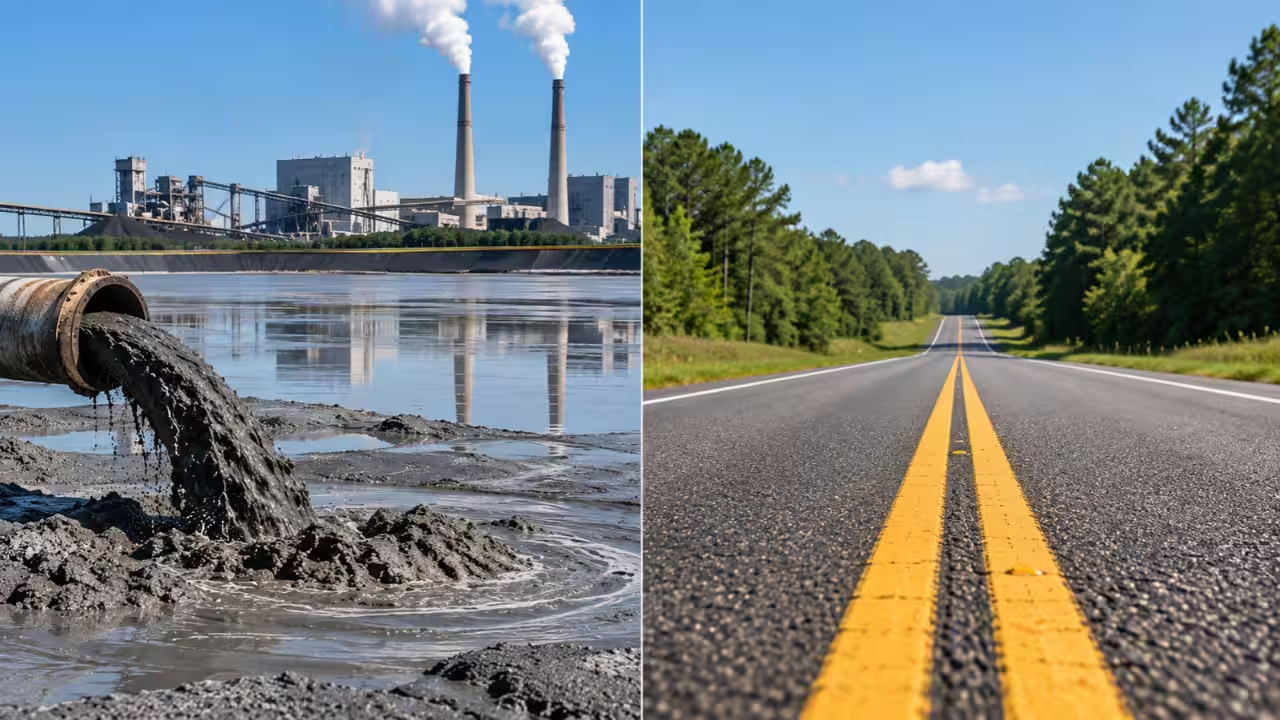
Mississippi rebuilt about 1.5 miles of State Route 15 in Stone County in 1987 by using pond ash from subbituminous coal. The project divided the roadway into five test sections, with four using lime-stabilized ash and one using cement-stabilized ash, while a separate 0.85-mile section used mechanically stabilized sand-clay material as the control. Engineers used the sections to compare the performance of different ash mixtures with the control section, and the road was monitored after construction, with measurements taken over the following three years to assess pavement condition and deflection.Five test sections on one roadPond ash is a mixture of ash materials collected and stored in settling ponds at coal-fired power plants, and the project was designed to examine pond ash as a base material for a paved road. The five test sections used different stabilization mixes, with four containing lime at concentrations that ranged from 2% to 7%, and one using 7.5% Portland cement. The control section used mechanically stabilized sand-clay subbase material.All of the sections were mixed in place, and a double bituminous surface treatment was then applied as the road's wearing surface. The Federal Highway Administration recorded the project in its User Guidelines for Waste and Byproduct Materials in Pavement Construction, and lists the Mississippi project as an example of a stabilized road base using Class C pond ash.Engineers measured how the road movedThe roadway was monitored after construction, and deflection measurements were taken every year through 1990. Deflection is the amount a pavement surface moves under a load, and engineers use the measurement to assess how a pavement responds when traffic places a load on it. The FHWA record says that the sections that contained 6% and 7% lime, along with the 7.5% cement section, recorded much lower deflection readings than the control section and the section containing only 2% lime.It did not mean that every ash mixture performed identically, since the type and amount of stabilizing material mattered. The control section and the 2% lime section had no observed cracking after three years, while the cement-stabilized section had the most cracking. The FHWA classified the cracking as shrinkage-related rather than structural, and noted that shrinkage cracking is common in cement-stabilized granular materials, particularly soil-cement mixtures.Three years of field dataA separate Federal Highway Administration record of the Mississippi project describes the work as an evaluation of power plant pond ash for highway construction. The study tracked the test sections for three years and included measurements of pavement deflection, visible distress, ride quality, and the strength of material cores. The project report says that both the test sections and the control section provided good performance during the three-year service period.The results provided highway engineers with field data on several different ash mixtures rather than a single yes-or-no test. The control section provided a conventional comparison, while the stabilized ash sections showed how changes in lime and cement content affected pavement behavior. The FHWA's later guidance lists the Mississippi project among documented applications of coal ash in stabilized road bases.The Route 15 project was built as a field test, but the road was still a working state highway, and by 1990, engineers had three years of measurements from sections built with pond ash and from the conventional control section. The records show lower deflection in the stronger stabilized ash sections, while the observed cracking remained nonstructural, and the project became one of the documented U.S. examples of coal combustion material being used in highway pavement construction.You use AI every day. Now get your AI Quotient. Take the AIQ test.
Topics in this story
Gathered from external sources. Rights to this text belong to whoever originally published it.