In 2000, a Colorado man gave up money to leave debt and financial motives behind; 12 years later, he was still surviving through foraging, gifts and discarded goods
Explore the intriguing story of Daniel Suelo, who abandoned money in 2000 to live a life of foraging and generosity for over a decade. Discover how his unique lifestyle challenges societal norms about money and self-sufficiency.
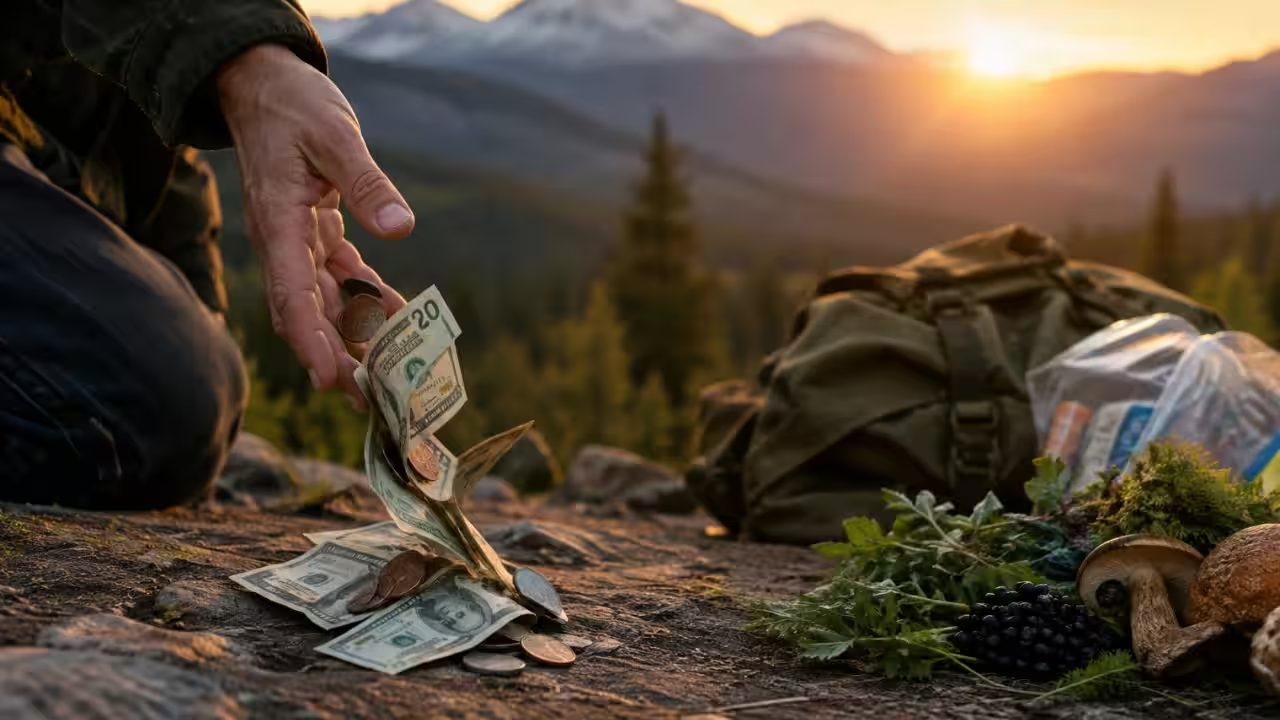
Daniel Shellabarger, who later became known as Daniel Suelo, decided to live without money in autumn 2000 after leaving his last thirty dollars in a phone booth at a truck stop in Pennsylvania, according to an account by Clay Bonnyman Evans published in The Coloradan. Mark Sundeen’s book The Man Who Quit Money, published in 2012, gave an account of Suelo’s way of life in the vicinity of Moab, Utah, where Suelo lived in a cave and gathered wild foods, as well as collected leftover food. In a blog post reproduced by Peace Corps Online, Suelo described money as a stand-in for the past as debt and the future as credit, never the present. The man had led a moneyless life, which is different from total self-reliance, since Suelo would accept any freely donated gifts and rejected any money or bartering system. This article looks at Suelo's lifestyle alongside two other sources: a 2006 psychology study on money and a federal report on food waste.University of Colorado degree and Peace Corps service in EcuadorSuelo's background appeared ordinary. Peace Corps Online, in a document reprinted in 2009, listed Suelo as a former Peace Corps volunteer in Ecuador who had earned an anthropology degree at the University of Colorado and worked as a lab technician. Furthermore, it is mentioned that he was 48 years old and lived in a cave around one hour away from Moab. The Coloradan’s account, as preserved by Clay Bonnyman Evans, placed him in the class of 1984. The Deseret News reported that he had been depressed for about 10 years before his 2000 decision.Twelve years of foraging and scavenging, 2000 to 2012Sundeen’s version, as quoted in the blog Citydesert, depicts the 12 years of living without money in which Suelo lived on wild edibles, scavenged food, some roadkill and gifts. An Associated Press profile of Suelo, published in the Summit Daily in 2009, provides additional details. Suelo went through Moab's garbage once a week and found more than enough for himself. Suelo assured the reporter that he never got sick because of the scavenged food.He rejected barter because he saw it as a form of money, the Deseret News reported. In an interview on Becoming Minimalist, he disagreed with the intro calling him boastful for avoiding food stamps and any other government assistance since it might imply that he considers himself superior to those who need such help. Gordon Stevenson, who directed a film about Suelo, talked to AP about the contradiction between Suelo's way of life and his reliance on people who use money. The Coloradan reported in 2013 that he had lived in a cave outside Moab for 13 years. Peace Corps Online's account of his 2000 hitchhike shows he did not stay in one place. In a 2021 profile, Utah Stories reported that he had made a home near Moab during the 1990s, before he gave up money.Vohs, Mead and Goode's nine money experiments, 2006In The Psychological Consequences of Money, published in Science, Kathleen Vohs, Nicole Mead and Miranda Goode reported nine experiments. The 2006 experiments suggested that money primes a more self-reliant orientation, making people less dependent on others, which offers background on how life without money differs from ordinary financial life. Moreover, they preferred to engage in solitary play, solitary work, and sit themselves at a greater distance from an unfamiliar individual compared to people exposed to neutral terms.USDA food waste estimates for 2010: 133 billion pounds, 31 percentThe food recovered by Suelo fits into the national pattern, which is well-established. USDA's Economic Research Service published a paper titled "The Estimated Amount, Value, and Calories of Postharvest Food Losses at the Retail and Consumer Levels in the United States." According to the statistics provided there, 133 billion pounds, out of 430 billion pounds of food available for consumption, were wasted in 2010, which is 31% of the available food, retail value of which was estimated at $161.6 billion. According to the estimates provided by the agency, retailers wasted 43 billion pounds of food, which is 10% of the available amount, and consumers wasted 90 billion pounds, which is 21%. The amount of wasted calories amounted to 387 billion per day, and meat, poultry and fish accounted for 30% of the total value lost.The agency reported that there was an average loss of 1,249 calories per person per day. Meat, poultry, and fish constituted 30 percent of the food wasted in terms of value, amounting to $48 billion. Reasons for wastage at the retail level included broken equipment like malfunctioning cold storage, ordering more than required and discarding damaged produce. This is shown by Suelo’s experience of the visible effect of food wastage; however, there are many other kinds of wastage included in the above statistics that cannot be recovered from trash.Suelo's return to financial society, 2015 to 2021Utah Stories reported in 2021 that Suelo's moneyless period lasted about 15 years, from 2000 until he returned to financial society in 2015 to care for his parents. A 2021 profile by Utah Stories described him as living in Colorado with his mother. The profile also said that he was still adjusting to life in a money-based society after years without money.You use AI every day. Now get your AI Quotient. Take the AIQ test.
Topics in this story
Gathered from external sources. Rights to this text belong to whoever originally published it.