In 2022, road base tests mixed recycled tire pieces with crushed concrete, and both small and medium tire blends showed significant rutting after 1,000 loading cycles
Discover how mixing recycled tire pieces with crushed concrete can impact road construction, as tests reveal challenges and opportunities for sustainable paving materials.
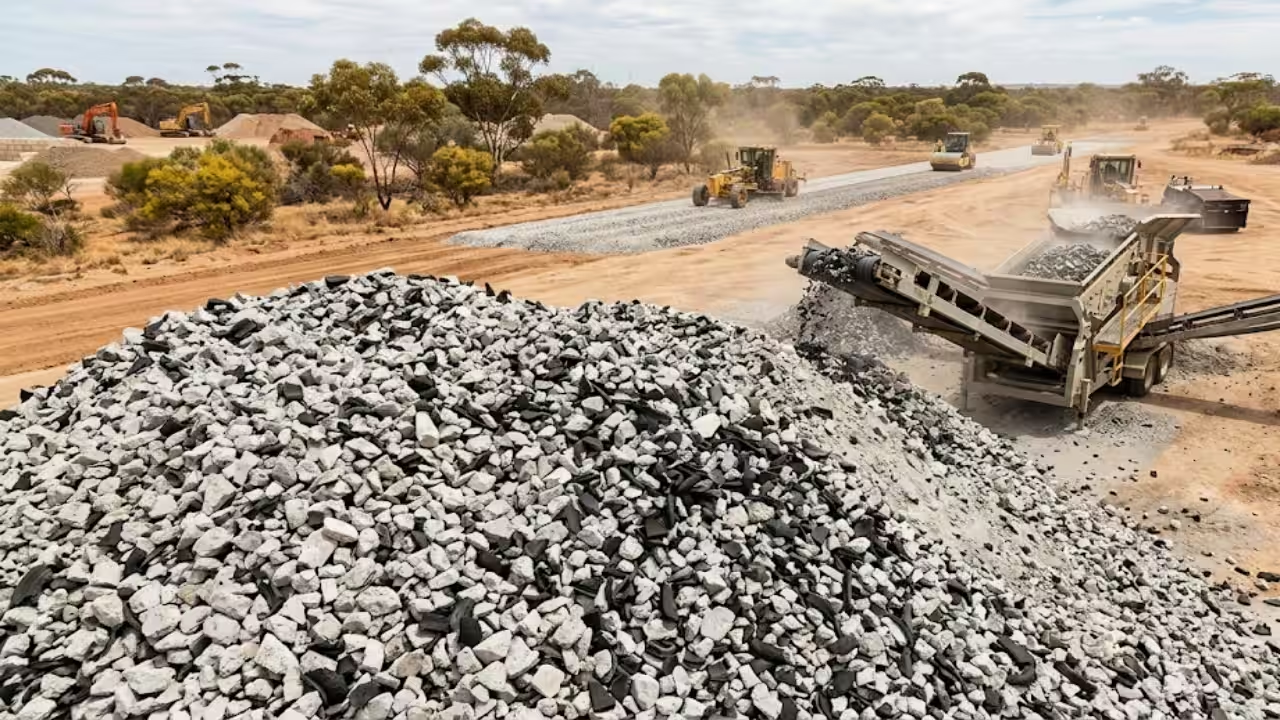
Worn out tires reach the end of their useful lives in huge numbers each year, and finding a second use for them is not easy. Researchers in Australia have been exploring whether old tires could go into road construction instead of landfill. Roads are often considered a practical target because they can take in large volumes of material. After testing by the Australian Road Research Board (ARRB), Victoria's transport department has been increasing the use of recycled materials in unbound bases for lightly trafficked state roads. Researchers at Melbourne's Swinburne University of Technology explored what happens when the two wastes are joined. Crushed concrete mixed with small and medium tire fragments showed significant rutting after 1,000 loading cycles in the wheel tracker test.What the team testedThe idea was to see if tire pieces could replace part of the quarry stone that normally forms the subbase layers of the pavement. The mixes contained recycled concrete aggregate (crushed demolition concrete) and tire derived aggregate (shredded pieces of old tires) in small and medium sizes. Two tests were made. The repeated load triaxial test squeezes a cylinder of material inside a pressurised cell again and again to measure permanent deformation. The wheel tracker rolls a loaded wheel back and forth over a compacted sample to measure rut depth. According to the paper, the triaxial test put samples through 30,000 cycles in three stages of 10,000, at a confining pressure of 50 kilopascals.Rutting is important because it is the groove that develops along wheel paths. Engineers trace it to too much deformation in the base layer, since the asphalt on top simply follows whatever moves underneath. A base settles under traffic, and eventually a rut appears on the surface. The Australian Road Research Board runs an oversized wheel tracker called Austrack, which applies heavy vehicle loads to predict how unbound bases will rut in the field. It is the sort of test any new base material must eventually pass.What the tests suggestedIn the wheel tracker test, the researchers recorded significant rutting in both blends after 1,000 cycles. The rut depth under the medium tire blend was higher than under the small tire blend for the first 760 cycles, after which the pattern changed. Overall, medium tire sections performed better, with less permanent deformation in the triaxial test and less rutting in the wheel tracker. The medium mix also resisted repeated loading better than the small one at a 2 per cent tire share. Crushed concrete alone deformed far less in the triaxial test than either tire combination.The results look discouraging for tire rich layers, yet the researchers still say the blends suit pavement base and subbase use, because the particle size, compaction, bearing strength and triaxial tests supported adding modest amounts of tire pieces. That gap makes sense once you consider where the material goes. A subbase sits below the base and carries less stress, so a small amount of tire in that layer is very different from a tire rich surface exposed to heavy wheels.Why rubber alters the blendEarlier work had not examined such a long horizon, so in 2019 researchers at RMIT University's Soil Dynamics and Earthquake Engineering department blended crushed concrete with 0.5, 1 and 2 per cent crumb rubber and ran 100,000 loading cycles in a triaxial rig. Researchers from RMIT University’s Soil Dynamics and Earthquake Engineering department blended crushed concrete with 0.5%, 1% and 2% crumb rubber, then ran 100,000 loading cycles in a triaxial rig in 2019, since earlier work had not examined such a long horizon.Tire pieces can go into road layers, but only in limited amounts, in medium rather than small pieces, and with the toughest tests done before anyone builds a road on them. Medium pieces performed better than small pieces, and plain recycled concrete performed better than either blend. The study suggests councils and contractors should be cautious, since a material can perform well in one test but struggle in another.You use AI every day. Now get your AI Quotient. Take the AIQ test.
Topics in this story
Gathered from external sources. Rights to this text belong to whoever originally published it.