In 2007, American Peace Corps volunteer Laura Kutner began collecting plastic bottles in Granados; by 2009, they formed 2 schoolrooms and inspired 10 more schools
US News: Discover how Laura Kutner, a Peace Corps volunteer, repurposed 8,000 plastic bottles to create schoolrooms in Granados, Guatemala, inspiring a movement in sustainable construction and waste management across multiple communities.
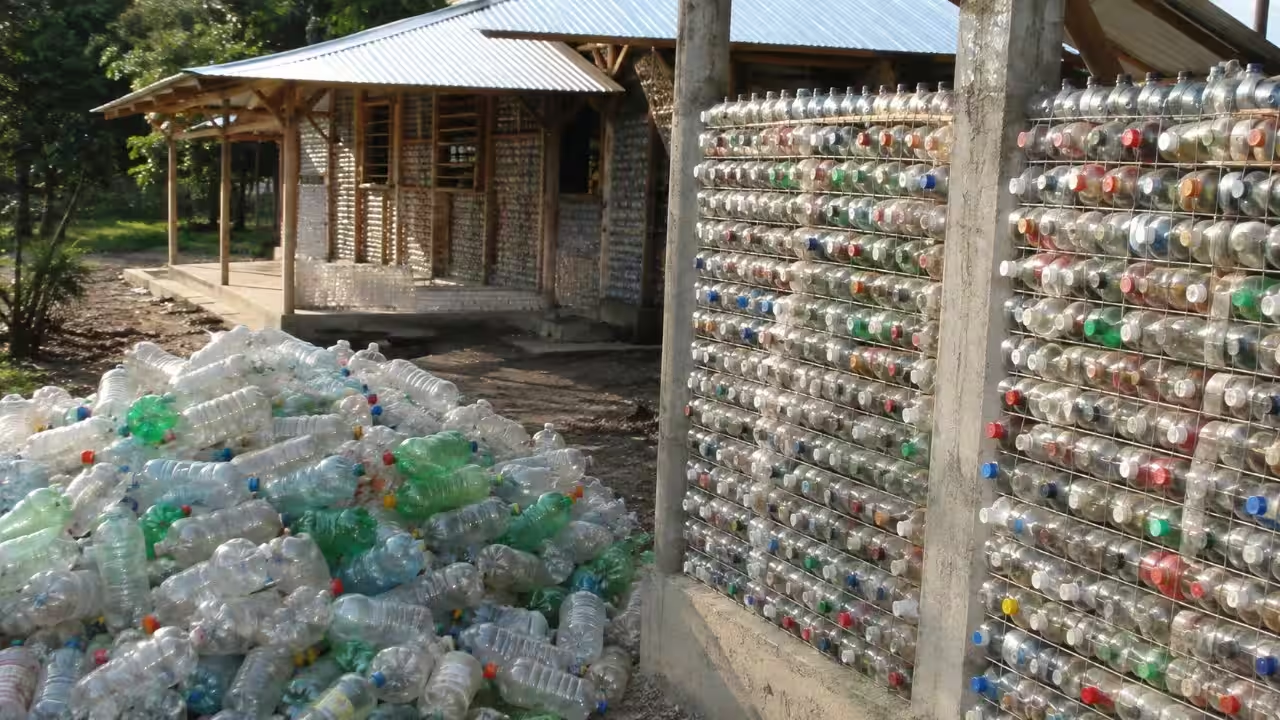
A discarded plastic bottle is usually treated as a piece of waste, but in Granados, Guatemala, thousands of them became part of a school. When American Peace Corps volunteer Laura Kutner arrived in the mountainous community in 2007, she encountered both a shortage of classroom space and a persistent waste problem. Two unfinished classrooms already had metal frames and roofs, but there was not enough money to complete the walls. Kutner eventually found a way to turn the rubbish around the community into a construction material.From litter to building materialAccording to Smithsonian Magazine, Granados, in Guatemala's Baja Verapaz region, had limited waste-disposal options, and rubbish frequently accumulated around the community. Kutner noticed the problem while working with local students and began considering whether some of that waste could be put to practical use. The idea came while she was sitting with students and drinking from a plastic bottle. She realised that the bottle was roughly the same width as the metal framing of the unfinished classrooms. Kutner had also encountered examples from elsewhere in Latin America where plastic bottles packed with waste were being used as building blocks. With the support of local engineers, she began adapting the approach for the school. The process was simple, but labour-intensive. Students and residents collected discarded plastic bottles, cleaned them and packed them tightly with inorganic waste such as plastic bags, wrappers and aluminium packaging. Paper and cardboard were excluded because they could decompose inside the bottles. The resulting "eco-bricks" were then placed inside metal frames and enclosed with chicken wire before the walls were covered with concrete.Kutner and school principal Reyna Ortiz organised workshops to explain how the bottles had to be prepared. Students were encouraged to collect and fill bottles themselves, and as the project required more material, volunteers also travelled to neighbouring communities to collect additional bottles and waste. What began as a way to complete two unfinished classrooms consequently expanded into a broader community clean-up effort. Construction of the walls began in February 2009. Kutner was later transferred to San Miguel Dueñas, but continued travelling back to Granados as the project neared completion. By October that year, the wall was finished, forming part of the two-room school.What the bottles could actually doThe Granados project was more than an unusual recycling exercise. It demonstrated how a material with little immediate value could be incorporated into a low-cost construction system when conventional building materials were difficult to afford. Research published in Materials & Design later examined the physical properties of PET bottle eco-bricks made by packing waste plastic into bottles. Laboratory tests found that their mechanical strength was closely related to how heavily the bottles were packed, while the researchers also identified potential benefits in sound insulation and light transmission. The study concluded that such eco-bricks could have construction applications, although their suitability depends on how they are manufactured and where they are used. This is important because a plastic bottle does not automatically become a replacement for a concrete block simply because it is tightly packed with rubbish.An idea that travelled beyond GranadosThe most lasting part of the project was perhaps what happened after the classrooms were completed. Kutner continued sharing the construction method, while other volunteers and communities became interested in the approach. Smithsonian reported that 10 additional schools had been built in Guatemala using the plastic-bottle technique. The Peace Corps also documented how the project encouraged communities to think differently about waste. Instead of treating discarded bottles and wrappers solely as rubbish, residents could collect, sort and repurpose some of that material. The project therefore connected two local problems, unfinished school construction and unmanaged waste, through a single community effort.According to a field report published in Children, Youth and Environments, Laura Kutner’s classroom project in Granados, Guatemala, involved children and young people in every stage, from collecting waste to constructing the classrooms. She highlighted hands-on learning, teamwork, creativity and community participation as key to creating more sustainable projects. The Granados classrooms were completed in 2009 and are now about 17 years old. However, the available reports do not provide a recent assessment of their condition or long-term performance.The project showed something more practical: even a material regarded as worthless can become useful when a community has the need, organisation and technical guidance to put it to another purpose. In Granados, thousands of bottles that might otherwise have remained scattered around the town instead became part of a school where children could learn. And the method did not remain confined to those two classrooms. It became an example that other communities in Guatemala chose to adapt, turning a small local experiment into a much wider idea.Catch the latest World News and Live updates. Download the TOI app.
Topics in this story
Gathered from external sources. Rights to this text belong to whoever originally published it.