Netanyahu promises Iran regime change: Can Israel topple Tehran government?
Israel can inflict devastating damage on Iran, but analysts question its ability to overthrow Tehran’s government.
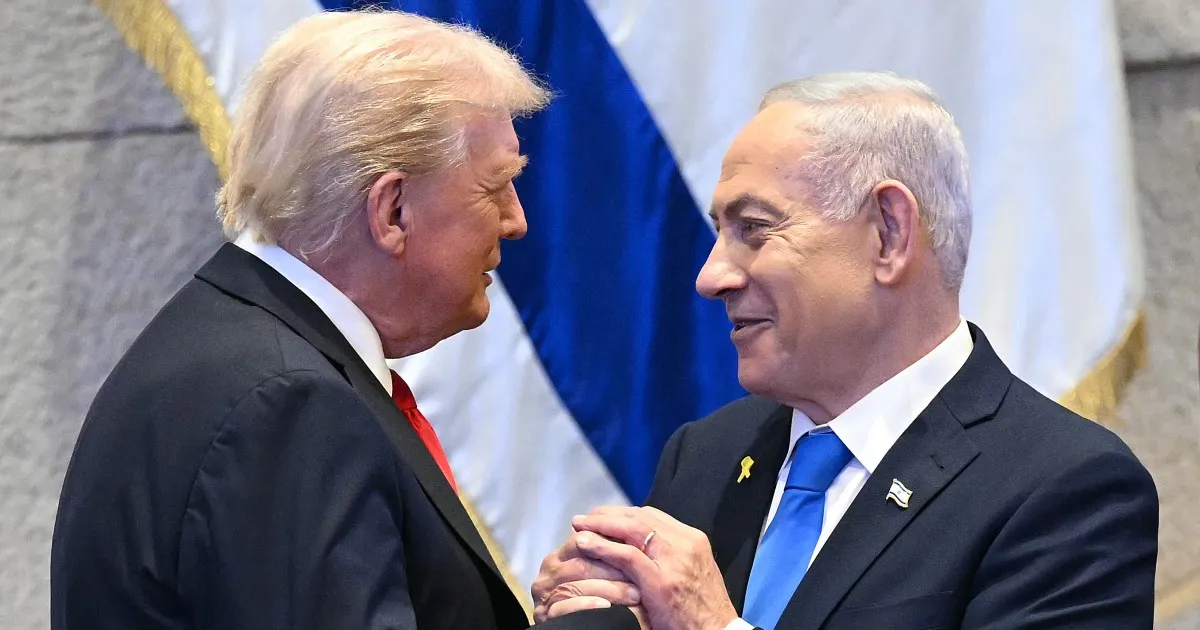
Israel’s Prime Minister Benjamin Netanyahu has said that overthrowing Iran’s government remains Israel’s “primary objective”, as he faces declining support in the polls before national elections next week.
His remarks came after conversations with United States President Donald Trump on Sunday and a visit to Israel by Pentagon chief Pete Hegseth. But Netanyahu offered no indication that Washington had agreed to join another offensive against Iran, let alone a campaign to bring down Iran’s leadership.
While Israel has the firepower to inflict serious damage on Iran, analysts told Al Jazeera, it lacks a clear strategy for translating military gains into the overthrow of Iran’s government. Air strikes alone are unlikely to achieve that objective, while a ground invasion would demand a far greater military commitment, they said.
A renewed offensive would also mean confronting a state that has already survived two rounds of attacks and retains the means to retaliate – both against Israel and its Gulf neighbours who are hosting US military assets. US backing, meanwhile, remains uncertain, with experts questioning Washington’s appetite for renewed fighting as it is yet to find a credible prospect of forcing Iran’s government to surrender to its demands.
Israel’s ability to attack Iran is not in doubt, experts say. Urban Coningham, a research fellow at the Royal United Services Institute (RUSI), told Al Jazeera that its offensive weapons stockpiles, and “aerial refuelling” capabilities give it a substantial advantage. “Israel could again establish air superiority and strike Iranian targets,” he said.
But while Israel can inflict serious damage, analysts are sceptical that it can accomplish regime change.
Netanyahu has portrayed Iran’s leaders as a major threat since his first term as prime minister in 1996. Addressing the US Congress that July, he said, “The most dangerous of these regimes is Iran, that has wed a cruel despotism to a fanatic militancy.”
Nearly 30 years later, US participation in the June 2025 war, and again in the campaign launched on February 28 this year, delivered the military intervention Netanyahu had long sought. The overthrow of Iran’s government, however, did not follow. Netanyahu himself acknowledged the limits of airpower in March, saying, “You can’t do it only from the air.”
“There has to be a ground component, as well,” he added, without explaining what that would involve.
Caglar Kurc, an assistant professor at Abdullah Gul University in Kayseri, Turkiye, said bombing could weaken Iran’s military but not necessarily eliminate its ability to fight back. “Airpower can degrade military capabilities but cannot fully destroy offensive capabilities,” he told Al Jazeera. “Well-hidden systems would survive.”
Overthrowing the government, Kurc said, would require a willingness to deploy troops and remain on the ground for years. Israel can also no longer assume that covert methods used in earlier attacks would prove equally effective again.
Coningham described intelligence assets as “use and burn” because deploying these methods risks exposing networks that Iranian security services will investigate and disrupt.
Israel still has “human intelligence assets on the ground”, he said, while “cyberattacks” could also form part of another campaign. But using those capabilities risks revealing and sacrificing them, making the prospect of a tangible military gain an important consideration.
Covert operations and cyberattacks, in his assessment, do not offer a clear route to overthrowing Iran’s government. Coningham was similarly sceptical that Kurdish or Baloch armed groups could provide the ground force needed to challenge the state. In March, the Trump administration was said to be actively discussing providing arms to opposition Kurdish groups, according to CNN, which cited Kurdish and US officials. But this never progressed.
“Kurdish groups lacked the military capabilities to take on the Islamic Revolutionary Guard Corps (IRGC),” he said.
Iran also does not need to match Israel aircraft-for-aircraft to make another offensive very costly, experts say.
Sidharth Kaushal, a senior research fellow at RUSI, told Al Jazeera that the “Iranians likely retain sizeable stocks of missiles,” even if damage to their targeting systems may constrain their effectiveness.
“The actual antiship missile stockpiles likely remain large, both because they are comparatively easy to make, and Iran has in-housed much of the production of older Chinese ASCMs, and Iran’s southern mountains provide natural shelters against air attack,” Kaushal said.
Coningham said that, for Israel, sustaining its defences would be more difficult, with previous exchanges having drawn down interceptor stocks.
Repeated attacks also impose a financial burden, as Israel will be intercepting relatively inexpensive Iranian drones with far more costly defensive weapons. Over a prolonged exchange, that imbalance could place further pressure on Israel’s interceptor supplies, while Iran retains the capacity to mass-produce more cheap weapons for a lot longer.
Analysts consider this unlikely, pointing to diverging political interests between Tel Aviv and Washington, with Trump facing pressure to avoid renewed escalation before the US midterm elections.
The Financial Times reported this week that an Israeli proposal for renewed strikes had failed to secure Trump’s approval, although it suggested disagreement about immediate action rather than Washington ruling out future attacks altogether.
Without Trump’s participation, Coningham said, Israel would lack US capabilities for striking deeply buried facilities. These include the 30,000-pound GBU-57 bunker-busting bombs that US B-2 bombers dropped on Iran’s Fordow and Natanz nuclear facilities in June 2025. Designed to penetrate deeply buried targets, the weapons gave Washington an offensive capability Israel could not match on its own.
Coningham also suggested that, if Israel were to attack without US support, Iran might concentrate its retaliation on Israeli territory while avoiding US targets and disruption to the Strait of Hormuz.
Such an approach would seek to punish Israel without drawing Washington directly into the fighting, potentially further isolating a country already widely ostracised by the international community amid its genocide in Gaza.
But analysts say the central obstacle that could ultimately prevent Israel from attacking Iran is the gap between its ability to destroy military targets and its capacity to force political change within Iran.
“You cannot change a regime unless you are prepared to deploy troops and stay in the country for some years. Israel cannot control Iran. The United States would not engage in another regime change, which could take decades,” Kurc added.
Topics in this story
Gathered from external sources. Rights to this text belong to whoever originally published it.