Healthcare goes digital: When doctors go behind the app wall, who gets left behind?
India News: What if your phone becomes the first thing you need to see a doctor?As healthcare increasingly moves from hospital counters and paper records to apps .
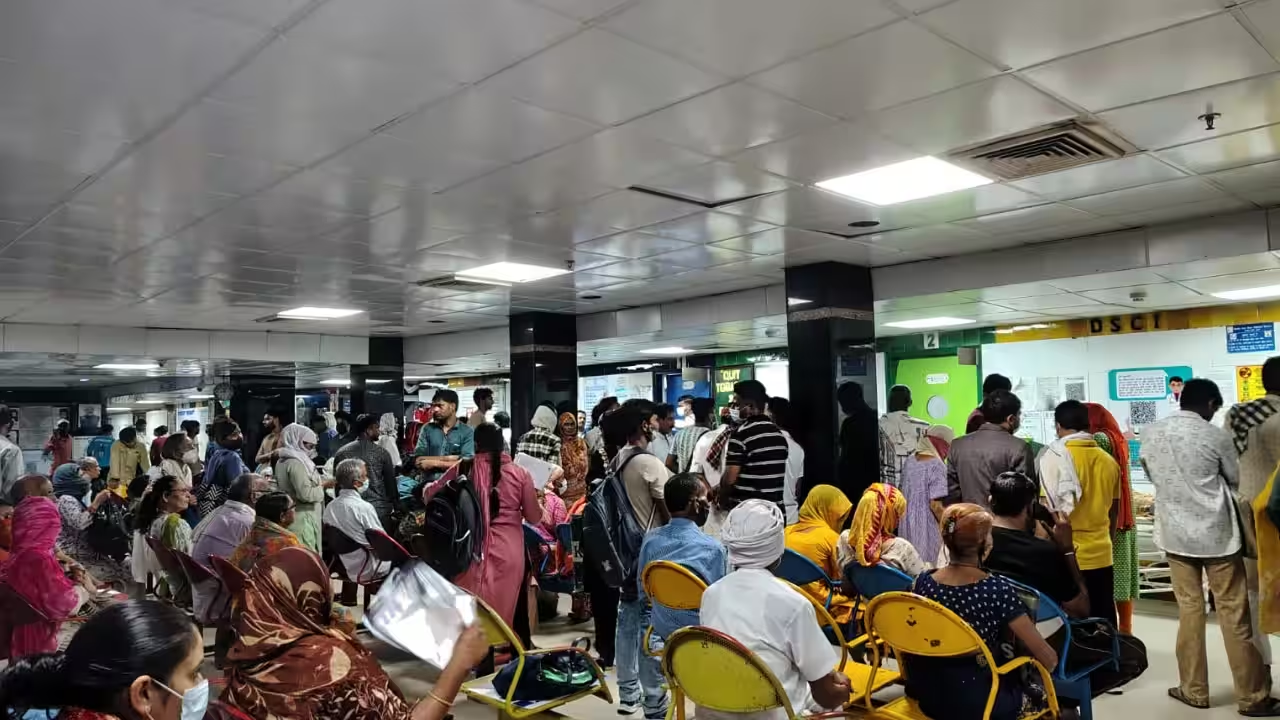
What if your phone becomes the first thing you need to see a doctor?As healthcare increasingly moves from hospital counters and paper records to apps and online portals, access to care is becoming closely tied to access to technology.For many patients, digital healthcare can mean quicker consultations, easier access to medical records and fewer trips to hospitals. But for others, particularly older people, rural communities, low-income families and those with limited digital literacy, the shift can add another layer of difficulty.The problem is not simply whether a person owns a smartphone. Patients may struggle with internet connectivity, downloading and navigating apps, remembering passwords and OTPs, uploading documents or understanding information presented online.In many households, a single smartphone is shared by several family members, while caregivers often become the bridge between patients and digital health services.As government and private healthcare services increasingly encourage, and in some cases require, people to use digital platforms, a larger question is emerging: Is technology making healthcare more accessible, or creating a new barrier to accessing it?When the smartphone becomes the gateway to healthcareDigital health has opened up several ways for patients to manage their care remotely. People can consult doctors online, monitor blood sugar through connected devices, receive medication and appointment reminders, and access diet and educational resources without making frequent hospital visits.Telemedicine became particularly important during the Covid-19 pandemic, when lockdowns made physical consultations difficult. But the experience also exposed how uneven access to digital healthcare could be.A DIG-EQUITY study published in The Times of India, examining the experiences of people with diabetes, caregivers, healthcare providers, policymakers and community organisations in urban and rural Tamil Nadu, found significant differences in how people used digital health services.Younger patients were generally more comfortable with smartphones, health applications and teleconsultations, while many older people needed family members to book appointments, join consultations or access medical reports.For some, physical limitations added to the problem. Impaired vision or hearing, as well as difficulty handling smartphones, could make navigating digital platforms harder.Even among younger people, digital access did not automatically translate into a preference for online care. Some people with type 1 diabetes continued to prefer in-person consultations because of the need for physical examinations.The digital divide is also closely linked to where people live and what they can afford.Urban patients are more likely to have reliable internet connections, smartphones and access to digital services. A study published in Nature, examining barriers to digital health transformation in India, found that the challenges went beyond simply having a smartphone or internet connection.The study identified poor network coverage and inadequate IT infrastructure, the high cost of devices and digital systems, a lack of technical expertise, language and communication barriers, and difficulties faced by users among the major challenges.For patients, these barriers can have very practical consequences. The study noted that some had to rely on family members' smartphones to attend teleconsultations, while the cost of smart devices could limit access to mobile health applications.The findings suggest that digital access cannot be measured simply by whether someone owns a phone. Reliable connectivity, affordability, digital skills, language accessibility and the availability of human support all influence whether a patient can actually use digital healthcare.That distinction becomes particularly important as healthcare services increasingly move online. Putting a service on a digital platform does not automatically make it accessible to everyone.ABHA and the push towards connected healthcareIndia's digital health infrastructure is expanding rapidly. The Ayushman Bharat Digital Mission (ABDM), through platforms such as ABHA, is aimed at creating a connected digital health ecosystem, while eSanjeevani has widened access to telemedicine.With hundreds of millions of ABHA IDs created and telemedicine consultations running into hundreds of millions, the scale of this shift is significant.But the benefits of digital healthcare are not evenly experienced.The gap becomes particularly visible when digital systems are introduced at the hospital level. For some patients, the shift has not removed queues; it has created an additional one.Rekha (name changed), a patient at the Delhi National Cancer Institute, said patients earlier had to wait in a single OPD queue, with doctors arriving around 8am. According to her, the process now involves generating a token through the ABHA app before reaching the hospital, followed by another number at the reception.“Earlier there used to be only one OPD line and the doctors used to arrive at 8am. Now they have made it mandatory to download the ABHA app and apply for a token number. Then we get another number from reception, and doctors arrive at 10am. Several patients need immediate care, but this extra queue has made life a bit more difficult,” she said.For those without a smartphone or reliable internet connection, Rekha said the process can begin hours before they reach the doctor. Some patients, she said, arrive around midnight or 1am and spend the night waiting because they cannot access the network or generate a digital token.Those with smartphones may apply through the ABHA app around 5am and reach the hospital by 7am, she said, only to wait again at reception before seeing a doctor later in the morning.Dr Manisha Arora, Director, Internal Medicine, CK Birla Hospital, Delhi, said ABHA should remain a facilitator rather than become a gateway to treatment.“A patient should never feel that access to technology determines access to healthcare,” she said, noting that patients without an ABHA ID, smartphone or internet connectivity should continue to be able to register physically and receive the same clinical care.She stressed that hospitals should adopt a digital-first, not digital-only, approach.“That means retaining manual registration counters, providing assisted kiosks and having dedicated digital-support personnel, particularly for elderly and first-time users.”Insurance goes digital, but payment and paperwork remain a burdenDigital insurance processes are another area where patients can struggle. Families dealing with hospitalisation may simultaneously have to navigate e-KYC, pre-authorisation, co-payments, deductions and non-payable items.Manivannan Selvaraj, Founder and Managing Director, Kauvery Group of Hospitals, said translating a clinical treatment plan into a pre-authorisation submission, and then managing the queries and follow-ups that come back, involves a long chain of steps that a patient is neither equipped nor educated to handle, and should not have to handle while they or a family member is unwell.“Sometimes delays or claim issues arise because documentation is incomplete rather than because of a medical concern,” Arora said, stressing that hospital insurance desks need to act as patient counsellors, explaining the process rather than merely uploading documents.“True digital accessibility is when technology works in the background and the patient still experiences a human interface at the front,” she said.At 65, Amarnath (name changed) has an insurance policy but says managing it digitally has become difficult. He is often unsure about when he can claim, when premiums are due and how to complete the process online, leaving his son to handle the details for him.“I have an insurance policy, but I often don’t know when I can make a claim, when the premium is due or how to complete these processes online. My son manages it for me. At my age, it is not always easy to visit a centre every time I need to check my policy or make a claim. If healthcare is becoming digital, these services should also be made accessible to elderly people, so that we can manage them ourselves without having to depend on others,” he said.He also highlighted how the growing use of digital payments in hospitals can create another challenge for elderly patients unfamiliar with the technology. Having a UPI-enabled phone does not necessarily mean being comfortable using it, particularly during a medical emergency when payments may need to be made quickly.“I have UPI on my phone, but for people of our generation, it is difficult to become fully comfortable with the process and make an immediate payment, especially during a health emergency. This is something that should also be addressed,” he said.Covid era showed that systems still struggleThe pandemic offered an early and stark example of how closely technology and healthcare had become intertwined.While telemedicine and digital systems helped patients access services during lockdowns, other parts of the healthcare chain showed that digitisation alone could not solve problems of capacity and access.As reported by The Times of India earlier, delays in Covid testing became a major concern during the second wave. Udham Singh, 22, developed high fever, severe cough, body ache and breathlessness after his sample was collected for an RT-PCR test. His report, which confirmed Covid infection, came several days after the sample was taken.“I would have landed in an ICU had I waited for some more time. The element of uncertainty due to delay also caused extreme mental trauma,” Singh said.For patients waiting at home, the delay was not merely an inconvenience. It affected decisions about treatment and isolation. Some families also faced difficulties maintaining quarantine while waiting for test results.Priya Jaiswal, a resident of Old Delhi, recalled how a network outage during the pandemic left her dependent on officials for essential medicines. With her internet connection down, she could not use UPI to make payments or order medicines online, leaving her waiting for officials to arrive at her home.“We had to wait for hours for officials to arrive and hand over the medicines while we were in quarantine. Even online consultations became difficult because of continuous power cuts at a time when we needed healthcare the most,” she said.The surge in demand for Covid testing also put pressure on government laboratories to issue digital reports on time, highlighting another challenge for digital healthcare: a digital interface is only as effective as the system supporting it.Covid-19 vaccination certificates also affected people's travel and employment plans.Varghese Thomas, a youth from the city, told TOI that five people in his group had taken their first vaccine dose around the same time, but only one had received the certificate nearly 40 days later.“When we applied for jobs, prospective employers were asking us about the vaccination. They wanted us to produce the certificate,” he said.Registering through Co-WIN was another difficulty for people in rural areas.As reported by The Times of India earlier, 68-year-old Adhi Kesavan from Gudiyattam in Tamil Nadu's Vellore district had to travel around 5-7 km with his wife to a common service centre to register for vaccination.Kesavan did not own a smartphone or know how to use one. He was directed to the centre by his panchayat head, who told him that his details could be registered there and that the hospital would contact him when a vaccine became available.“I heard from our panchayat head that we can get vaccinated if we register at the e-sevai maiyyam. Our number will be given to the hospitals nearby and we will get a call once the vaccine is ready,” Kesavan said. He was still waiting for that call.Digital healthcare cannot mean digital-only healthcareIndia's digital-health expansion will ultimately be measured not only by how many people are connected to the system, but also by whether those who are not can still access care with the same ease and dignity.The goal should not be to make healthcare digital at any cost. It should be to make healthcare more accessible, using technology when it helps, and providing human support when it doesn't.Because for a patient struggling to connect, navigate an app, remember an OTP or make a digital payment, the smartphone should never become another obstacle between them and a doctor.Get the latest India News and Live updates. Download the TOI app.
Topics in this story
Gathered from external sources. Rights to this text belong to whoever originally published it.