In 2018, Rihanna’s foundation began preparing Caribbean clinics for hurricanes with solar power; the work now spans climate resilience
For many people, Rihanna’s public profile is tied to music, fashion and the global reach of Fenty Beauty.
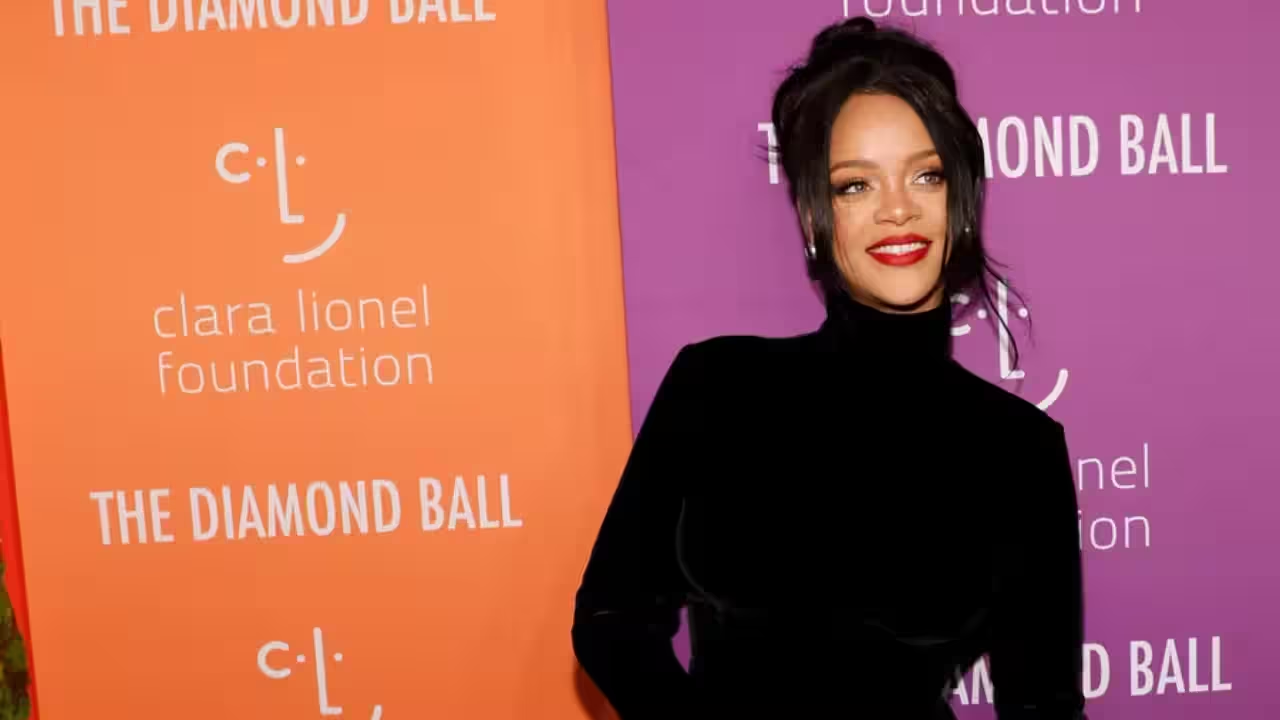
For many people, Rihanna’s public profile is tied to music, fashion and the global reach of Fenty Beauty. Her philanthropic work has developed on a different track. Since 2012, the Clara Lionel Foundation has funded projects spanning health, education, women’s entrepreneurship, culture and climate resilience, with more than $100 million directed towards work in the Caribbean, the United States and East Africa. Some of its climate work has focused on a practical problem familiar across the Caribbean: keeping essential health services operating when hurricanes strike. That approach took shape in 2018, after successive destructive storm seasons, when the foundation began supporting health with stronger infrastructure and solar power systems.Rihanna’s foundation adds solar power to hurricane-ready clinicsThe foundation’s Caribbean health programme grew out of a shift towards preparing medical facilities before disasters happen. Rather than limiting assistance to the aftermath of a hurricane, the work has included improvements intended to help clinics remain functional when electricity supplies, buildings and other infrastructure are damaged, as reported by Clara Lionel Foundation (CLF).Solar power became part of that effort. Health centres can depend heavily on reliable electricity for lighting, refrigeration, communications and medical equipment, making power failures particularly disruptive during severe weather. Supporting renewable energy systems therefore formed part of a broader effort to make clinics more resilient.The initiative began in 2018, after two particularly destructive hurricane seasons in the Caribbean. The work focused on strengthening healthcare infrastructure while giving facilities an alternative source of electricity when conventional power networks were disrupted.What began Rihanna’s philanthropic journeyThe Clara Lionel Foundation was established by Rihanna after the death of her grandmother from complications related to cancer. It was named after her grandparents, Clara and Lionel, and its earliest work was closely connected to healthcare.The foundation’s first major act was to provide the hospital where her grandmother had received treatment with a modern radiotherapy machine. From there, its work expanded considerably. Healthcare remained an important part of its portfolio, but funding also moved into education, arts and culture, women’s economic opportunities and disaster preparedness.Over time, the organisation built a team that included global health specialists and policy professionals. As reported by CLF Annual Report 2022 and Forbes respectively, its work has also brought partnerships with organisations and philanthropists outside Rihanna’s own foundation, including Twitter co-founder Jack Dorsey (#StartSmall) and Jay-Z’s Shawn Carter Foundation.How Rihanna’s foundation is preparing clinics for disastersThe foundation has also provided large-scale assistance when crises have already taken place. According to Associated Press (AP), during the COVID-19 pandemic, it distributed more than $33 million towards emergency response and related efforts.That experience sits alongside the longer-term preparedness work. There is a distinction between replacing what a hurricane has destroyed and making a clinic less vulnerable before the next storm arrives. The Caribbean programme has increasingly reflected the latter approach, with infrastructure upgrades and solar energy intended to give healthcare facilities more capacity to operate during disruption.Melissa revealed the limits of preparing healthcare facilities aloneThe need for that preparation became particularly clear after Hurricane Melissa struck the Caribbean last October. The storm was among the strongest Atlantic hurricanes to make landfall, and Jamaica experienced widespread disruption.The clinics reinforced through the foundation’s earlier programme had not yet extended to Jamaica when Melissa arrived. According to the United Nations in the Caribbean, more than 279,000 people remained displaced five weeks after the storm, while five major hospitals in Jamaica sustained severe damage.The foundation has since launched the Rebuild & Reimagine Fund to support recovery in Jamaica, Haiti and other Caribbean islands affected by Hurricane Melissa. Its focus includes health, water and education. The response also illustrates the limits of preparing individual facilities in isolation. A clinic may have stronger walls or its own solar generation, but patients still depend on functioning hospitals, roads, water systems and other services beyond the facility itself.Rihanna’s philanthropy combines disaster response with long-term climate resilienceRihanna’s philanthropic work now covers two sides of disaster management. The foundation has continued to provide money after major emergencies, while its earlier investments in Caribbean clinics show a longer-term interest in reducing the effects of future storms.The solar-powered clinic model is one example of that approach. It combines an immediate infrastructure need, reliable electricity, with a broader climate adaptation strategy. For health facilities operating in hurricane-prone regions, keeping basic services running can depend as much on preparation carried out months or years beforehand as it does on emergency funding after a storm.The foundation’s work in Jamaica is now adding another layer to that effort, with health, water and education included in its recovery plans. What began with a healthcare-focused response to a family loss has therefore developed into a wider programme covering both emergency assistance and preparation for increasingly disruptive climate events.You use AI every day. Now get your AI Quotient. Take the AIQ test.
Topics in this story
Gathered from external sources. Rights to this text belong to whoever originally published it.