A 12-foot Burmese python revealed Florida’s bizarre new method for finding hidden invasive snakes after it swallowed a collared opossum
US News: Deep in the forests of Florida’s Key Largo, an opossum is being used to find an animal that researchers rarely see coming. Fitted with a small trackin.
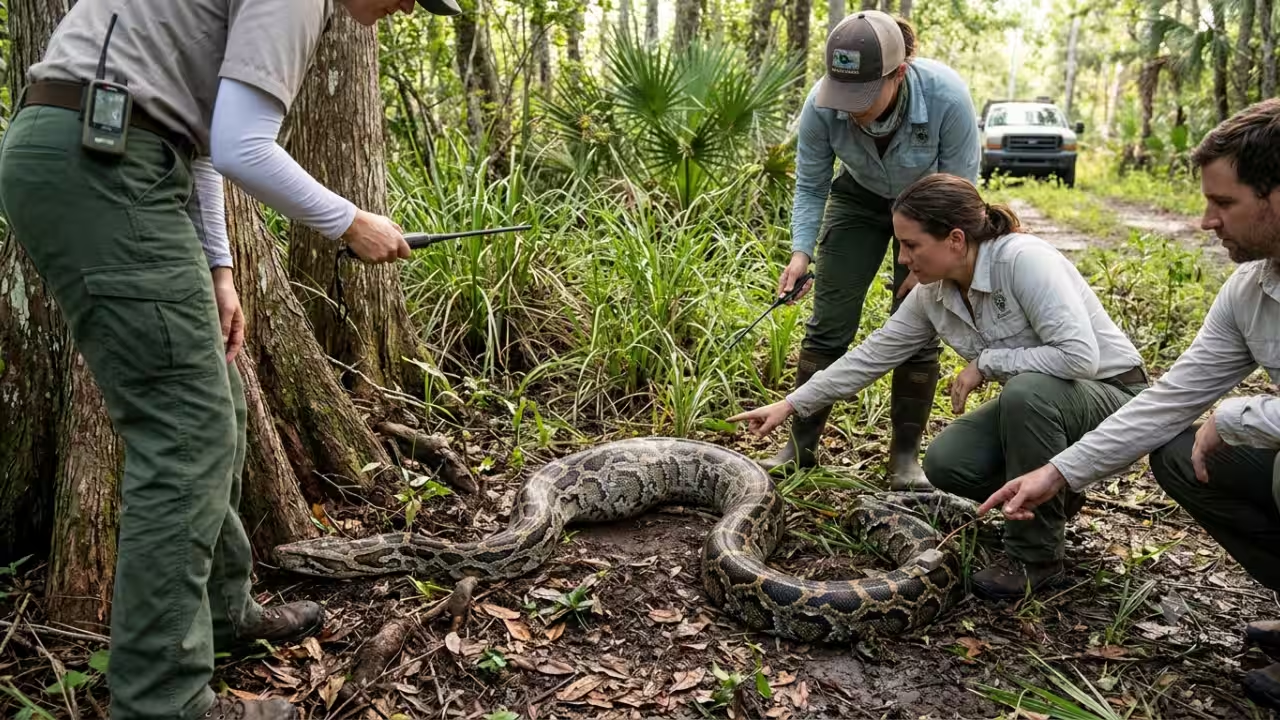
Deep in the forests of Florida’s Key Largo, an opossum is being used to find an animal that researchers rarely see coming. Fitted with a small tracking collar and released back into the wild, the marsupial goes about its normal movements through the undergrowth. The collar is programmed to notice when that movement suddenly stops. If the signal later starts travelling again, it can point scientists towards a Burmese python carrying the device inside its body. The unusual method grew out of a mammal-tracking project rather than a plan to hunt snakes.A strange signal in 2022 led researchers to a large female python that had swallowed a collared opossum, revealing that the transmitter could continue working inside the snake. Since then, the approach has been developed into a practical way of locating some of Florida’s largest invasive pythons, which can be exceptionally difficult to spot in the Everglades.Florida researchers discover a strange new way to track hidden pythonsAs reported by South Florida Sun Sentinel, the idea did not begin as a python-hunting technique. In 2022, Michael Cove, curator of mammals at the North Carolina Museum of Natural Sciences, was studying how raccoons and opossums used Crocodile Lake National Wildlife Refuge. Then one of the collars behaved strangely.A mortality signal indicated that an animal had stopped moving. That might have meant a road accident, an attack by another animal or some other cause of death. But the signal later began travelling again. It stopped, moved, stopped again.That pattern was difficult to explain if the collar was still attached to the opossum. It made much more sense if the animal had been eaten and the collar had remained inside its predator. The likely culprit was a Burmese python.Tracking the signal was not straightforward. Key Largo is built on ancient coral rock, with a landscape containing holes, cavities and places where a large snake can remain concealed. It took about a month before the team located the animal responsible.They eventually recovered a female python measuring about 12 feet long and weighing roughly 66 pounds. It had egg follicles, indicating that it was a reproductive female. The collar was still intact inside the snake and transmitting a signal.How a swallowed collar keeps tracking Florida pythons from insideBurmese pythons have a useful weakness from the perspective of the tracking system: they digest large meals slowly.A collar swallowed with an opossum does not immediately disappear. Instead, it remains inside the python while the snake digests its meal. That gives researchers time to follow the signal.The important sequence is the change in behaviour. A collar first reports that its animal has stopped moving. Later, the signal itself starts appearing in different locations. For biologists, that combination can indicate that the opossum has been eaten and that the predator carrying the collar has moved.The team began developing the accidental discovery into a more deliberate method. Grant support from the South Florida Water Management District helped turn the experiment into a larger field operation, while Southern Illinois University graduate researcher A.J. Sanjar became involved in working out how the technique could be used more effectively.According to the Washington Times, the equipment also became cheaper. Early collars could cost around $1,500. Later versions were available for about $190, making it much easier to consider fitting larger numbers of animals.Why Florida researchers release collared opossums where pythons are huntingThe opossums are deliberately fitted with collars because they are potential prey for Burmese pythons. After being captured, however, they are returned to the same habitat rather than moved somewhere unfamiliar.That distinction matters to the researchers because the animals would still be exposed to predators, vehicles and other hazards in the wild. The collar allows the team to learn what happens when one disappears.According to CBS12 News, Jeremy Dixon, manager of the wildlife refuge, has defended the approach by pointing out that the danger faced by the opossums already exists. The research is intended to reveal when one has been taken by a python and use that event to locate the snake.Still, the method raises an obvious question: does fitting an animal with tracking equipment and releasing it as a potential meal amount to deliberately putting it in danger? There is no simple way around that question. The project depends on a predator eating the very animal carrying the device.How collared opossums lead Florida researchers to large Burmese pythonsThe choice of opossums has another advantage. A large Burmese python can swallow a surprisingly substantial meal, while a smaller snake cannot. A collared opossum therefore works, in effect, as a size filter. The system is more likely to lead researchers towards a python capable of consuming it.That is useful because large females are particularly important targets. Burmese pythons can produce large numbers of eggs, so removing a mature female can prevent a substantial number of young snakes from entering the population.By April 2026, the project had been credited with helping locate and remove 18 Burmese pythons. Every one was more than eight feet long, with the largest measuring around 13 feet.Dixon said, “These are all reproductively viable pythons.”At that stage, 32 opossums had been fitted with collars, with the team aiming to increase that number to at least 40 during the summer.One python apparently provided an especially clear demonstration of how the system could work. A 12-foot snake was found to have swallowed two collared opossums, producing two separate mortality signals from essentially the same location.Florida has tried dogs, drones and scout snakes to find hidden pythonsThe opossum system sits within a much larger effort to locate Burmese pythons, which have become firmly established across southern Florida.Finding them is difficult because the snakes are well camouflaged and can remain out of sight for long periods. Researchers and wildlife managers have consequently tried several different approaches, including detector dogs, drones, thermal imaging and specially trained male pythons that can act as scouts. There have even been attempts involving robotic prey.The difficulty is partly a matter of scale. The Everglades contains vast stretches of wetland, forest and difficult terrain, much of it unsuitable for people searching on foot. A python does not need to move far or make much noise to avoid being detected.That makes an animal which naturally travels through the same habitat an intriguing tracking device.Florida’s unusual python tracker does not always lead to a snakeThe method is far from foolproof. In one case, a collar produced the expected mortality signal before beginning to move again. Researchers followed it, expecting to find a python. Instead, they encountered fresh snake faeces and the collar.The python had apparently swallowed the opossum, retained the collar long enough for it to transmit and then passed the device. By the time researchers arrived, the snake had gone.There have also been collars that simply disappeared. At one stage, three of 43 deployed collars were confirmed to have been eaten, while six could no longer be located. So the signal does not always end with a captured python. Sometimes it becomes a trail that goes cold.How Florida researchers adapted their collars to track hidden pythonsThe equipment has also changed as the researchers learned what information they actually needed.The early approach relied on GPS movement data. But once the basic trick was understood, detailed movement histories were less important. The key requirement was knowing where the collar was when researchers needed to find it.By 2026, the project had moved towards simpler VHF transmitters rather than full GPS tracking. Their batteries could last close to two years, reducing the amount of maintenance required in the field.The collar does not need to tell researchers everywhere a snake has travelled. It only needs to remain inside the snake long enough to point towards it.Why Florida’s Burmese pythons are a growing concern for native wildlifeThe research published in PNAS, titled ‘Severe mammal declines coincide with proliferation of invasive Burmese pythons in Everglades National Park’ revealed that Burmese pythons have had particularly severe effects on native mammals in the Everglades. A long-running road survey published in 2012 recorded dramatic declines in sightings of several species inside Everglades National Park, including raccoons, opossums and bobcats. Opossum observations fell by 98.9% in the survey, while raccoon sightings declined by 99.3%.Those figures should not be read as a statewide population census. They came from a specific road survey within the national park. Even so, the scale of the recorded change illustrates the ecological pressure associated with the spread of the snakes.The US Geological Survey has also documented substantial impacts from invasive pythons on native wildlife in south Florida.Against that background, the collared-opossum experiment is less about finding a clever gadget and more about solving a basic problem: how do you locate an animal that is exceptionally good at remaining unseen?For the researchers, the answer has turned out to involve another animal moving through the same landscape. An opossum walks into the forest with a transmitter around its neck. Somewhere out there, a python may be watching.Catch the latest World News and Live updates. Download the TOI app.
Topics in this story
Gathered from external sources. Rights to this text belong to whoever originally published it.