Thalidomide survivor given two minutes to live takes to the skies
Teresa Smith, 65, hopes to raise £5,000 for the neonatal unit at Liverpool Women's University Hospital.
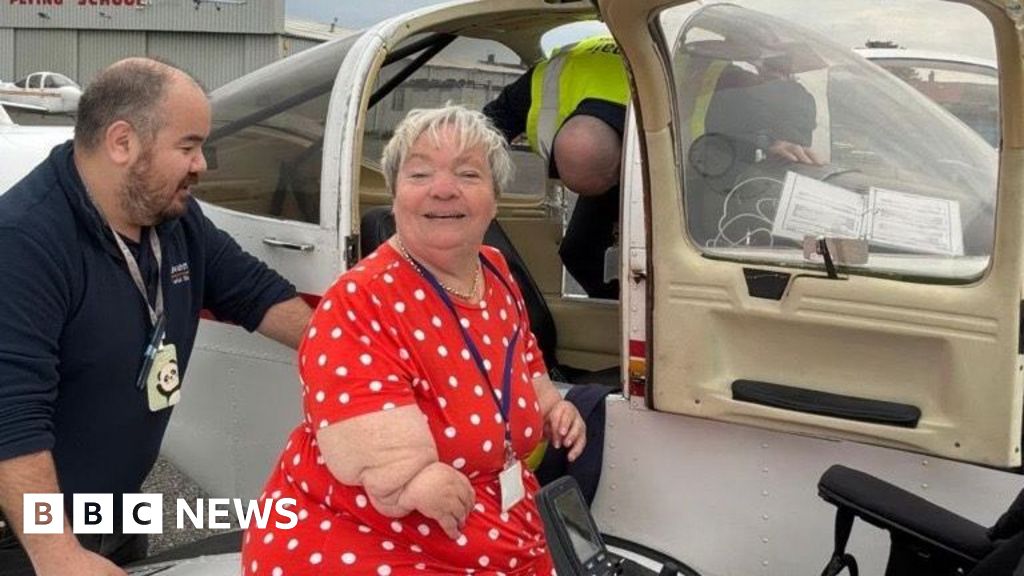
When Teresa Smith was born nearly 66 years ago at just 28 weeks, with no legs and short arms, it was feared she would only live for a couple of minutes.
Having been delivered at her parents' home in Walton, Merseyside, on 12 October 1960, Teresa was immediately rushed to hospital by a midwife, transported in the warm pocket of her father's overcoat.
A survivor of Thalidomide - one of the world's biggest drug scandals - Teresa spent much of her first two-and-a-half years receiving lifesaving treatment at Alder Hey hospital.
Sixty-five years later, the retired social worker is poised to pilot a charity flight to raise money for today's generation of premature babies.
"My family was told that I might have only two minutes to live," she explained. "Against the odds, I survived and have been fortunate to lead a full and meaningful life."
While pregnant, Teresa's mum was prescribed Thalidomide for back pain.
"The drug was given out in the early 1960s for morning sickness," Teresa explained.
"But it was classed as the wonder drug of the world - and it was just given for everything."
First developed by a German scientist Chemie Grunenthal in 1954 thalidomide was marketed as a sedative and treatment for morning sickness in the late 1950s and early 1960s
It was prescribed in the UK under the brand name Distaval between 1958 and 1961
According to The Thalidomide Trust, the drug created a range of disabilities in babies including shortening and absence of limbs, malformation of hands and fingers, damage to ears and eyes, sensory impairment, facial disfigurement/palsy, and damage to the brain, internal organs and skeletal structure
Thalidomide also caused women to miscarry, with some affected babies dying soon after birth - making it harder to determine how many were affected by the drug
The Thalidomide Trust estimates 100,000 babies were affected worldwide
Teresa said that while her parents had been aware that Thalidomide had caused her physical issues, they received little help when she was a toddler.
"My parents got no support whatsoever," she said.
"They couldn't even get anyone to help me to get in and out of the bathroom when my mum had a hysterectomy."
Teresa said her parents had been very supportive throughout her childhood.
"Growing up was very isolating," she said. "But I did have good family and good friends.
"My parents were very strong, and always supported and encouraged me to be as independent as possible."
She met other Thalidomide survivors when attending a special educational needs school in Merseyside.
"Thalidomide was one of the biggest drug scandals in the whole world, but we did have a rather a large population in Liverpool," she said.
Teresa said she was not granted an academic education until a headmistress at a local junior school took her on, along with 11 other children with disabilities.
"I was a talented young girl and I wasn't given any education for a long time," she explained.
"My education was done very much the hard way.
"My friend used to get my books down from John Moores library.
"Now we have got more accessibility, and disabled people have got more access to technology.
In December 2009, Thalidomide survivors in the UK were given a grant of £20m by the government, to be distributed through the Thalidomide Trust.
A public apology by the government followed in January 2010 - with the then-Health Minister Mike O'Brien, in a statement to MPs, expressing his "deep sympathy"
But Teresa described it as an "appalling apology really - so I have not really recognised that".
Teresa, who went on to be a social worker helping children with disabilities, said she thinks more needs to be done to recognise Thalidomide survivors - as well as to improve care for disabled people in general.
"We went through a lot of pain and anguish, and I think we're very unique people," she said.
"We need to have a memorial to honour these parents and the children that didn't survive.
"I feel very strongly about this because I have been very blessed with my life.
"I feel that one of the reasons why I have survived is to be able to challenge these issues."
Teresa is undertaking a charity challenge to help others in the region who, like her, have been born prematurely.
Later, she will embark on only her second flight. Setting off from near to Liverpool John Lennon Airport, she will pilot a small plane, flying over Liverpool Women's University Hospital, to raise money for neonatal equipment.
"I can't climb a mountain or scale a wall, so I thought I would do something a bit different," she said.
Teresa will take the 40-minute flight over Liverpool in an adapted plane.
"I am taking to the skies for two babies who are close relatives of mine - including one who was born at only 28 weeks," she said.
"The vulnerability of newborn babies is a very personal part of my own story.
"Their experiences made me want to do something practical to support premature and newborn babies - as well as the wonderful staff who care for them."
While she is nervous ahead of the challenge, Teresa said she was reassured by the presence of a co-pilot in the cockpit.
"It is really going to take quite a bit of courage for me," she admitted.
"I hope we can make an important difference to the care babies receive at Liverpool Women's Hospital."
A Department of Health and Social Care spokesperson said: "We recognise the devastating and enduring impact of thalidomide.
"Our thoughts remain with all those affected, including those who lost their lives and the families who continue to live with that loss.
"This government is committed to meeting the health needs of Thalidomiders, ensuring that they can live with the dignity they deserve, and access the care and support that is right for them, including via the Thalidomide Health Grant which provides vital support to help meet the present and future health and wellbeing needs of Thalidomiders living in England."
Listen to the best of BBC Radio Merseyside on Sounds and follow BBC Merseyside on Facebook , X , and Instagram . You can also send story ideas via Whatsapp to 0808 100 2230.
The Thalidomide Trust: About Thalidomide
Liverpool Women's University Hospital Charity
Editor who exposed Thalidomide impact dies aged 92
Mum's skydive fundraiser for daughter's lifesavers
Topics in this story
Gathered from external sources. Rights to this text belong to whoever originally published it.