Brazil restored river forests using three seeding methods and planted seedlings; 15 years later, row-seeding stored 155 tonnes of biomass per hectare
Since 2006, researchers working with the Instituto Socioambiental have restored 75 riparian forest sites along a 500km stretch of Mato Grosso, Brazil,
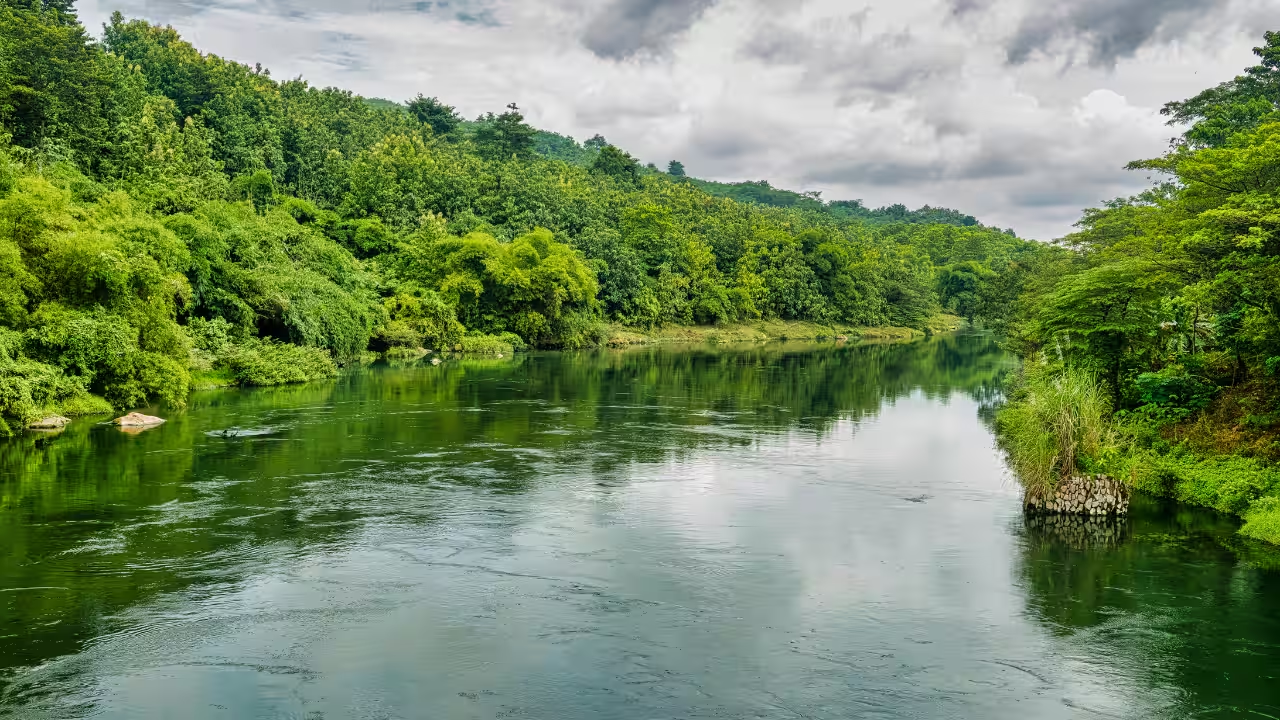
Since 2006, researchers working with the Instituto Socioambiental have restored 75 riparian forest sites along a 500km stretch of Mato Grosso, Brazil, using five different approaches, three direct seeding techniques (broadcast, hole and row), seedling planting, and natural regeneration. Fifteen years on, a study published in the Journal of Environmental Management found the results were far from equal. Row-seeding, in particular, pulled dramatically ahead of every other method for storing carbon above ground. Here's how a simple choice in planting technique ended up making such an outsized difference.A 15-year experiment across 75 riparian forests in BrazilThe study ‘Carbon stocks in riparian forests in the Amazonia-Cerrado transition over 15 years: Effects of restoration methods and edaphoclimatic factors’ tracked 75 sites in the Amazonia-Cerrado transition zone, all previously cleared for cattle pasture, sampling each one in 2017 and again in 2022 as part of a continuous 15-year chronosequence. Sites were restored using broadcast-seeding (45 sites), hole-seeding (11), row-seeding (10), seedling planting (4) or natural regeneration (5). By the 15-year mark, row-seeding had produced a mean aboveground biomass of 155.2 tonnes per hectare, roughly double that of broadcast-seeding (80.6 tonnes) and hole-seeding (73.8 tonnes), and well ahead of seedling planting (67.8 tonnes) and even natural regeneration (97.1 tonnes).Why row-seeding grew bigger trees than broadcasting or holesThe researchers traced row-seeding's advantage to the mechanical precision of the grain drills used to plant it, which buried seeds at a depth well suited to certain long-lived pioneer species. Chief among them was Enterolobium timbouva, an oval-seeded tree with substantial energy reserves that can emerge from deeper soil, protected from predators and drying out, and which came to dominate row-seeded sites older than a decade. By contrast, broadcast-seeding favoured Tachigali vulgaris, a small-seeded species that thrives near the surface but tends to die off within 10 to 20 years, helping explain why broadcast sites' biomass growth slowed over time as that transitory species was replaced.The hidden divide; carbon in trees vs carbon in soilWhile the trees above ground told a clear story of technique mattering enormously, the carbon stored in the soil beneath told a completely different one. Soil organic carbon stocks, ranging from 11.4 to 73.5 tonnes per hectare across all sites, showed no meaningful link to a site's age or its restoration method at all. Instead, soil carbon was shaped almost entirely by local conditions such as cation exchange capacity, base saturation and moisture, meaning restoration choices that dramatically boost trees overhead may do little to change what's stored underground, a decoupling the researchers say reflects patterns seen elsewhere in tropical forest research.Row-seeding's cost advantage for carbon-focused restorationBeyond its ecological edge, row-seeding also came out ahead financially. It cost roughly $2,442 per hectare to implement, similar to broadcast-seeding (2,451) and was cheaper than hole-seeding ($3,246), yet its far greater carbon capture meant it worked out to just $7.91 per tonne of CO2 sequestered over 15 years, compared with $15.30 for broadcast and $22.10 for hole-seeding. That makes row-seeding not just the most effective of the three direct-seeding techniques studied, but also one of the more cost-effective restoration strategies documented anywhere in the tropics, well below the roughly $29 per tonne reported for mixed-species tree plantings elsewhere in Brazil.You use AI every day. Now get your AI Quotient. Take the AIQ test.
Topics in this story
- Row-seeding forest restoration Brazil
- riparian forest carbon storage
- Instituto Socioambiental restoration study
- Amazonia-Cerrado transition reforestation
- direct seeding vs seedling planting
- carbon sequestration cost per tonne
- Mato Grosso forest restoration
- Enterolobium timbouva pioneer species
- tropical reforestation carbon stocks
- cost-effective forest restoration technique
Gathered from external sources. Rights to this text belong to whoever originally published it.