In 2021, Malaysian police steamrolled 1,069 Bitcoin-mining machines worth about $1.25 million; the machines were allegedly linked to stolen electricity
Rest of World News: In a bid to tackle electricity theft linked to illegal Bitcoin mining, Malaysian police destroyed 1,069 mining machines worth $1.25 million, sending a stern warning against power theft and its consequences.
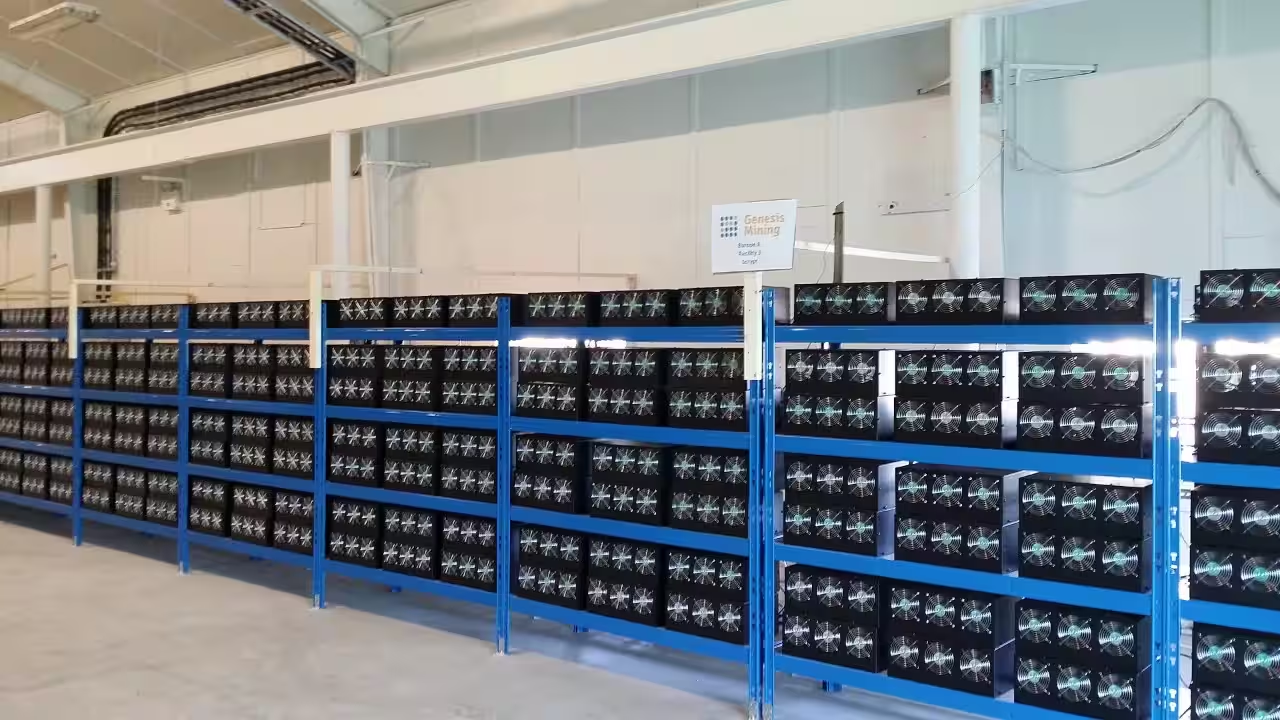
In July 2021, 1,069 confiscated bitcoin mining units, worth a total of 5.3 million ringgit ($1.25 million), were lined up in the parking lot of a police station in Miri and crushed one by one with steamrollers, the culmination of several joint raids that police in Miri, Sarawak, and Sarawak Energy Berhad had carried out between February and April 2021, according to Bernama and The Star. Police said evidence gathered from miners who had illegally tapped SEB's power lines showed losses of 8.4 million ringgit (about $2 million). As a result, eight people were detained, and six of them were charged with electricity theft under Section 379 of Malaysia's Penal Code, drawing sentences of up to eight months in jail and fines of up to 8,000 ringgit (about $1,900), The Star reported. The Electricity Supply Act 1990 allows for stiffer penalties under Section 37(1), which some reports put at up to 1 million ringgit in fines and 10 years in prison for tampering with installations in a way that endangers life or property, while other accounts and the government's own published version of the Act cite a lower ceiling of 100,000 ringgit and five years. Across Malaysia and in several other countries, cheap or free electricity can make illegal mining more attractive for people looking to cash in on crypto without paying for the power it takes to run.The raid destroyed machines worth roughly $1.25 millionThe 1,069 rigs were seized in six raids carried out between February and April 2021 in Borneo, in a joint operation by the Miri police and SEB, the state utility company, which valued the equipment at 5.3 million ringgit, or roughly $1.25 million at the exchange rate at the time, and put its own loss from the theft at 8.4 million ringgit. Rather than letting the hardware return to use, as happened in China earlier that year, Malaysia decided to destroy it. Assistant Commissioner Hakemal Hawari, the leading police officer handling the case in Miri, stated that this was done following an intelligence report regarding miners connecting to SEB's power grid.Electricity theft was valued at close to $2 millionThe SEB estimated that they had been robbed of 8.4 million ringgit, which is about $2 million based on 2021 exchange rates. A total of eight people were arrested in relation to the theft of electricity to mine bitcoins, and six of them faced charges in court under Section 379 of Malaysia's Penal Code, with fines of up to 8,000 ringgit (about $1,900). Hawari further associated the electricity theft with three house fires in the area, and also stated that overloaded, unauthorised wiring could cause power outages and endanger lives. Section 37(1) of the Electricity Supply Act 1990 is also cited by some reports as carrying penalties of up to 1 million ringgit in fines and 10 years' imprisonment for tampering with installations in a way that endangers life or property, though other reports and the government's own published version of the Act put the maximum at 100,000 ringgit and five years.Why mining machines draw so much power in the first placeBitcoin mining is an energy-intensive process, requiring nonstop calculations to verify transactions and generate new coins, and the more computing power the network throws at the problem, the harder those calculations become. In an August 2023 report titled "Bitcoin electricity consumption: an improved assessment," Alexander Neumueller, research lead at the Cambridge Centre for Alternative Finance, revised the group's 2022 estimate of the network's annual electricity use down from 105.3 terawatt hours to 95.5 terawatt hours, after finding that outdated assumptions about the efficiency of ASIC mining hardware had overstated demand.A 2022 paper in the journal Energy & Environment, by researchers Dindar and Gül, looked specifically at how utilities can identify mining farms that are stealing power. As mentioned by the authors, the primary evidence lies in the electricity signature and not in the usage of power. In their experiments conducted on the neutral line of the power grid, they found specific harmonics generated by mining data centers, which indicate that the power companies may identify illicit farms through monitoring the quality of electricity data.Malaysia's crackdown fits a wider regional patternMalay Mail reported in March 2021 that Melaka police were hunting a bitcoin miner accused of causing about 9 million ringgit ($2.2 million) in losses to the utility company Tenaga Nasional Berhad (TNB). Three months later, China's province of Sichuan took measures to shut down its mining activities due to environmental reasons, leading the miners to move to less restrictive locations. In Malaysia, destroying the devices rather than reselling them appears intended as a warning to would-be miners elsewhere: Miri's police chief said that, for now, there are no other active mining operations left in the area. Together, the Cambridge and Energy & Environment research point to the same underlying vulnerability: wherever electricity is cheap to steal and oversight is thin, mining's power costs make theft profitable enough to keep tempting operators. While the steamroller in Miri made for a striking image, the more effective fix, the detection research suggests, is stopping the theft right at the meter.Catch the latest World News and Live updates. Download the TOI app.
Topics in this story
Gathered from external sources. Rights to this text belong to whoever originally published it.