Min Zin’s freedom must be first on the Trump-Xi summit agenda
Former Senate staffer Ellen Bork urged President Trump to demand the release of wrongfully detained Americans Min Zin and Youlin Chen during his summit with Chinese leader Xi Jinping.
As the summit meeting between President Trump and China’s General Secretary Xi Jinping gets under way today, the first item on the agenda must be freedom for Min Zin, an American expert on Myanmar, who has been detained in China since June 3.
Min Zin, 53, was already in China, if only barely, when he was arrested at the Kunming airport upon his arrival to participate an academic workshop. The Chinese government announced it was investigating him for “endangering national security.”
The charge is absurd and raises questions about why Beijing moved against him after he had previously visited China without incident.
Certainly, Zin has the kind of background autocratic regimes dislike. As a teenager, he participated in Burma’s pro-democracy protests of 1988. Although violently crushed by the military, the protests brought Burma’s democracy movement to international prominence and to the forefront of American policy toward the country. (Myanmar is the official name for the country although Burma, the anglicized version, remains widely used.)
Zin’s career has been in research and academia. After arriving in the U.S. he married, became a U.S. citizen and pursued a Ph.D. at the University of California-Berkeley.
Like many other exiles, Zin returned to Burma when limits on the media, political activity and education were eased in 2011. He founded the Institute for Strategy and Policy-Myanmar , one of the country’s first independent think tanks in 2016. However, when a military coup overthrew the elected government in 2021, Zin and the institute relocated to Thailand.
In January, I met Zin at his office in northern Thailand. I found him thoughtful, intellectual and entirely focused on policy solutions to Burma’s many problems. That requires attention to Beijing’s growing influence in Burma which it borders. His institute has documented the role Chinese transnational criminal organizations and state-affiliated actors play in Burma’s multibillion-dollar scam centers and China’s appetite for its rare earth minerals.
Since the military unseated the elected government, Myanmar has seen an unprecedented level of armed conflict pitting multiple ethnic and pro-democracy forces against the regime. The conflict threatens China’s interests there, especially the deep-water port it is building at Kyaukphyu on Burma’s southwest coast. Kyaukphyu gives Beijing access to the Indian Ocean and could reduce China’s dependence on the Strait of Malacca upon which Beijing currently relies for 80 percent of its oil .
Recent gains by Burmese rebels in the area around Kyaukphyu may have led Beijing to seek to ingratiate itself with Myanmar’s government. Daniel Swift, a former U.S. diplomat in Myanmar, speculates that Beijing arrested Zin as an “ offering ” to Burma’s junta — “a public demonstration of loyalty” just before the visit to China of Min Aung Hlaing, the former general running Burma’s military-backed government later that month. In fact, Beijing announced Min Zin’s arrest and Min Aung Hlaing’s visit on the same day.
But if arresting an American citizen helps Beijing manage its relations with Myanmar, it should immeasurably complicate relations with the Trump administration. American academics and tourists alike must now reconsider their plans to visit China. They must also be aware that Beijing reaches across borders to harass and forcibly repatriate its critics in other countries where it cultivates influence.
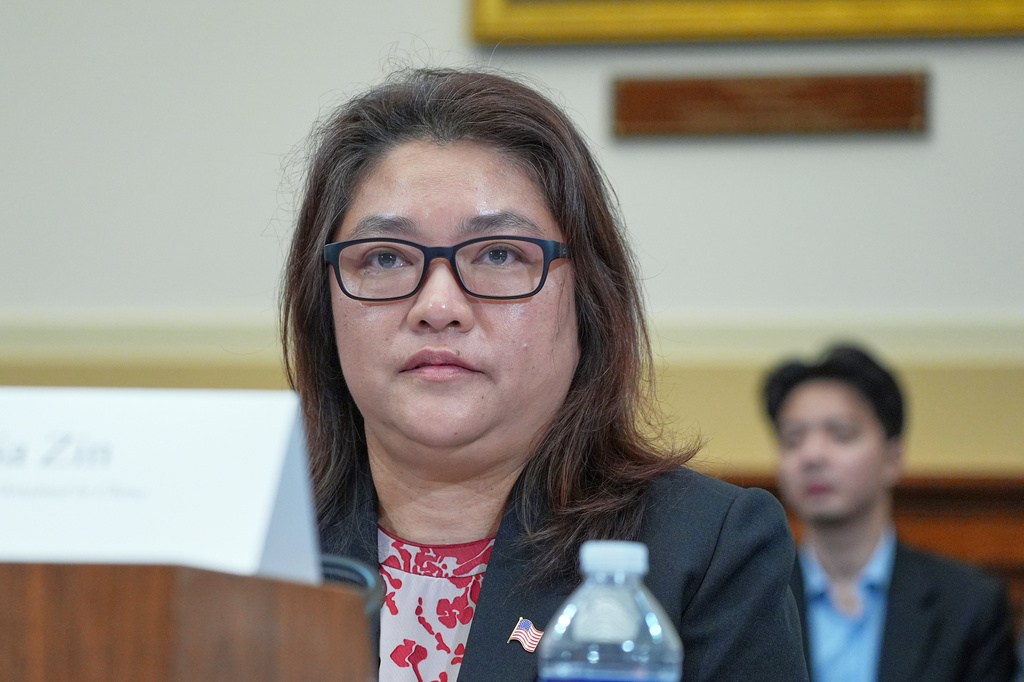
China’s political system and repression consistently earn a “not free” rating from Freedom House , which cites the Chinese Communist Party’s domination of the judicial system and the absence of due process in criminal proceedings. Zin’s wife, Sylvia Zin, gave a harrowing account of her husband’s detention to a subcommittee of the House Foreign Affairs Committee on Sept. 16. He has undergone lengthy interrogations, confinement in a small cell lit 24 hours a day and interruption of his Buddhist meditation. He has not been allowed access to a lawyer.
The U.S. State Department has designated both Min Zin and Youlin Chen , an American seismologist held by China since 2024, “wrongfully detained” a status which raises the priority on their cases and commits resources to help them and their families. China mocked that finding with its foreign ministry spokesman claiming, “China is a country governed by the rule of law, and there is no such thing as so-called wrongful detention.”
Only consequences for detaining American citizens will lead China to free Min Zin and Chen. Trump should inform Xi of these when they sit down to talk and insist that the men be sent on their way home before Xi’s plane takes off from the U.S.
Ellen Bork is a former senior staff member for Asia on the Senate Foreign Relations Committee. She has written extensively about American policy in support of democracy and human rights in China.
Topics in this story
Gathered from external sources. Rights to this text belong to whoever originally published it.