In 2009, a British filmmaker left home to visit 201 countries without a flight; four years later, he had reached them by road, rail and sea
Explore the incredible journey of Graham Hughes, a British filmmaker who traveled to every country in the world using only public transport, raising funds for WaterAid and creating a unique travel narrative.
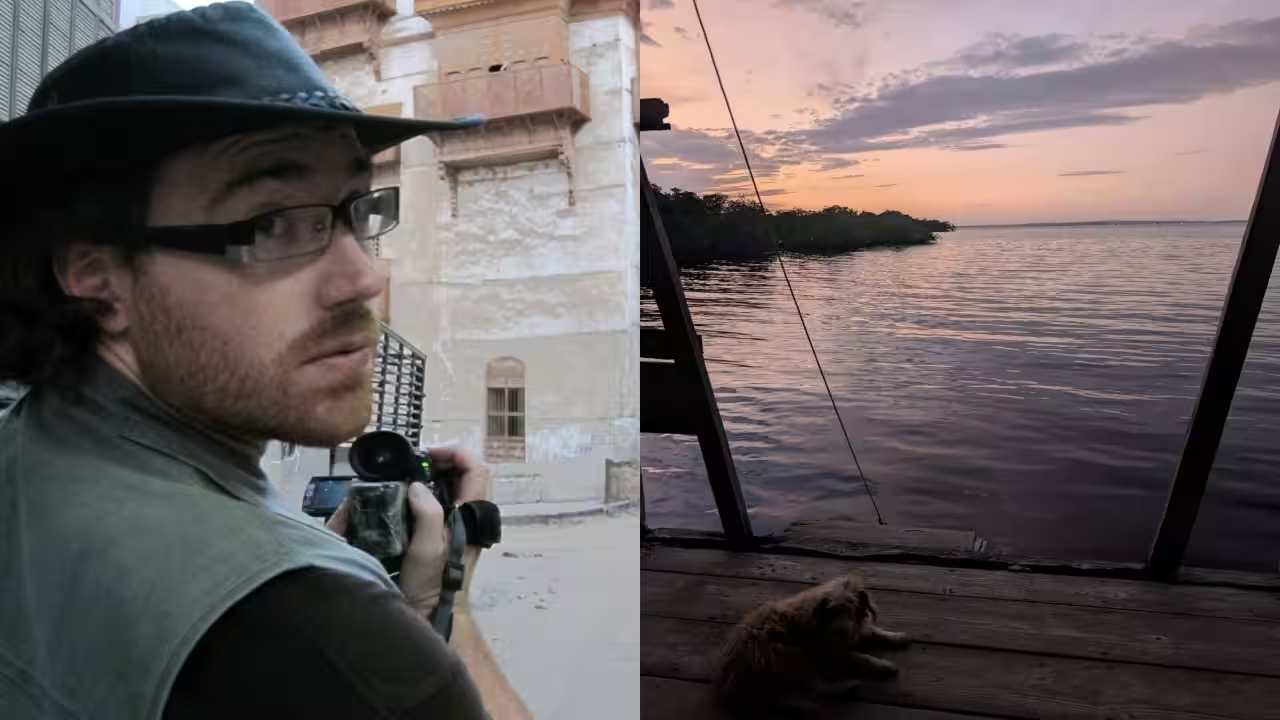
Since a plane can reach almost any capital city in a day or two, the idea of travelling to every country in the world has become almost commonplace for anyone with the means and time. When that option is eliminated, however, the same objective becomes something far more like an expedition than a checklist, complete with malfunctioning buses, cargo ships that sail according to no set schedule, and borders that occasionally refuse to let a passenger pass.Liverpool filmmaker and adventurer Graham Hughes had exactly such a restriction in mind when he set off on 1 January 2009, crossing from Argentina into Uruguay to start what he named the Odyssey Expedition. Hughes, who only travelled by bus, train, taxi, cargo ship and foot, and who would not hitchhike, drive himself or board a single airline, arrived in his 201st and last country, South Sudan, on November 26, 2012, finishing the voyage in four years and 31 days. His achievement was later confirmed by Guinness World Records as the fastest time to visit every country utilising just public surface transit.Crossing seas without ever flyingThe biggest issue was reaching island nations and those separated by open water, since scheduled public transit rarely served them and Hughes had to find what passage he could. On one occasion, he sailed four days across open water in a small wooden boat to reach Cape Verde. Elsewhere, he scheduled his movements around infrequent cargo ships that might only visit a remote port once every few weeks or so. His thorough account of the entire journey, country by country, The Odyssey Expedition, says he spent a week in jail in the Democratic Republic of the Congo, was arrested trying to enter Russia and had to run a blockade to get to Cuba.Hughes also recorded and presented a television series on the first 133 countries of his tour, made for Lonely Planet and screened in more than sixty countries by National Geographic and the BBC in eight parts. All of the trip was on a tight budget of around one hundred dollars a week, the money coming mostly from savings, credit and assistance from family and friends, and Hughes was surviving on couchsurfing, cheap hostels and extended stretches of not eating properly so as to keep costs down.A trip with a benevolent purpose attached to itAs well as the record, Hughes also used the journey to raise funds and awareness for WaterAid, an international charity that aims to expand access to clean water, good sanitation and basic hygiene in communities throughout the world. The link was made obvious by how often Hughes found himself reliant on the kindness and basic infrastructure of the countries he passed through, from a surprise meeting with the Prime Minister of Tuvalu to nights spent in villages where he was the only stranger for miles.The subsequent verification of its completion was almost as taxing as the journey itself. The record was officially certified by Guinness World Records in 2014 after more than a year spent examining over a million GPS data points, ten thousand photographs, four hundred hours of video, and every page of Hughes’s passports; in part because Hughes had to return to Russia in January 2013, after the expedition itself had ended, to correct an earlier illegal border crossing there.What the narrative ultimately shows is less about travel bragging rights and more about what becomes possible when plane travel is deliberately excluded. In each of the 201 nations Hughes visited, he was obliged to rely only on scheduled ground and sea transport, which meant direct interaction with ordinary people and unglamorous logistics, a slower and considerably more grounded way of seeing the world than most travelers ever attempted.You use AI every day. Now get your AI Quotient. Take the AIQ test.
Topics in this story
Gathered from external sources. Rights to this text belong to whoever originally published it.