Between 1907 and 1928, a Kansas retiree built a home and garden from concrete, leaving more than 150 sculptures now preserved as the Garden of Eden
Explore the Garden of Eden in Lucas, Kansas, a unique retirement project by Samuel Perry Dinsmoor featuring over 200 concrete sculptures that reflect his populist and religious beliefs. This historic site attracts thousands of visitors annually and showcases grassroots art at its finest.
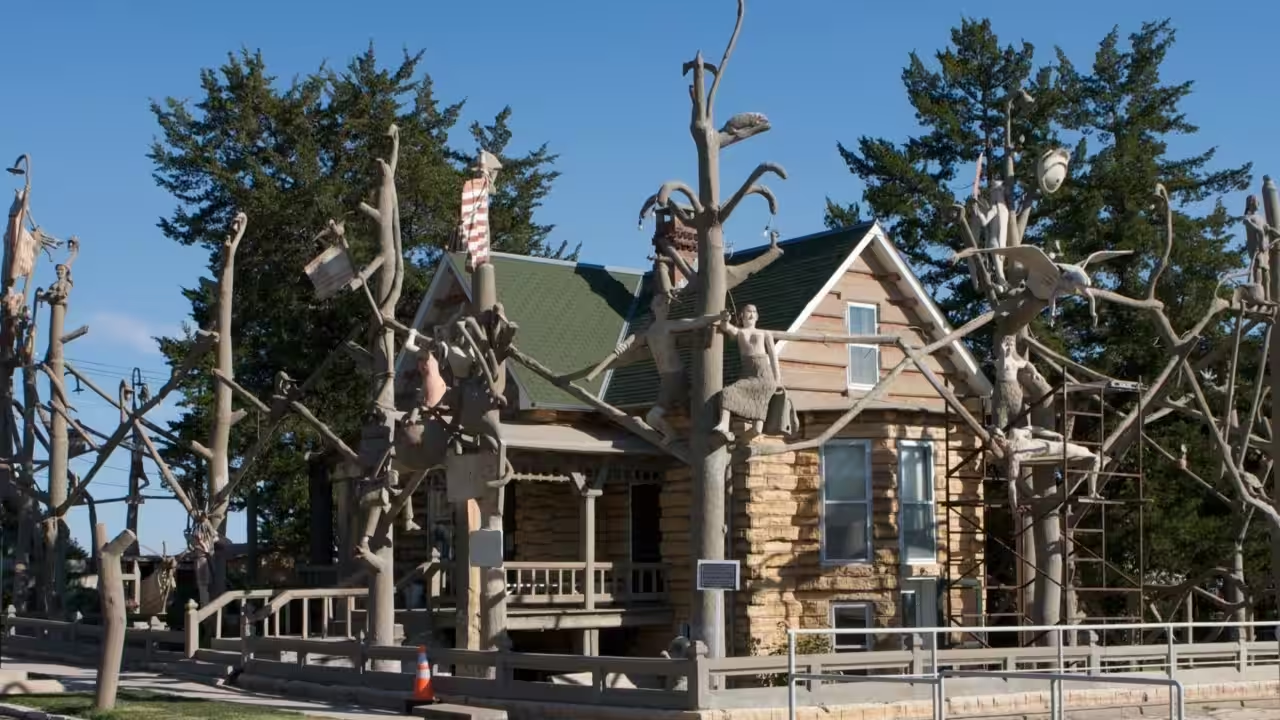
Samuel Perry Dinsmoor was a former teacher and Union Army veteran who, after moving from his farm into the little town of Lucas in central Kansas, chose to spend his retirement building a cabin, a garden and a statement about the world. According to the Kansas Historical Society, Dinsmoor created more than 150 concrete sculptures there, many of which reflect his religious views and Populist politics. The site is listed on the National Register of Historic Places, and he worked on it from 1907 to 1928. It is now called the Garden of Eden and is considered one of the best examples of grassroots art in the United States.A stone log cabinDinsmoor was born in Ohio in 1843, according to the Kansas Historical Society. He enlisted in the Union Army in 1862, served three years and saw 18 major battles, including Gettysburg. He then taught school in Illinois for five terms before turning to farming. In 1888 he moved to Russell County, Kansas, spent a spell in Nebraska and was back in Russell County by 1891. He retired from farming in 1905, moved into Lucas and bought a quarter of a block, and that is where the Garden of Eden began.The showpiece was a stone log cabin that was not made of logs at all. Dinsmoor used local post rock limestone, a stone that got its name because farmers carved it into fence posts on a prairie that lacked timber. The Kohler Foundation describes an eleven-room cabin built from that limestone. Dinsmoor's own description mentions a private light plant under the back porch, and local tradition holds that it was the first cabin in Lucas to have electricity.Concrete with a missionAccording to the Kansas Historical Society, Dinsmoor used 113 tons of cement on the garden, and this is where the story moves from architecture to argument. The Kohler Foundation says his sculptures reflect both his Populist ideas and his religious convictions, and both organisations count roughly 150 pieces.According to the National Register nomination, many of the statues sit on concrete trees, some as high as forty feet. A tableau depicts a doctor, a lawyer, a priest, and a banker crucifying labour. Another has a Goddess of Liberty. Life-size representations of Adam and Eve welcomed tourists, though local politicians soon demanded they wear concrete loincloths. Dinsmoor even rigged a speaking tube so he could address curious passersby through the mouth of an angel. He also had a mausoleum erected for himself on the grounds, and visitors can still see him in a coffin with a glass top. Building the garden was demanding work, and Dinsmoor built it to last, molding each figure over steel and chicken wire.Reclaimed from neglectDinsmoor died in 1932. His wife sold the property to pay her taxes, and the garden went to seed. It sat neglected until it was bought and reopened as an attraction in the late 1960s, and it joined the National Register of Historic Places on April 28, 1977. In 2012, the Kohler Foundation sponsored a substantial renovation. Crews stripped away vines and trees, wiped away years of moss and mould, and revealed the original stained concrete. Some figures were also freed of the concrete loincloths the community had once demanded. The Kohler Foundation says the garden now draws more than 10,000 visitors a year to a community of fewer than 500 people.Its meaning has also broadened. The National Trust for Historic Preservation describes a stone log cabin surrounded by tall concrete sculptures that protest against bank trusts and monopolies. The trust adds that Dinsmoor's populist vision has been at the heart of Lucas since 1909, just two years after he began building.The Garden of Eden is near the corner of Kansas and Second Streets in Lucas, along the Post Rock Scenic Byway. There are guided tours that discuss the tales behind the sculptures, and opening hours vary by season, so it's worth checking the official Garden of Eden website before heading out. Dinsmoor wanted people to stop and look, and more than a century later they still do.You use AI every day. Now get your AI Quotient. Take the AIQ test.
Topics in this story
Gathered from external sources. Rights to this text belong to whoever originally published it.