National Engineers' Day 2026: Meet A. Lalitha, India’s first female engineer who defied a male-dominated profession
News News: Engineering has always been connected with males and has remained a male-dominated segment. Remember that dialogue from 3 Idiots? “Beta hua to enginee.
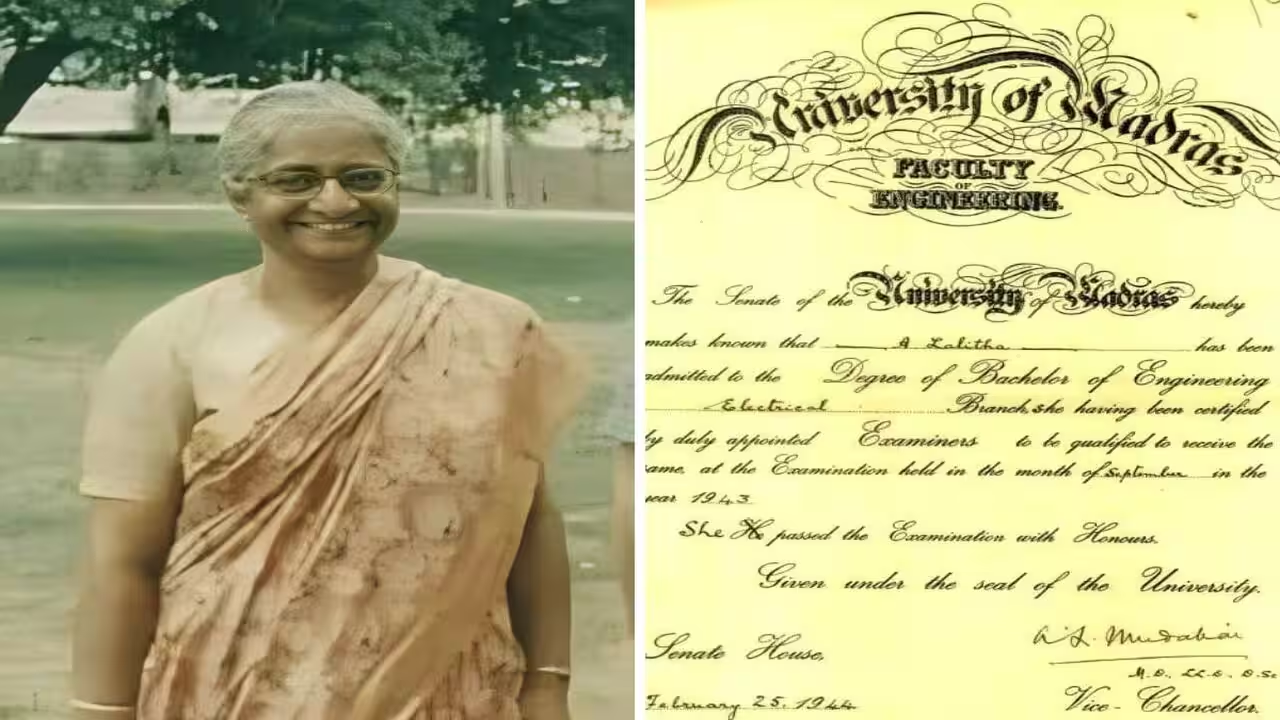
Engineering has always been connected with males and has remained a male-dominated segment. Remember that dialogue from 3 Idiots? “Beta hua to engineer aur beti hui to doctor.” No matter how much we preach about gender equality, deep down, we have all witnessed the ever-existent and deeply rooted patriarchy that our society carries forth. But we are saying this in 2026. And a girl in the 1900s unshackled all the barriers and chose an unconventional path. Ayyalasomayajula Lalitha, born in 1919 in Madras, etched her name as one of the first female engineers of India.As it is well said by some, “We think it to be impossible until it is made possible by someone.” And hence, we always owe these trailblazers a lot. They opened the doors and left the footprints for their predecessors to follow. Lalitha’s journey was not an aisle of roses; it was filled with personal loss, determination, and an unshakable commitment to education. But her story is not merely about being the first woman to earn an engineering degree in India. It is about how she opened a door that had barely existed for women.A young mother who refused to give up on educationA Lalitha was born on August 27, 1919, into a Telugu-speaking family in Madras, now Chennai. She was married at the age of 15 and gave birth to her daughter, Syamala, in 1937.Just four months after her daughter’s birth, Lalitha lost her husband. At an age when her life could easily have been defined by circumstance, Lalitha chose education instead. With the support of her father, Pappu Subba Rao, who was himself a professor at the College of Engineering, Guindy, she completed her secondary education and decided to pursue engineering. At that time, engineering colleges in India were overwhelmingly male-dominated.She entered a college filled with men and etched her name on the leaves of historyLalitha joined the College of Engineering, Guindy, to study electrical engineering. She was the only woman among hundreds of male students.Yet, according to her daughter, the environment at the college was more supportive than one might expect. The administration arranged separate hostel accommodation for Lalitha, while fellow students ensured that she did not feel isolated.Lalitha was not entirely alone in breaking the gender barrier. P.K. Thressia and Leelamma Koshie, née George, were also studying engineering at the institution around the same period.In 1943, Lalitha graduated with a degree in electrical engineering, becoming India’s first woman engineer.Her education did not end with a degree. She undertook a one-year apprenticeship at the Jamalpur Railway Workshop, gaining practical exposure to engineering work in one of the country’s major railway repair and overhaul facilities.From railway workshops to major engineering projectsAfter completing her training, Lalitha worked with the Central Standards Organisation in Shimla. She also assisted her father with research involving smokeless ovens and an electrical musical instrument known as the jelectromonium.She subsequently spent a year in the electrical department of the East Indian Railways before joining the Indian government's Office of the Electrical Commissioner as a technical assistant.In 1948, she took another major step in her career when she joined Associated Electrical Industries (AEI), a British engineering firm in Calcutta.Her work there would place her on one of independent India’s most ambitious infrastructure projects.Lalitha’s work on Bhakra Nangal DamAt AEI, Lalitha worked on the Bhakra Nangal Dam project, one of the country's landmark engineering undertakings.Her responsibilities included designing transmission lines and substation layouts. The work demanded technical expertise at a time when women engineers were still an extreme rarity in India.She remained associated with AEI, which was later taken over by the General Electric Company, for nearly three decades. She retired in 1977 after a long professional career.For Lalitha, engineering was not simply a profession through which she had broken a gender barrier. It became a field in which she built a sustained body of work.She took India’s women engineers to the global stageLalitha's contribution extended beyond her professional assignments.In 1953, the Council of the Institution of Electrical Engineers in London elected her as an associate member. She was later promoted to full membership in 1966.In 1964, she became the only female engineer from India to attend the First International Conference of Women Engineers and Scientists in New York.The following year, she was elected a member of the British Women's Engineering Society.Her international engagement also had a wider purpose. As India's representative on the organising committee for the Second International Conference of Women Engineers and Scientists, held in Cambridge in 1967, Lalitha helped ensure that five Indian women were able to attend the conference.Her achievement, therefore, was not confined to becoming the first. She also worked to make sure that more women could follow.A legacy that began with one woman refusing to step backLalitha never remarried after her husband's death. Her sister-in-law helped raise her daughter, Syamala, who later earned degrees in science and became a mathematics teacher.Lalitha died on October 12, 1979, at the age of 60 after suffering a brain aneurysm. But she left this abode, leaving an indelible mark on the hearts of young generations. Her story inherently carries forth not only a powerful lesson but also an emotion that being first is pivotal, but making the path easier for those who will follow is a greater achievement. Today, on National Engineers' Day, let us remember and pay our tributes to all those ingenous minds who walked with a beacon of light and knocked on the doors that were otherwise closed.Get the latest Education News and Live updates. Download the TOI app.
Topics in this story
Gathered from external sources. Rights to this text belong to whoever originally published it.