How Scott Colom turned his Mississippi Senate race into a nail-biter
Mississippi Sen. Cindy Hyde-Smith (R) is fighting for her political life as Democrat Scott Colom threatens to pull off one of the biggest upsets of the midte...
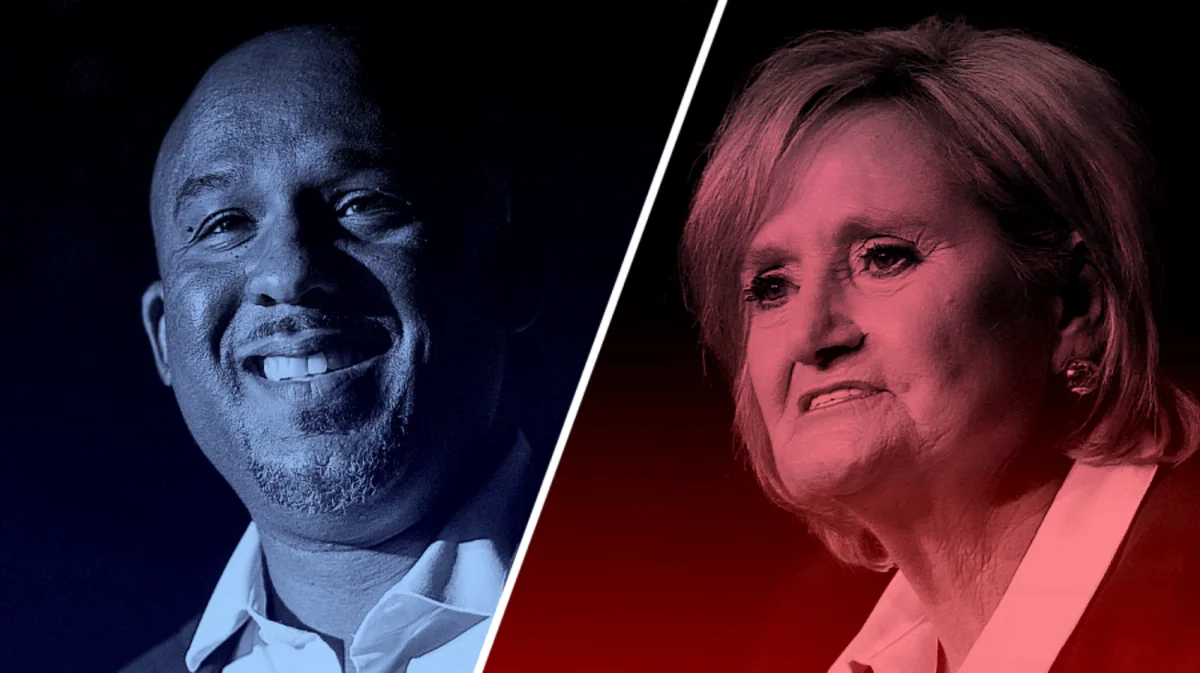
Mississippi Sen. Cindy Hyde-Smith (R) is fighting for her political life as Democrat Scott Colom threatens to pull off one of the biggest upsets of the midterms in a state that hasn't elected a Democratic senator since 1982.
Before polls closed Tuesday, Decision Desk HQ (DDHQ) gave Hyde-Smith a 91 percent chance of winning her race. But by late Friday afternoon, Colom led by 2,734 votes in DDHQ's tally, with thousands of ballots still outstanding.
Some of Colom's biggest gains have come in counties Hyde-Smith won handily six years ago. In the Memphis suburbs, he leads by roughly 6 points in DeSoto County, which she carried by 16 points in 2020. On the Gulf Coast, the incumbent's lead in Harrison County has narrowed from 17 points in 2020 to about 4 points in the latest unofficial count.
Colom has also picked up votes in places where Republicans still led by wide margins. In Pearl River County, Colom drew about 4,000 votes, or 24 percent, in the preliminary count — compared with the 2,400 votes, or 22 percent, that Democratic gubernatorial nominee Brandon Presley got in 2023. Former Vice President Kamala Harris won 16 percent of the vote in 2024.
Colom benefited from a national political environment that favored Democrats, but he also gave voters in Mississippi a local target for their frustration over rising prices by turning Hyde-Smith's suggestion that shoppers choose a cheaper protein into a pitch to "pick another senator."
Organizers worked to turn out Black voters, and preliminary returns show about 10 percent more votes were cast in majority-Black counties than in the 2023 governor's race. The New York Times estimated that 91 percent of Black voters back Colom.
The Times's preliminary estimates show a shift toward Democrats across age, race, gender and education groups compared with 2024. Hyde-Smith still led among white voters by 49 points, but that was 19 points narrower than President Trump's margin with those voters two years earlier.
New Southern Majority, a super PAC launched by the Southern Poverty Law Center's political advocacy arm, saw an opening to reach GOP voters while other organizations focused on turning out Black voters this cycle, according to Brannon Miller, whose consulting firm, Chism Strategies, ran the effort.
He said the group spent just under $1 million on messaging to Republican voters in the race, targeting about 200,000 Republicans with messages that focused almost entirely on criticizing Hyde-Smith over issues including the war in Iran, high gas prices, tariffs and her support for data centers.
Miller suggested that messaging was effective, pointing to Colom's gains in red counties like Pearl River and DeSoto as a sign that some voters who typically back Republicans crossed over this cycle.
"There's literally no other explanation," Miller said. "These are places where Democrats get less than 15 percent of the vote in a presidential year. There are not Democrats there to turn out."
"So when Scott Colom doubles the number of votes that Brandon Presley got in some of these counties, or close to it, that has to be coming from white Republicans flipping and voting for the first Black senator since Reconstruction," he continued.
DeSoto stands out as the county that saw the biggest swing toward Democrats from the 2024 presidential race. Trump carried the fast-growing Memphis suburbs by 24 points in 2024, but Colom is now leading by roughly 6 points, accounting for a 30-point shift over just two years. Colom drew about 28,100 votes in the county, nearly twice as many as Presley received there in 2023.
"In my mind, a big part of the swing is explained by the opposition to data centers," Miller said, pointing to a facility in DeSoto that has drawn significant backlash from locals about persistent noise issues.
DeSoto County Democratic Party Chair Deborah Williams said she also thought the backlash to the data center might have hurt Hyde-Smith's support, but she attributed more of the swing to the work organizers did, knocking on nearly 70,000 doors and working to increase absentee ballots.
She also said she thinks voters weren't excited about Hyde-Smith and that Colom's "Mississippi Matters" message resonated especially with young voters. On Election Day, she said she went from precinct to precinct and was surprised to see just how many young voters were lining up at the polls. She said some were waiting two or three hours in the rain just to get a chance to vote.
"[Mississippi] had been perceived as a deep-red state, but it really wasn't a deep-red state. It was a state where people weren't engaged in this process for a number of different reasons," Williams said. "So yes, I think Scott had a lot to do with bringing that sense of pride back to the state of Mississippi, and people did embrace that."
Arekia Bennett-Scott, executive director of Mississippi Votes, said young people have been organizing in the state for years but the push to redraw Mississippi's congressional districts gave them a particular reason to show up this year.
Bennett-Scott noted that many students saw redistricting as a threat to Black political representation and responded by rallying in Jackson in May and organizing across campuses.
"They understand that voting is a tool, not the only tool, but it's a tool that they can fight back with this particular election cycle," she said, referring to youth turnout.
The Times estimated that voters under 30 in Mississippi backed Colom, 62 percent to 33 percent — a whopping 44-point swing toward Democrats compared with 2024.
But the political organizer emphasized that the higher youth engagement is not about any single candidate or party.
"Young people are fighting towards power, and that speaks to the way that they showed up," Bennett-Scott said, adding, "They know what's at stake, and they align themselves with what and who was speaking the language of justice for them in this moment."
The razor-thin margins in the deep-red Mississippi Senate race took many political observers by surprise, but local organizers note that the state has gotten a lot more competitive in recent years and people are only now paying attention.
"I think that there's a stereotype of the state as being what it was in the 1960s that just no longer holds," Miller said.
"It's not like this is a new Mississippi," he continued. "This is the Mississippi that's been there for at least the past decade. This was just finally when all of the right confluence of circumstances came together to allow us to win."
Topics in this story
Gathered from external sources. Rights to this text belong to whoever originally published it.