A ‘reverse-Ginsberg’ scenario could flip the Supreme Court without packing
In Henry VI, Shakespeare wrote, “Defer no time, delays have dangerous ends.” Many today would like to chisel those words above the doors to the Supreme Court. Time and time again, justices waited too long for their own legacies. For many conservatives, the decisive loss of both houses of Congress has created a true nightmare…
In Henry VI, Shakespeare wrote, “Defer no time, delays have dangerous ends.” Many today would like to chisel those words above the doors to the Supreme Court. Time and time again, justices waited too long for their own legacies.
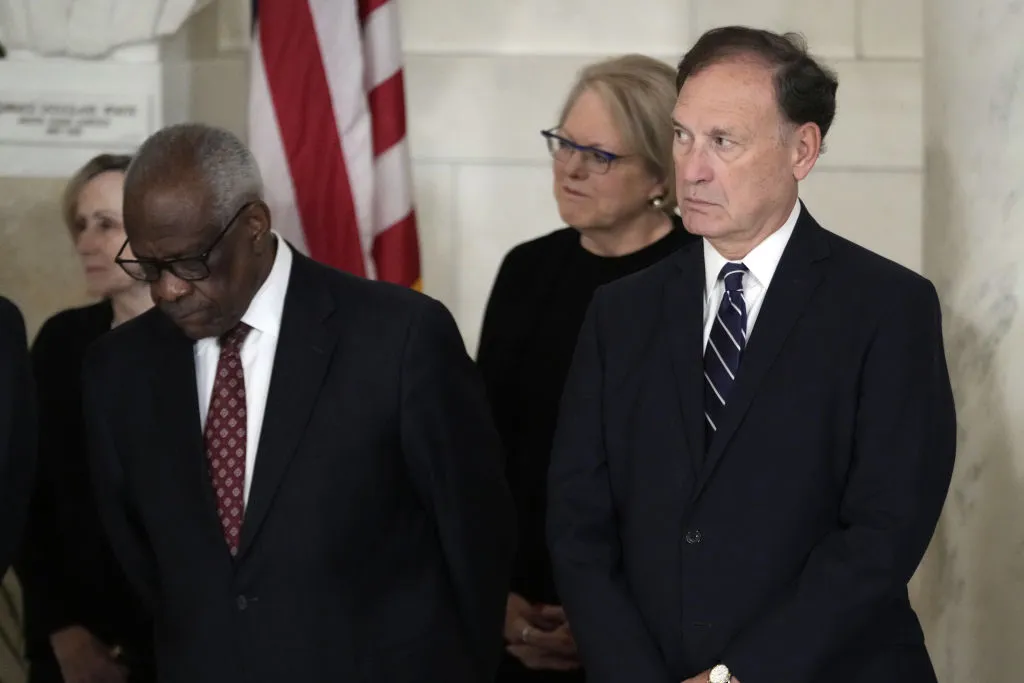
For many conservatives, the decisive loss of both houses of Congress has created a true nightmare scenario in which two conservatives (Justices Clarence Thomas and Samuel Alito) could hand Democrats the opportunity to take control of the Supreme Court without having to carry out their court-packing schemes. Control of the court could now be lost by sheer attrition.
Timing has always been a looming question for justices who want to see their seats filled by like-minded jurists. However, it is difficult to walk away from being one of nine.
Some served beyond their own capabilities in clinging to the court, becoming befuddled and isolated with age. That was the case with iconic justices such as William Douglas and Thurgood Marshall.
Others stayed too long to guarantee the preservation of their own legacies. The most recent example is Ruth Bader Ginsburg. Some of us wrote for years that Ginsburg was risking her legacy by not retiring while Barack Obama was president. After President Trump replaced her with Justice Amy Coney Barrett, many liberals (who were consciously silent before her death) lamented her decision.
Now, conservatives worry they may face a double tap. For two years, there has been speculation that Thomas (78) and Alito (76) might retire to allow a Republican president and Republican Senate to select their successors. Both declined to do so.
If they were hoping for a two-year cushion, that window just closed with a resounding bang. Even if they were to resign in the next two years, it is unlikely that Trump could replace either with a conservative nominee.
With at least 54 Senate seats (and perhaps as many as 56), the Democrats do not fear defections from independent-minded senators like Sen. John Fetterman (D., N.J.). They will also cite the denial of a vote for Merrick Garland during the Obama administration as a justification for denying a vote to Trump nominees.
Even before the election, liberals had raised money to campaign against even prospective nominees for Trump.
Former Vice President Kamala Harris called for Democratic donors to oppose “additional justices” that might be nominated by Trump “before they happen.” She praised the fundraising by Josh Orton, president of the dark-money group “Demand Justice.” It was a notable endorsement, since Demand Justice was infamous for its campaign to get Justice Stephen Breyer to resign, including mobile billboards reading “Breyer, retire. Don’t risk your legacy.” Demand Justice has also pushed a radical agenda, including court-packing .
Of course, Breyer did resign, allowing Biden to replace him with Ketanji Brown Jackson, arguably the farthest-left justice to ever sit on the court.
As soon as the Democrats took control, the Senate Minority Leader (and possible incoming Majority Leader) Sen. Chuck Schumer (D-N.Y.) declared that they would bar “any crappy nominees,” which was taken to mean any Trump nominee.
In fairness to Thomas and Alito, neither is diminished by age. Both have appeared in public and shown they are fully capable and effective. In the cases of Douglass and Marshall, they were eventually pressured to resign after they appeared on television and were clearly enfeebled.
The last two years have seen some of the most important opinions from Thomas and Alito in their careers on the court. Now, however, they could be looking at not two more years but six more years to wait for a Republican president if the midterms foreshadow the 2028 election.
If so, by the time a Republican could succeed such a Democrat, Thomas would be roughly 84 and Alito 82. And the Senate may not even then be ready to confirm like-minded successors.
The risk is tremendous. If their vacancies cause a reverse Ginsburg, the court would shift from a 6-3 majority favoring conservatives to a 5-4 majority favoring liberals.
Worse yet, in the calls to pack the court with a liberal majority, politicians and pundits often point to Biden-appointee Justice Ketanji Brown Jackson as the model. Jackson has been widely criticized for a radical jurisprudence that discards longstanding norms and doctrines, including by her two liberal colleagues.
Such a court would make court packing entirely unnecessary. The signature opinions of Thomas and Alito would likely fall in quick succession, from Thomas’s gun rights decision in Bruen to Alito’s abortion ruling in Dobbs.
Nevertheless, it is much to ask for two jurists to resign when they are both mentally and physically capable, particularly after rendering some of their most influential opinions in the last two years.
Some believe that justices should not engage in strategic resignations to shape the ideology of the Court. These justices, they reason, have a right to serve out their lifetime appointments as long as they can do the job. They can have a clear conscience serving as long as they are able, and leave their replacements to the will of the American people.
In any case, with less than six weeks left with a Republican Senate, the time has effectively run out for the retirement option in holding these seats for conservatives.
The irony is that these two justices can take considerable credit in the building of the conservative jurisprudence that has emerged in recent years on the court. They have shown great patience in building the authority to overturn longstanding cases, from Roe v. Wade to Humphrey’s Executor . That legacy may now rest with their own longevity in the years to come.
Topics in this story
Gathered from external sources. Rights to this text belong to whoever originally published it.