Early voting surges in battleground states as Democrats outpace GOP gains
Early voting is surging in several key battleground states, giving Democrats hope that their strength in midterm polling could translate into a turnout advantage in November. In North Carolina, more than 1.2 million early ballots have been accepted, a 37 percent increase from the same point leading up to the 2022 midterms, according to an…
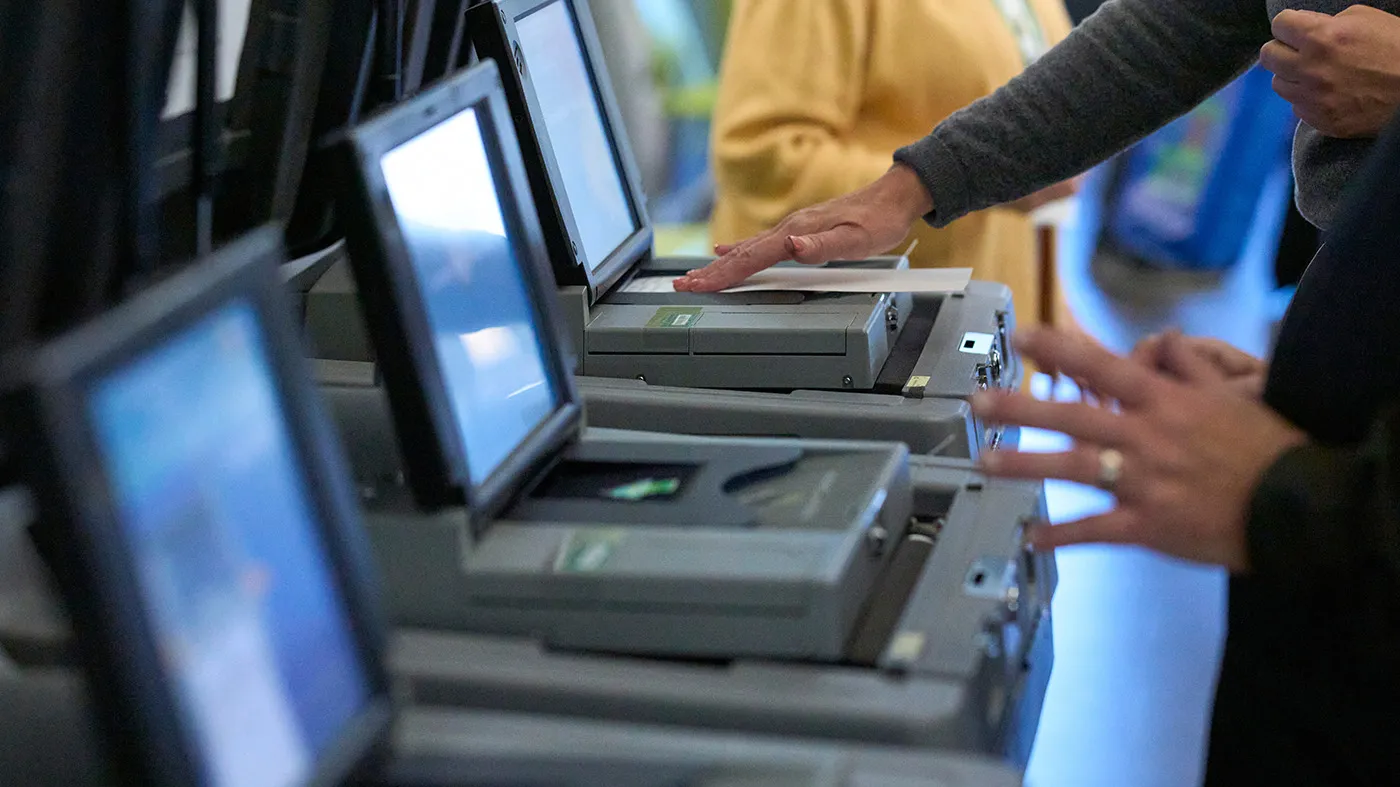
Early voting is surging in several key battleground states, giving Democrats hope that their strength in midterm polling could translate into a turnout advantage in November.
In North Carolina, more than 1.2 million early ballots have been accepted, a 37 percent increase from the same point leading up to the 2022 midterms, according to an analysis released Friday by Catawba College political scientist Michael Bitzer.
That growth — which includes both in-person and mail-in ballots — has been driven by a 47 percent increase among registered Democrats and a 60 percent increase in participation among unaffiliated voters. Early voting among Republicans is up 2.6 percent.
Similar patterns are emerging elsewhere, with high turnout especially pronounced in historically Republican-leaning states with competitive Senate races this cycle.
More than 23 million ballots have been accepted nationwide, compared with more than 15 million reported at a similar point ahead of the 2022 midterms. In Kansas, early voting is up roughly 69 percent, while it’s up 41 percent in Maine and 24 percent in Iowa, according to a New York Times analysis of state election records and voter data through Thursday.
Michael McDonald, a University of Florida political science professor who tracks early voting, said Democrats and unaffiliated voters are similarly outpacing Republicans in turnout gains compared to 2022 across states where he has comparable party registration data — including Kansas, Maine, Iowa and Nebraska.
“It’s the same pattern. Democrats and unaffiliateds are engaged. Republicans are not as engaged,” McDonald told The Hill, adding, “And it explains why you might be seeing this shift of the battleground into these red states. Overall, there’s just more engagement among Democrats.”
McDonald cautioned that there is a range of factors that can affect states’ early voting numbers, including changing timelines for when mail-in ballots are sent out.
There are also limits to what early voting data can reveal. Not all states record party registration, and there’s no guarantee that a voter’s party affiliation will match that of the candidate they choose to support.
But McDonald said the early voting patterns give credence to polls showing Democrats in a strong position heading into Election Day.
“The early voting data is just telling me that what we know from the polling data is correct. That yes, the polling is not telling us something wrong. There’s not some big polling miss on the horizon,” McDonald said.
In Texas, Democrats are hoping Senate nominee James Talarico can end the party’s more than three-decade drought in statewide elections. But Texas does not register voters by party, making it harder to determine whether Democrats’ strength in polling is translating into an early turnout advantage.
Decision Desk HQ’s modeling suggests a narrower partisan gap than in some other states. Of the 2.06 million ballots cast in person or returned by mail as of Thursday, an estimated 44.3 percent came from Democratic voters and 43.7 percent came from Republicans. Among Hispanic early voters, the model estimates Democrats outnumber Republicans by roughly 2.5 to 1.
Democrats are also pointing to strong participation in Travis County, a Democratic stronghold that includes Austin.
More than 158,000 in-person ballots were cast during the first four days of early voting, up roughly 61 percent from the same point in 2022 and 19 percent from 2018, according to a compilation of state election data provided by the county Democratic Party. The county’s registered electorate has also grown since 2018, so the increase in ballots does not necessarily represent a higher participation rate.
“In Travis County, where Democrats really need to run up the score, we’re beating 2022 and 2018 turnout levels—elections when Beto [O’Rourke] was on the ballot—and pacing towards 2024 turnout,” Luke Warford, chair of the Travis County Democratic Party, said in a statement to The Hill.
But higher turnout in Democratic strongholds alone will not be enough for Talarico to win in November, said Brandon Rottinghaus, a political science professor at the University of Houston.
“Democrats don’t just need high turnout to win statewide. They need urban margins large enough to overcome rural margins, and Republicans’ rural floor has risen since 2018,” Rottinghaus said. “High turnout is necessary for Democrats, but not sufficient.”
He also noted that high turnout this cycle is “not only a Democratic story,” saying there’s a “slight purple tinge to the turnout so far,” and redder, rural areas are “slow out of the gate but catching up.”
In Georgia, where Sen. Jon Ossoff (D-Ga.) is favored to fend off his Republican challenger, voters also do not register by party, “so we can only make guesses about who is turning out to vote based on geography and demographic factors,” said Andra Gillespie, a political scientist at Emory University.
Early voting is slightly higher this year, with approximately 1.5 million ballots cast through Thursday, up from roughly 1.4 million at the same point in 2022, according to the Times analysis.
Gillespie said Democrats likely benefit from elevated turnout among Black voters and among voters living in the metropolitan areas of Atlanta, Athens, Savannah, Macon and Augusta. But she said participation is also strong in traditionally Republican areas, like Cherokee and Forsyth counties.
“Democrats have been trying to make inroads there, so it is not clear whether the people turning out are Democrats or Republicans yet,” she said.
In Virginia, where Democrats are targeting several GOP-held House seats, nearly 930,000 early ballots had been cast through Thursday, roughly 80 percent more than at the same point in 2022, according to the Virginia Public Access Project.
“Early voting in Virginia has been concentrated in congressional districts where Republicans are playing defense, not offense,” University of Mary Washington political scientist Stephen Farnsworth said.
He noted that, although Virginians do not register by party, “polling shows far more interest in voting among Democrats than Republicans.”
Several factors could still influence turnout in the next week. Republicans have time to narrow the participation gap, and GOP voters have historically turned out more heavily on Election Day.
President Trump’s shifting message on mail-in ballots could also affect voter behavior. He has repeatedly attacked and tried to restrict mail voting but has more recently encouraged Republicans to vote early or by mail.
“The big question this year is whether Republicans are more likely to take advantage of early voting now that President Trump has relaxed his rhetoric about why one should only vote on Election Day,” Gillespie said. “If Republicans vote alongside Democrats in early voting, then we may not see Election Day surges in voting in Republican areas that we have seen in the past.”
McDonald, meanwhile, said concerns about mail voting could push some Democrats to vote in person, reducing the likelihood of their ballots being rejected. More than half a million mail ballots were rejected for various reasons in 2024, according to the U.S. Election Assistance Commission.
“If there are fewer people who are voting by mail, and it’s particularly Democrats, that means that there are going to be fewer Democratic rejected mail ballots,” McDonald said.
“Trump may have inadvertently done a favor to the Democrats by encouraging their voters to vote in person, and we’re seeing that in the in-person early voting.”
Topics in this story
Gathered from external sources. Rights to this text belong to whoever originally published it.