The Memo: GOP fumbles for way forward in a world beyond Trump
A historic election week is ending, but the debate about the future of the Republican Party is just beginning. On one side are those who see the midterms as a wholesale repudiation of President Trump — or at least a startling reminder that neither he nor his party is immune to the laws of political…
A historic election week is ending, but the debate about the future of the Republican Party is just beginning.
On one side are those who see the midterms as a wholesale repudiation of President Trump — or at least a startling reminder that neither he nor his party is immune to the laws of political gravity.
According to this theory, everything from Trump’s war on Iran to his solipsistic rhetoric about White House renovations weighed heavily on voters who were mostly concerned with the cost of living.
On the other side of the internal divide are those who urge their party colleagues not to overreact or overcorrect. This faction believes that, while some minor course corrections may be necessary, the right-wing populism that Trump espouses retains broad appeal.
These aren’t just abstract debates, of course.
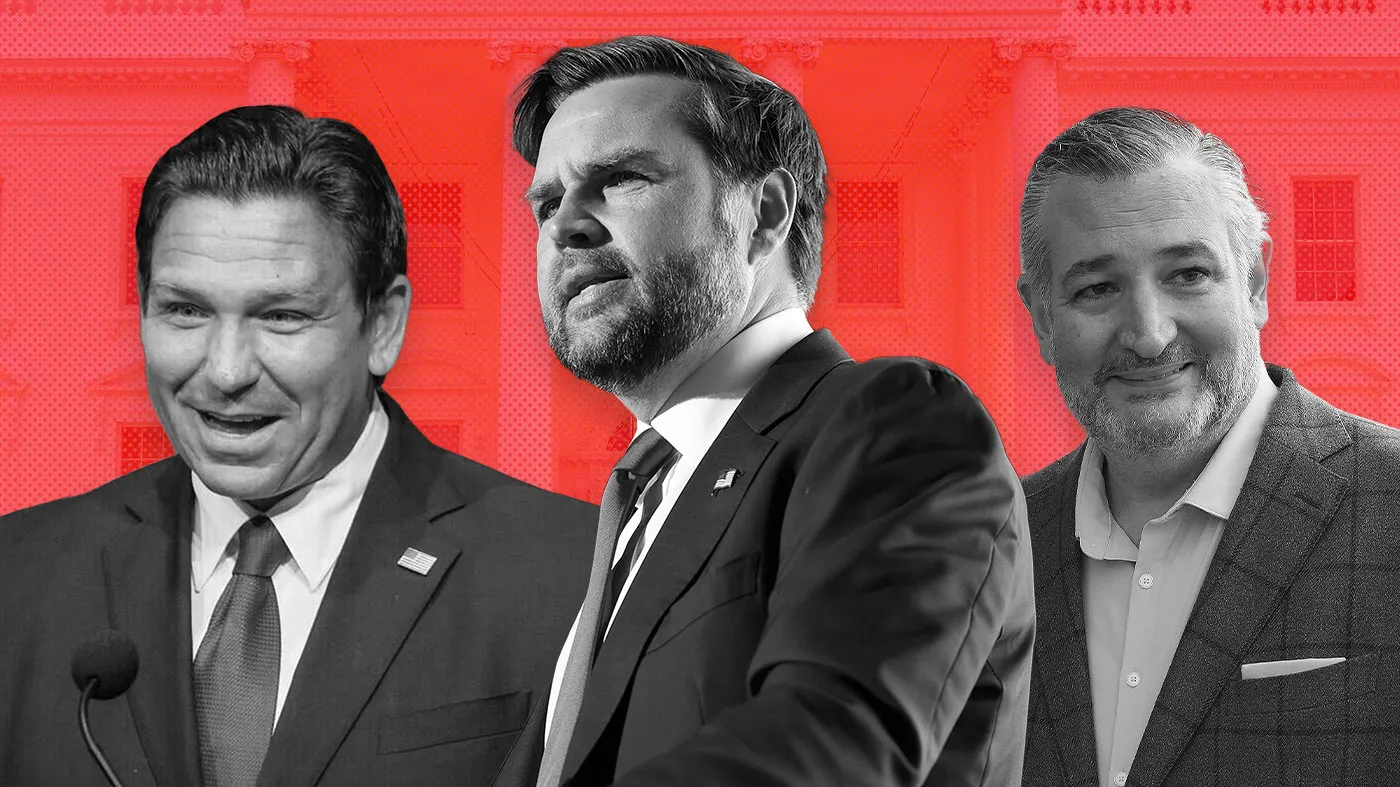
Since Tuesday’s cataclysm — where GOP-held Senate seats were lost even in crimson strongholds like Texas, Kansas and South Carolina — potential 2028 standard-bearers have been offering their prognosis about what went wrong. The implicit message in the responses from Vice President Vance, Florida Gov. Ron DeSantis (R) and Sen. Ted Cruz (R-Texas), among others, is that they are the people to put it right.
Vance, on social media , wrote, “The reason we lost is the war” — a very thinly veiled reminder that he is perceived as a skeptic about the conflict.
DeSantis lamented at a press conference that the results were “close to an extinction-level event” — but noted that his Florida was “the one state that was able to hold the line.”
Cruz, in a lengthy post on social platform X , highlighted how the GOP had alienated Hispanic voters and emphasized his record in winning their support.
The battle to define the GOP’s future direction, and to determine who leads it into the 2028 election, looks set to be fierce.
For the moment, Trump critics are feeling validated.
Former Arkansas Gov. Asa Hutchinson (R) told this column that the election results were a manifestation of “defiance” from the electorate against Trump’s “style and chaos.”
Hutchinson, who ran a long-shot campaign against Trump for the GOP nomination in 2024, said that his party now had an opening to “not simply be a mirror image of President Trump, which it has been, really, for the past 10 years.”
Beyond questions about Trump himself, Hutchinson argued that a change in direction was imperative for the Republican Party’s electoral self-preservation — and that such a move was possible without any abandonment of conservative values.
“We have to be in a position to win the votes of those in the middle — and the new generation of voters,” he said. “That takes change and adjustment, but it’s not a violation of fundamental principles.”
At the other end of the GOP’s spectrum are the Trump loyalists who disdain such anxieties and say the best response to Tuesday’s results is to keep rolling down the MAGA road — regardless of how much liberal outrage or media criticism this generates.
This camp takes heart from Trump’s announcement Friday afternoon that Stephen Miller is to become White House chief of staff , replacing the departing Susie Wiles.
To say Miller is controversial is an understatement.
He is widely seen as the main architect of the administration’s immigration enforcement policies, an advocate of extremely expansive executive powers, a fierce critic of judges who have the temerity to rule against the president, and a pugnacious cable-news brawler — among other things.
“I’m going to miss Susie [Wiles] a lot, but we’re now at war and Stephen Miller is a wartime consigliere,” longtime Trump adviser Michael Caputo told this column, suggesting there is a need to gird for battle with a Democratic-controlled Congress.
Caputo, who demurred on discussing the battle for the 2028 GOP nomination, argued that the Trump administration needed to intensify its focus. He said this pattern had already been seen in the past from Democrats, when then-President Obama endured significant midterm defeats for his party.
“I would counsel that, like Obama, we double down,” Caputo said. “And there’s nobody better to double down with than Stephen Miller.”
Others draw different lessons from the midterms — even if they acknowledge such talk is taking place against the backdrop of a president who reacts volcanically to criticism and a GOP base that is still supportive of him.
“Everybody is delicately weighing in, everybody’s discussing this privately — consultants, candidates, everyone,” said Brendan Steinhauser, a Texas-based GOP strategist who is also the CEO of the Alliance for Secure AI.
“Clearly, Ted Cruz and Marco Rubio and JD [Vance] and Ron DeSantis are doing similar: ‘What are the takeaways from the election? What are we confident in saying about the election? If we feel the need to be more critical of the president, is it a bad idea if we step out?’ Everyone is having those conversations.”
The strategist said his view was that the cost of living hurt the GOP more than anything else, but that a host of other topics — from the war to the exponential growth of data centers to concerns about corruption — also played on voters’ minds.
But Steinhauser was frank in admitting it’s too early to say what it all means for 2028.
“I don’t want to overstate it,” he said. “There are all these articles saying ‘MAGA is dead’ but the base is going to be with Trump. It’s so hard to predict, but it would be the wrong analysis to think they want a George W. Bush-type figure.”
The mere fact that Trump suffered such an electoral rebuke in the midterms perhaps complicates Vance’s position more than anyone else’s.
His message blaming the war for the GOP’s defeat was widely seen as an effort to create distance from Trump without seeming disloyal. It’s not clear if it’s possible to thread this needle over a longer period.
Doug Heye, a GOP strategist and former communications director of the Republican National Committee, noted that Vance was hardly the first vice president to face this challenge.
In 2024, then-Vice President Kamala Harris’s remark, during an interview with ABC’s “The View,” that there was “not a thing” she would have done differently from then-President Biden came to haunt her.
“These are very difficult waters,” Heye said. “It’s like watching the Olympics — sometimes it’s hard to say whether something is possible until someone does it, until someone sticks the landing.”
“That’s where Republicans are right now,” he added. “They’re in the air, spinning. And we don’t know how, or who, can stick the landing.”
The Memo is a reported column by Niall Stanage.
Topics in this story
Gathered from external sources. Rights to this text belong to whoever originally published it.