Abolish extended Senate debate? The ends do not justify the means.
Senior legal fellow Thomas Jipping argues that President Trump’s push to abolish extended debate via the nuclear option threatens the Senate’s traditional role as a check on government power and risks permanent partisan instability.
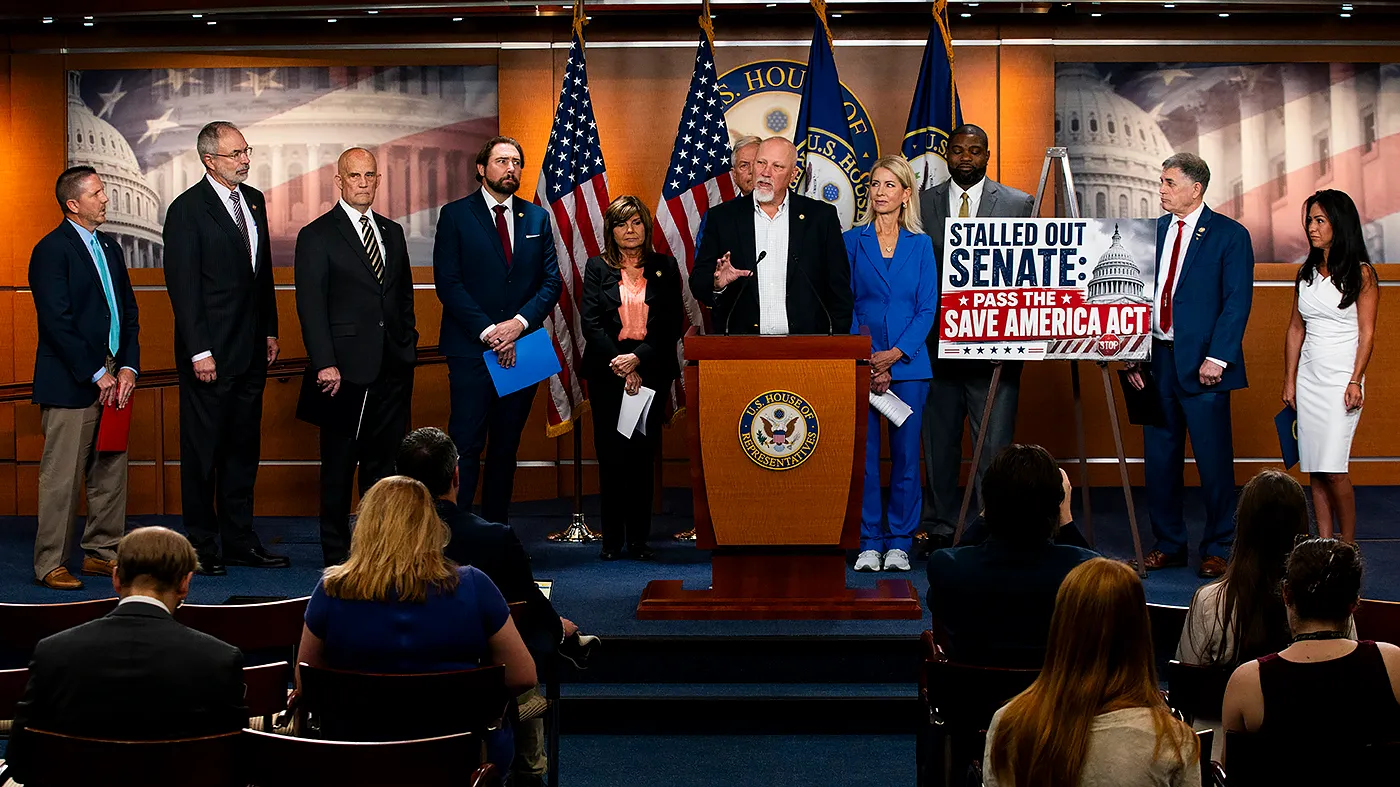
President Trump is demanding that Senate Republicans abolish extended debate, the Senate’s most distinctive feature for more than 200 years, to pass certain legislation, including the SAVE Act. Extended debate is an important limit on government power. Abolishing it would permanently weaken the Senate and its unique role in the legislative process to gain a few temporary political objectives. The ends truly do not justify the means.
It’s tempting to say, at least when it’s to your advantage, that the majority should always get everything it wants, especially when, like today, the same party controls Congress and occupies the White House. America’s Founders saw it differently. They knew that protecting our liberty — the primary purpose of government — requires structuring government the right way for the long term. There need to be “controls” on government and loosening those controls undermines liberty.
Those controls include separating government power into three branches, and dividing Congress into two differently designed houses. The Founders designed the Senate to be more deliberative than the action-oriented House and, therefore, senators have long had more freedom than House members to debate legislation.
In the beginning, the consensus was that debate should focus on the legislation at hand. Starting in the 1830s, however, senators increasingly used their freedom to debate not to facilitate the legislative process but to disrupt it. A filibuster occurs when senators refuse to stop debate so the Senate can vote on a bill.
Still, during the 19th century, the Senate repeatedly refused to abolish extended debate altogether. Instead, starting in 1917 , the Senate regulated extended debate with rules that set a specific vote threshold (60 votes today) for invoking cloture, or ending debate, on legislation.
My own analysis , just published by Advancing American Freedom, documents how both parties have used extended debate to their advantage when in the minority. Republicans, for example, have stopped dozens of significant Democratic initiatives that would have empowered labor unions, federalized elections, restricted election-related speech, liberalized immigration, addressed climate change, and even prohibited pro-life state or local laws. If ending debate required 51 votes rather than 60, as some of the loudest voices demand, much of that radical legislation would be law today.
The Senate has amended the cloture rule a few times, adjusting the vote threshold or the legislative matters that the rule covers, but always through the established process and with wide bipartisan support. The Senate has regulated extended debate, but has never abandoned it completely.
Doing so would be disastrous, especially because the only way to do it during this congressional session would be to bypass the established amendment process and guarantee endless partisan retaliation.
The regular amendment process won’t work this time because it requires 67 votes for cloture on a proposed rules change. The alternative is a parliamentary maneuver called the “nuclear option” that would leave the words of the cloture rule intact but pretend that they mean something different. The Senate, no doubt by a slim party-line margin, would vote that the words “three-fifths” in the cloture rule actually mean “simple majority.” If you are thinking that 60 does not, in fact, equal 51, you are right. But “whatever means necessary” includes pretending.
Rigging the rules in this way, so that any partisan majority can get whatever it wants, would create all sorts of long-term problems.
Let’s say the SAVE Act, requiring proof of citizenship to register for, and vote in, federal elections, is on the books and, when they next control Congress and the White House, Democrats set out to repeal it. With extended debate, Republicans could stop them; without it, they cannot.
Senate control has changed partisan hands no fewer than 10 times since the Senate first adopted its cloture rule. Neither party has held control of both the legislative and executive branches for more than four years since 1969.
Partisan control is going to change hands. If the Senate becomes like the House by abolishing extended debate, a slim partisan majority will have no obstacle to getting everything it wants, including undoing whatever was done when the opposing party had control. That is a plus if power is more important, but dangerous if liberty is the priority.
Wanting to get our way all the time is human nature and, as James Madison asked in 1788 : “[W]hat is government itself, but the greatest of all reflections on human nature.” If winning is everything, too much power is likely to end up in too few hands. That’s what the Founders designed our system of government to prevent.
In April 2017, 61 senators signed a letter to the party leaders defending “the right of Members to engage in extended debate on legislation before the United States Senate.” They noted “the unique role the Senate plays in the legislative process” and urged opposition to “any effort to curtail the existing rights and prerogatives of Senators to engage in full, robust, and extended debate as we consider legislation.” Twenty-seven of those signers, 15 Democrats and 12 Republicans, serve in the Senate today. They were right then and should stick to that position now.
Thomas Jipping is senior legal fellow at Advancing American Freedom .
Topics in this story
Gathered from external sources. Rights to this text belong to whoever originally published it.