Is David Beasley the most interesting second act in politics?
Former South Carolina Gov. David Beasley, known for his principled stance on removing the Confederate flag and his leadership as UN World Food Programme head, launched the Breaking Bread Together movement to bridge American political and cultural divides.
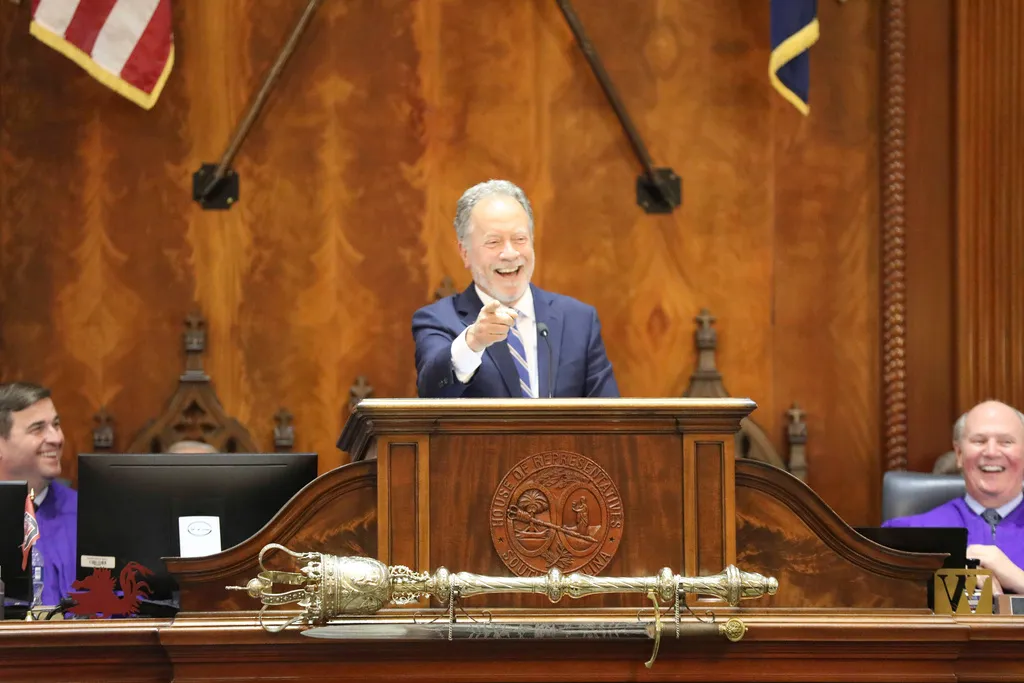
Not many political figures I know find a measure of peace in losing an election on a matter of principle. Only one went on to accept a Nobel Prize and now dedicates himself to healing the great rift in American politics.
Meet former Republican South Carolina Gov. David Beasley.
Beasley flashed like a meteor on the American political scene in the 1980s and 1990s.
He was elected to the South Carolina House of Representatives in 1978 at age 20 as a Democrat and rose through the ranks: majority whip, majority leader, then the youngest speaker pro tempore in the nation . In 1991, he joined the great migration of Southern Democrats into the ranks of Reagan Republicans. He was elected governor in 1994, and almost immediately, his name began flapping from pundits’ lips as a future Republican presidential contender. He governed as a conventional conservative, supporting economic development, welfare reform and pro-business initiatives. He also focused on prison reform and improving educational standards.
Reelection seemed all but guaranteed; a future in national politics entirely plausible.
Then South Carolina endured a wave of racially motivated church arsons and firebombings by Ku Klux Klan members.
Until then, Beasley had opposed calls to move the Confederate flag from the state House dome. The hate crimes changed everything for him.
He prayed. He deliberated. He listened to Black church leaders describe the terror they felt in their own sanctuaries, and the trauma of seeing the same flag embraced by white supremacists flying above their state Capitol. I imagine he also did what any political leader would do in that epic clash between moral conscience and political efficacy: carefully weigh the electoral risks.
In November 1996, he announced in a statewide television address that he had changed his position. He wanted the flag removed from the Capitol dome and placed beside a Confederate soldier monument instead. It may have seemed a decent compromise. But it drew fierce backlash: Many on the left said it did not go far enough; many on the right called it a broken promise and a betrayal of their heritage.
It is almost possible to say with absolute certainty that his reversal cost him reelection in 1998. Any political textbook will tell you that when your base is dispirited and your opposition is energized, you are running uphill on a Blue Ridge mountain.
On the night of his defeat, Beasley called his senior staff together. There was no doubt that his position on the Confederate flag had influenced the outcome. His advisors had even urged him to hold on discussing the issue until he secured his “certain” second term. But while the election was close, Beasley held his values closer.
Upon gathering his disparate team, he posed three questions: Did we do what was right? Did we do it at the right time? And did we do it the right way? Not in judgment or the chaos of division, but out of love for our neighbors, and a desire to bring people together. His team answered yes on all fronts. By that measure, Beasley deemed the campaign a success.
Beasley was not new to the cause of civil rights. His parents had been active in the movement, and he grew up in a predominantly Black community. His past caught up with his future, and his political career was over.
After leaving office, Beasley received the John F. Kennedy Profile in Courage Award from U.S. Sen. Ted Kennedy (D-Mass.) for his effort to remove the flag. In February 2017, U.S. Ambassador to the United Nations Nikki Haley nominated him to become the next executive director of the World Food Programme . During his term, he immersed himself — literally — in famines, insurrections, pandemics, and civil wars around the world. In December 2020, Beasley accepted the Nobel Peace Prize on behalf of the WFP for its efforts to combat world hunger.
His term was scheduled to expire in 2022. But United Nations Secretary-General António Guterres extended it amid the food crises created by the COVID-19 pandemic and the Russo-Ukrainian War. President Biden initially opposed the extension, but bipartisan support in Congress helped change the administration’s position. Beasley’s term as executive director finally expired in April 2023.
What does one do after intervening in conflicts across the globe?
His third act arrived in August with the launch of Breaking Bread Together , a national movement designed to bridge political, cultural and religious divides across America through shared meals. His goal is to use faith not as cudgel, but as an invitation to conversation. To inspire us to listen more and pontificate less. His point is that real change starts around kitchen tables, church halls and on community farms, not inside the Beltway.
The man has heart, but do not underestimate his natural political skills. I saw them for myself when we first met at a Washington, D.C. cafe with a menu of mostly unpronounceable beverages. Our server was a Black woman who spoke with a slight accent. Beasley’s ears perked up, and he asked where she was from.
Beasley immediately switched to fluent French, asking about her life and establishing an instant connection.
I may not agree with every one of his positions. But I believe political discourse needs his approach, and the next generation of political leaders could learn from it: Leave room to change your mind. Listen carefully. You can stand on principle and even suffer politically for it, yet still make the world a better place …perhaps one meal at a time.
Steve Israel represented New York in the House of Representatives for eight terms and was chairman of the Democratic Congressional Campaign Committee from 2011 to 2015.
Topics in this story
Gathered from external sources. Rights to this text belong to whoever originally published it.