Mississippi has an unexpectedly close Senate race but no recount procedure
The Mississippi Senate race could be headed for the courts, as two candidates are locked in a tight contest with no recount procedure on the books. The elect...
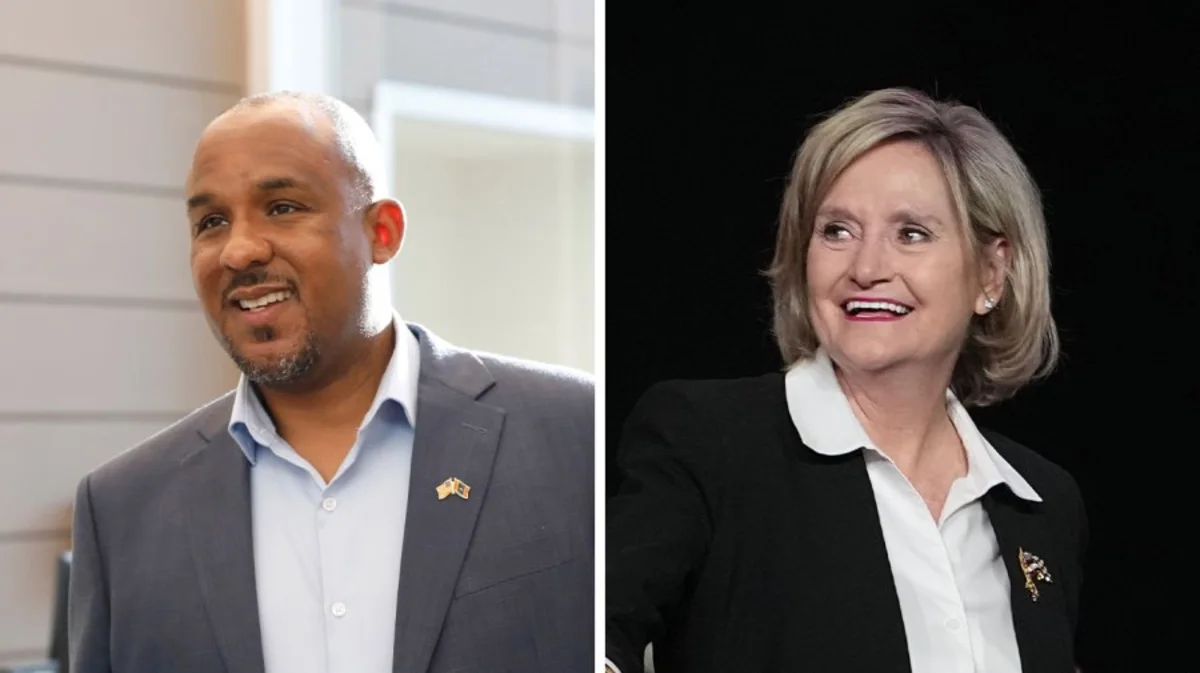
The Mississippi Senate race could be headed for the courts, as two candidates are locked in a tight contest with no recount procedure on the books.
The election between Republican Sen. Cindy Hyde-Smith and Democrat Scott Colom remained too close to call as of Wednesday evening, with Colom leading by less than a quarter of a percentage point. That's fewer than 2,000 votes.
And ballots are still coming in. The state allows mail ballots to be counted so long as they were postmarked by Election Day and received up to five business days later, a law that was upheld by the Supreme Court this summer. Mississippi is still waiting to see if roughly 3,600 outstanding ballots show up in time, according to the state's top election official.
In addition to those, Colom's campaign put the count for provisional ballots at around 15,000 on Election Day — but both sides are holding their breath.
"We are going to make sure every single vote has been counted, and I am confident we will ultimately flip this seat," Colom said in a post on the social platform X on election night.
Hyde-Smith assured supporters at a campaign watch party she wasn't going anywhere.
"I'll tell you the Democrats got out and worked, they really got out and worked, and a lot of them showed up today. But not enough of them. I'll just tell you that right now," the senator said, according to Mississippi Today . "I assure you I will continue to be your U.S. senator."
The final margins may well determine what happens next. A wide swing in either direction could soften the chance of legal challenges, but a close result could have the loser's lawyers racing to court.
"In some states, you know, a really close election automatically triggers a recount. That's not true in Mississippi," said Ronald Rychlak, a professor at the University of Mississippi Law School. "In fact, a candidate does not have an automatic right to a recount, even if they offer to pay for it in Mississippi."
State law establishes specific procedures for Mississippi Legislature candidates to contest the election. And if it were a county-level race, for example, state law would give candidates a 20-day window. "The candidate or the party has to go in front of the court and make the case," Rychlak said. "So instead of it being sort of an automatic thing, there is an evidentiary basis that has to be established, and there are procedures in place to help the party gather evidence to make that evidentiary basis."
But when it comes to federal offices like the U.S. Senate, nothing in Mississippi law provides an express way to contest the general election. It effectively leaves it up to judges to determine how disputes are resolved in any push by either side.
"You might not recount every precinct, and maybe a recount is sought in a particular area because that's where the evidence suggests that there may have been mistakes made," Rychlak said. "Then there would be a determination as to whether there was sufficient evidence set forth, and a court at that point could order, you know, a full or partial recount of the votes."
The lack of clarity is an anomaly. Other states have rules for handling challenges to congressional results, but Mississippi's are limited to primaries only.
Chris McDaniel attempted to contest the results of the GOP Senate primary after losing to Thad Cochran in 2014, alleging voter fraud. The state Republican executive committee declined to review the complaint because McDaniel had missed the 20-day cutoff. The Mississippi Supreme Court later agreed .
As Mississippi begins to sort out this year's unexpectedly close race, there's also the question of how Congress itself will react. The Constitution gives each chamber the power to "be the Judge of the Elections, Returns and Qualifications of its own Members."
There's another reason the answer may still take time. National Republicans took a Supreme Court loss earlier this year on when mail ballots can be counted, and now the party is grappling with the real-world implications.
In June, the high court ruled 5-4 that federal law does not preempt Mississippi and more than a dozen other states from accepting mail ballots that arrive after Election Day, so long as they were postmarked by then.
Responding to the ruling against the Republican National Committee (RNC), the committee's chair, Joe Gruters, said: "Republicans are not going to be deterred by this decision, and the RNC will keep fighting to have elections end on Election Day as Americans want."
But now, the party may need to rely on those votes to swing back into the lead in Mississippi. Decision Desk HQ estimated that roughly 8,500 ballots were still outstanding as of Wednesday, and many of the remaining ballots will be those last-arriving mail ballots.
Republicans for years attempted to shoot down the practice, which became more widespread in the wake of the COVID-19 pandemic.
Adding to the sting was that the Supreme Court's rejection was authored by Justice Amy Coney Barrett, one of President Trump's own appointees. She took on relentless public attacks from conservatives for it.
Although the justice perhaps wasn't envisioning a nail-biter Senate race this year, Barrett conceded at the time it was a "significant concern" that Mississippi's results could give rise to the appearance of fraud if the results "appear to flip after Election Day."
Still, Barrett said that isn't the Supreme Court's problem.
"Election fraud and its appearance are serious issues. Like other such issues, however, they must be addressed through the democratic process," she wrote.
It means that Mississippi is continuing to accept mail ballots through Nov. 10, five business days after polls closed.
"With the vote as close as it [is], that means we're going to have to wait to make sure that those are all in," Rychlak said. "We really have to count every ballot this time, and that means we have to until we have every ballot."
Topics in this story
Gathered from external sources. Rights to this text belong to whoever originally published it.