The Methodist pastor who could flip Kansas and the Senate
Adam Hamilton, the Democratic nominee for Senate in Kansas, went out of his way to welcome President Trump to the state earlier this week. “Mr. President, welcome to Kansas! It’s been nearly 20 years since a sitting president came to Wichita,” said Hamilton, a soft-spoken pastor from the Kansas City metro area, in a direct-to-camera…
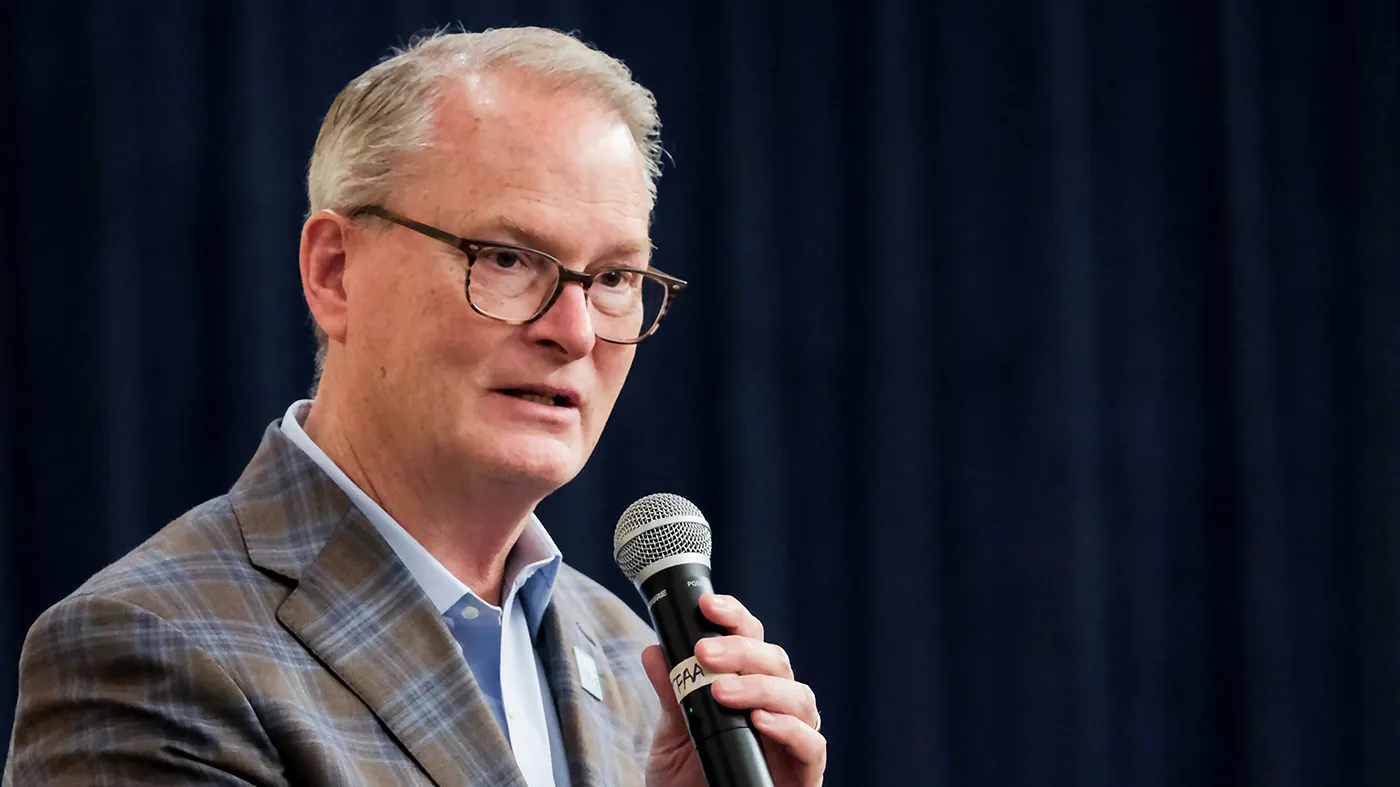
Adam Hamilton, the Democratic nominee for Senate in Kansas, went out of his way to welcome President Trump to the state earlier this week.
“Mr. President, welcome to Kansas! It’s been nearly 20 years since a sitting president came to Wichita,” said Hamilton, a soft-spoken pastor from the Kansas City metro area, in a direct-to-camera video his campaign released Monday. His voice rang with enthusiasm.
“Now, President Trump is here to campaign for my opponent Roger Marshall, that’s politics and I get it,” Hamilton added later. “But I want Kansans to know: If you voted for the president, you also have a place in my campaign.”
Hamilton is challenging Marshall in what’s become one of the most surprisingly competitive Senate races in the final months of the midterm election season. His success, some say, is due in large part to his profile.
Hamilton emerged from a crowded primary field in August because of his crossover appeal as a pastor of the largest United Methodist church in the U.S. He has decades of experience in leading and speaking to a politically mixed audience. He talks openly about his faith, but with less of a controversial theological edge compared with some of the other clergy running as Democrats this year. He married his high school sweetheart when he was 18 and still leads the same church he founded in 1990.
And now, he is the Democratic Party’s best hope to flip a Senate seat that nobody saw as competitive. Kansas, which hasn’t sent a Democrat to the Senate in nearly a century, is now one of the states that could return Democrats to a legislative majority.
“Hamilton offers independents and moderate Republicans an alternative to the far-right types of candidates and MAGA world folks,” said Don Haider-Markel, a professor of political science at the University of Kansas.
Because he’s a pastor, Hamilton “takes away one of the key arguments that Republicans often make about Democrats,” Haider-Markel said, “that they’re not real Christians.”
He’s also exceptionally well known in his state as pastor of the largest Methodist church in the country.
Several prominent Republicans in Kansas have already thrown their support behind Hamilton. Two former Republican governors , Bill Graves and Mike Hayden, endorsed Hamilton earlier this month. Marshall’s Republican primary opponent Arch Naramore, who won more than 20 percent of the vote, endorsed Hamilton in September.
Graves, in a video announcing his support for Hamilton, praised him for his civil, bipartisan approach to politics and governing.
“With our nation facing increasing partisan gridlock and division, it’s time Kansas does something different,” Graves said. “For the last six years, Senator Roger Marshall has turned his back on Kansas. In contrast, Adam Hamilton stands as a bulwark of kindness, humility and service to others.”
Hayden, in his video, said he supported Marshall in his previous election but has now grown disillusioned.
“Senator Marshall time and again has chosen to back the tariffs and the war, despite the consequences for Kansans,” Hayden said. “We need someone who listens and will fight to end the chaos and corruption in Washington.”
Marshall and his supporters have sought to undermine Hamilton’s faith-and-politics routine. National Republicans have joined in and shifted money to the race, buying ads that splice quotes from Hamilton’s sermons to suggest he believes white privilege and eating meat are sinful.
They have also pointed repeatedly to a former volunteer at a camp run by Hamilton’s church who was later convicted of sex crimes in two states. GOP ads have attacked Hamilton for not calling the police over allegations about the volunteer, as reported by the Kansas Reflector . Hamilton has acknowledged he should have passed the information to law enforcement originally and said his church later did so.
“Pedophile protector Adam Hamilton provided safe harbor for a sexual predator, and instead of calling the police, he welcomed the pedophile back to abuse children. Hamilton is too sick and dangerous to be anywhere near the U.S. Senate,” said Chris Gustafson, a spokesperson for the Senate Leadership Fund, a super PAC affiliated with Senate Republican leadership, in a statement Wednesday night.
But Hamilton’s reputation in the state could be particularly hard to besmirch, Haider-Markel said.
“It’s not as if they get to paint a portrait of Hamilton that’s, you know, tabula rasa, blank page of being able to describe him however you want,” Haider-Markel said. “There’s a record of what he’s done with his church and what he’s done in the community, and the Republicans can’t just label him and believe that’s going to work.”
During a debate Wednesday, Marshall mostly steered clear of Hamilton’s past and instead looked to counter his centrist argument.
“If he’s elected, Chuck Schumer controls the Senate, and this is exactly what we’re going to get,” Marshall said of Hamilton. “He’s going to say he’s going to vote against these things, but every Democrat stands up, and when Schumer tells him to jump, they say ‘How high?’ So why is he going to be any different once he gets to Washington?”
Hamilton said that he will not support Schumer, the current Senate minority leader, for majority leader if elected, making him one of a handful of aspiring caucus members to do so. Earlier this month, he told Politico he had said to Schumer’s face that he is a liability in Kansas.
“When I talked to Chuck Schumer, he said, ‘So what’s … you know, what’s the challenge in getting elected in Kansas?’ I said, ‘You. You know, you are.’”
He also repeatedly rebuffed links to prominent Democrats such as former Presidents Obama and Biden.
Hamilton worked with the Obama administration more than a decade ago. The pastor served a one-year term in 2016 on the President’s Advisory Council on Faith-Based and Neighborhood Partnerships, along with other religious leaders from around the country. He also delivered the sermon at the National Prayer Breakfast in 2013, and the following year, Obama called him a friend in an Easter speech .
Obama’s support could be helpful; he’s the most popular living president, per a June poll .
But other Democrats, like Schumer and Biden, are more likely to drag Hamilton down in the eyes of independent and Republican voters. Hamilton, accordingly, takes care to shake off ties to controversial Democratic policies and faces.
During Wednesday’s debate, he called Biden’s immigration policy “a disaster.” He stated there are only two genders, male and female. He said he “is not someone who favors the socialist party,” distinguishing himself from Democratic candidates backed by the Democratic Socialists of America.
In terms of what he does support, Hamilton has marked out a path of moderation. He says biological men shouldn’t play in girls’ sports; he “grieves” over civilian deaths in Gaza due to U.S. military aid but supports Israel’s right to defend itself; he wants a secure border and no amnesty for illegal immigrants; and he supports artificial intelligence regulation by Congress.
Beyond the issues, Hamilton’s success, if he wins, could make a larger statement about the return of religion to the Democratic Party, which has had few vocal religious practitioners in recent decades.
The United Methodist Church, Hamilton’s denomination, is considered “mainline Protestant,” which refers to Protestant denominations that are not evangelical and tend to be more moderate, leaning liberal on social issues. White mainline Protestants in general leaned toward Trump in 2024. Congregants in the United Methodist denomination, as of 2018, were also more Republican than Democratic, according to data from religion scholar Ryan Burge.
Some of Kansas’s most prominent midcentury politicians, including former Republican Sen. Bob Dole, were also Methodists. Hamilton mentions Dole often as a model of leadership for him, including Dole’s work on nutrition assistance.
Daniel Williams, associate professor of history at Ashland University, said a Methodist pastor from Kansas is probably the best person to communicate “in a way that transcends political divides.”
“I think he probably won’t do as well among strongly evangelical voters, people who may be Southern Baptists or aligned with the religious right,” said Williams, who studies politics and Christianity.
“But I do think that there may be a sizable group of people who can, who perhaps were not attracted to the Democratic Party in the past, but can feel more comfortable, I guess, with a candidate like Hamilton,” he said.
Heath Carter, a professor at Princeton Theological Seminary who studies American Christianity, said he is closely watching how this crop of religious Democrats does because it could help revive a religious fervor on the left that has historically been part of the party. That could be a factor for the 2028 presidential primary and beyond as the party sorts out the coalition of its future.
“These races are an interesting kind of early barometer for, to what extent can institutional Christian establishment kinds of organizations and institutions find new energy by engaging younger folks, and will people like Talarico and Hamilton offer a kind of vision of another option?”
Topics in this story
Gathered from external sources. Rights to this text belong to whoever originally published it.