Supreme Court opens new term with shaky Trump relationship
The Supreme Court justices return to the bench Monday for their new term, and their docket is already filling up with new confrontations on President Trump’s immigration agenda, among other major cases. The term begins at a moment when the court’s public approval stands near record lows and in the shadow of a fraught relationship between Trump…
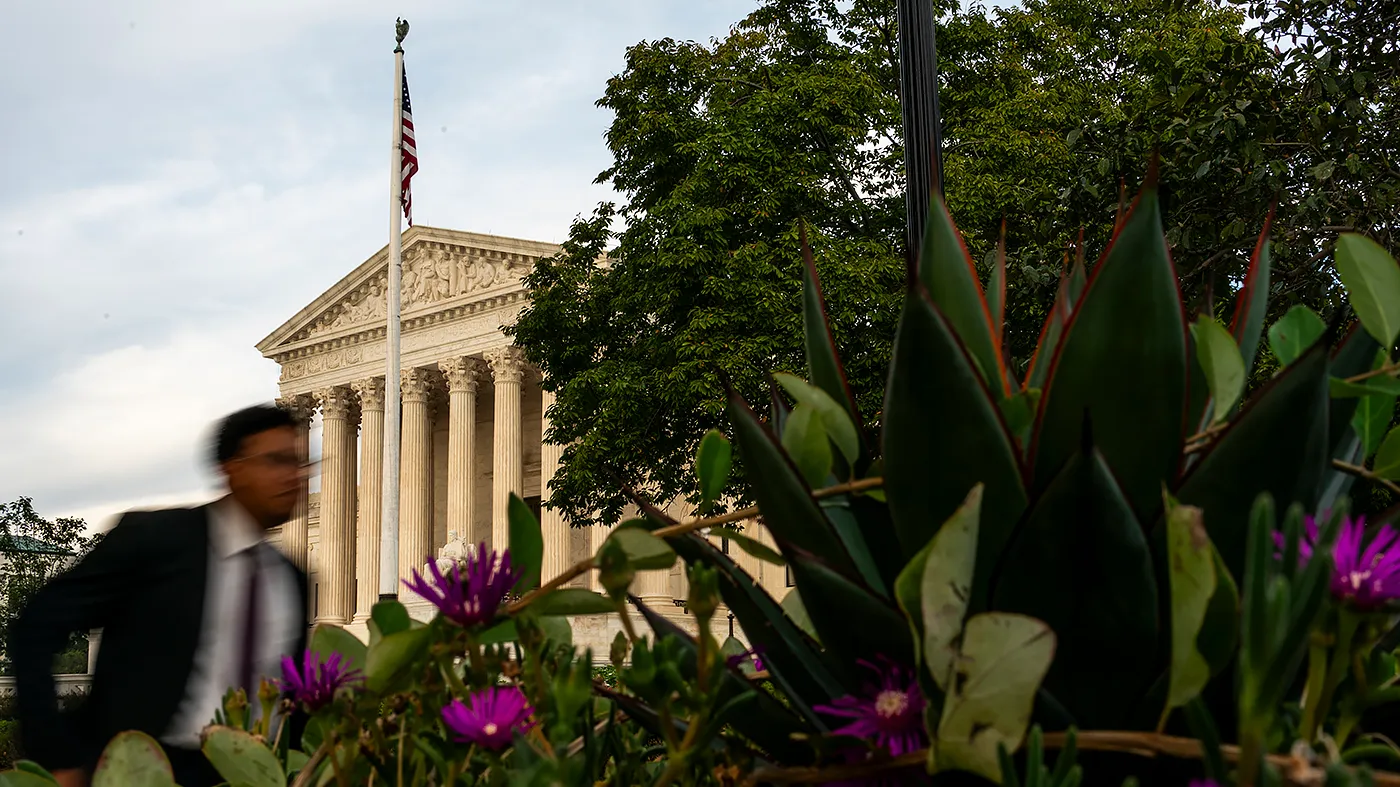
The Supreme Court justices return to the bench Monday for their new term, and their docket is already filling up with new confrontations on President Trump’s immigration agenda, among other major cases.
The term begins at a moment when the court’s public approval stands near record lows and in the shadow of a fraught relationship between Trump and the justices — namely the conservatives he appointed to the bench who have at times ruled against him.
“They voted against me too often,” Trump told Time magazine in an interview last week, referencing Justices Neil Gorsuch, Brett Kavanaugh and Amy Coney Barrett. “I gave them the position of a lifetime, and they vote against me often. They vote for me, too.”
It’s that mixed record that has fueled questions about how Trump’s agenda will fare this term at the Supreme Court, as lower court judges repeatedly block the president’s policies, prompting the disputes to continually reach the justices in a barrage.
In just the past week, the justices cranked up their docket by adding two major appeals brought by the administration concerning the president’s immigration agenda.
The court will review whether officials are giving enough due process before deporting migrants to third countries where they have no ties. They’ll also rule on the legality of Trump’s mandatory detention policy, which has fueled a tsunami of litigation in the lower courts. Decisions in both cases are expected by summer.
“Because of the vast number of illegal immigrants — particularly during the Biden administration, but for many years up until now — that just creates an incredible backlog of issues and concerns,” said Carrie Severino, president of the Judicial Crisis Network and a former law clerk to Justice Clarence Thomas. “Particularly as this president is trying to actually enforce the immigration laws.”
“So, immigration is definitely an issue,” she noted.
It leaves groups that have prolifically fought the president in court, like the American Civil Liberties Union (ACLU), gearing up for another major year at the Supreme Court.
“Last term, OT25 [October Term 2025], was one of the ACLU’s busiest ever,” Cecilia Wang, the group’s national legal director, told reporters during a briefing call last week. “This term may top that.”
Left-leaning groups have remained optimistic in their chances before the conservative-majority court after last term produced a mixed outcome for the president.
The court delivered Trump major wins on executive control over independent agencies and immigration but also struck down his signature tariff policy , thwarted his efforts to restrict birthright citizenship and blocked him from immediately firing Federal Reserve governor Lisa Cook.
Trump’s foes have also found relief in the justices’ recent emergency decisions that kept the president’s mail-in voting plan blocked ahead of the midterms.
It’s some of those decisions that have left the president reeling. Trump, in one recent social media post, called his nominees “merely a shell of their original selves.”
In an interview with CBS News set to air Sunday, Justice Samuel Alito brushed off any notion the justices have a political agenda and pointed out the bipartisan nature of court criticism.
“He has his own way of saying things,” Alito said of Trump. “But the criticism of the court, I mean, I want to be even-handed on this. The criticism of the court by [former] President Biden and justices by President Biden and his administration was very harsh. And President Trump has been very harsh.”
The public attacks didn’t stop the president from inviting Kavanaugh and Barrett to join him at the recent state dinner hosted for Chinese President Xi Jinping, however.
It’s not just Trump being critical. The Supreme Court’s public approval stands near record lows. A record-high 43 percent of Americans believe the court is too conservative, according to a Gallup poll conducted in early September. Just a little more than one-third of those surveyed said it was “just about right” ideologically, and 17 percent said it was too liberal.
Beyond the upcoming cases that directly implicate Trump’s agenda, some touch on political issues about which Trump’s base cares deeply.
The justices will hear challenges to an Arizona law that requires documentary proof of citizenship when registering to vote, a policy Republicans want implemented nationwide for federal elections. They’ll also take up several religious liberty disputes and examine the constitutionality of state bans on semi-automatic weapons, specifically AR-15s.
“We have a more exciting docket than we often do at this point,” said Severino.
“At the beginning of the Supreme Court term, some terms you would look at the list of the cases they’ve accepted already, and say, ‘Oh, it’s going to be kind of a snoozer,’” she added.
ACLU is asking the Supreme Court to add more cases to its plate. Among its pending requests is one that seeks to declare as unconstitutional Texas’s law requiring public school classrooms to post the Ten Commandments. The justices are set to consider taking up the case at a closed-door meeting after Texas responds in writing this fall.
“Our fundamental civil rights and civil liberties are under unprecedented attacks from all quarters,” Wang told reporters. “And many of those fights are poised to potentially make it up to the Supreme Court this term.”
On Monday, the term is set to begin with a bang as the justices consider a blockbuster case involving the fossil fuel industry. The Supreme Court will decide if cities and groups can use state law to force companies to pay potentially billions in damages over accusations they contributed to climate change and misled the public.
The case took an unanticipated turn last week when the court announced Alito’s last-minute recusal. Alito had faced pressure to exit the case due to perceived conflicts of interest related to his stock holdings in the oil and gas sector, but he told Bloomberg that his recusal was “prudent” — not required.
It’s a big week for Alito for unrelated reasons. On Tuesday, he’s set to release his first authored book since joining the bench, titled, “So Ordered: An Originalist’s View of the Constitution, the Court, and Our Country.” His CBS News interview is at the beginning of a rare media tour to promote it.
“It’s part of the job that you’re going displease people by making decisions on controversial matters, because one side or the other is going to really dislike you,” Alito told the outlet.
Topics in this story
Gathered from external sources. Rights to this text belong to whoever originally published it.