Jeffries faces tricky balancing act on Democratic defectors
This week’s stunning defection by two centrist Democrats has posed a dilemma for House Minority Leader Hakeem Jeffries (D-N.Y.) — now caught between liberals calling for scalps and others in the party urging restraint ahead of the midterms. From the left, Jeffries is facing pressure to punish fellow Democratic Reps. Jared Golden (Maine) and Marie…
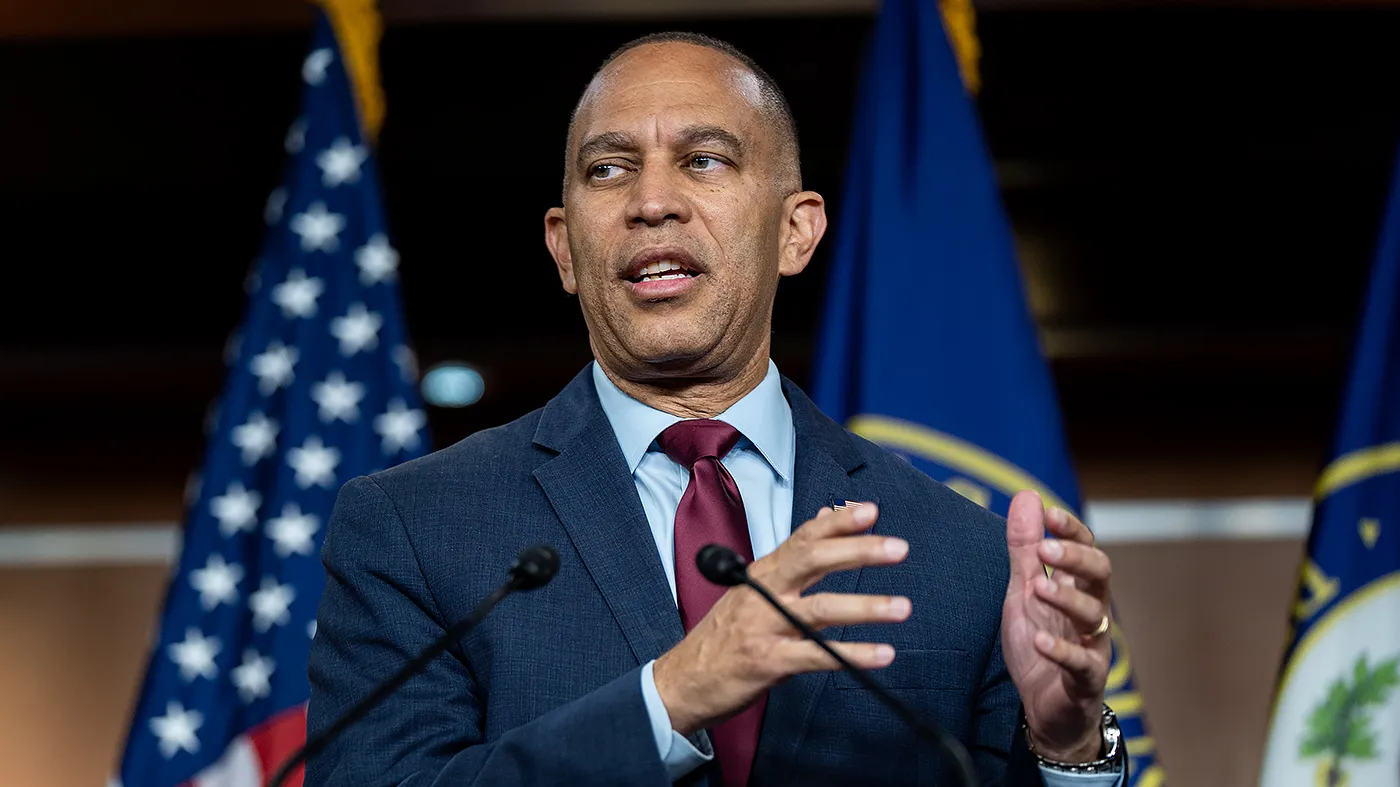
This week’s stunning defection by two centrist Democrats has posed a dilemma for House Minority Leader Hakeem Jeffries (D-N.Y.) — now caught between liberals calling for scalps and others in the party urging restraint ahead of the midterms.
From the left, Jeffries is facing pressure to punish fellow Democratic Reps. Jared Golden (Maine) and Marie Gluesenkamp Perez (Wash.), who both blindsided the caucus on Tuesday by supporting a Republican rule that salvaged much of the GOP’s September agenda. Some want them stripped of key committee assignments.
But another camp of Democrats is warning that such drastic disciplinary action would be ineffective, at best, and backfire, at worst. Not only is Golden retiring at the end of this term, making any punishment fleeting, but Gluesenkamp Perez is among the most vulnerable Democratic incumbents. Punishing her ahead of November could lend ammunition to her GOP challenger at the eleventh hour in a campaign cycle when every battleground seat could tip the scales of power in the next Congress.
“There’s the problem: One is leaving, and one is in a very vulnerable spot,” said one Democratic lawmaker. “There are some constraints.”
The lawmaker invoked the case of former-Rep. Phil Gramm (Texas) as a cautionary tale. Gramm entered the House as a Democrat in the late 1970s. But several years later — after Democrats kicked him off the House Budget Committee — he resigned his seat, switched parties and won the special election for his vacant seat as a Republican.
“Be careful what you wish for,” the Democrat said.
The saga presents the Democratic leader with a difficult balancing act, vying to appease a liberal base that’s furious with the aisle-hopping centrists without harming a key front-liner in ways that could hurt the party’s chances of flipping control of the House in November.
Complicating his ultimate response, Jeffries — who’s in line to become Speaker if the House changes hands — is also fighting to send a signal to rank-and-file members that crossing the aisle to help Republicans steal victories will not be tolerated. That’s especially the case for votes for procedural rules, which have traditionally been strictly partisan.
“It’s long understood what the dynamics are related to procedural votes connected to a rule,” Jeffries said.
Some Democrats said the episode forecasts a potentially tough environment if the party does hold the gavel next year — difficulties that will be more pronounced if the majority is thin.
“Especially with the democratic socialists coming,” said Rep. Don Beyer (D-Va.), “because we don’t know how they will be part of the team.
“We hope they’ll be part of the team, but we don’t know,” he continued. “If we get 230 or 232 or something, much less so. But if it’s 220?”
Golden and Gluesenkamp Perez stunned lawmakers on both sides of the aisle on Tuesday by supporting a GOP rule governing a series of Republican messaging bills that Speaker Mike Johnson (R-La.) wanted to pass ahead of the midterms. The legislation included proposals to condemn socialism, roll back environmental protections and bar U.S. universities from participating in boycotts of Israel — all hot-button issues Republicans see as beneficial on the campaign trail.
Five Republicans lined up against the rule to protest Johnson’s handling of a separate package on government funding — a number large enough to kill the rule and prevent the underlying proposals from reaching the floor.
The rule passed, however, when Golden and Gluesenkamp Perez provided the two votes that put it over the top.
Both lawmakers have defended that decision, saying it was the only way to ensure a vote on one of the proposals, which was designed to help Atlantic lobstermen keep their livelihoods.
The saga has infuriated many Democrats, who have centered their campaign message around the rising costs that have plagued Trump’s second term. The internal clash has distracted from that issue, and Democrats of all stripes are eager to put the infighting to bed and get back to a focus on the economy.
“We could have defeated that rule yesterday,” said Rep. Jim McGovern (D-Mass.). “And we could have been talking about affordability all week and instead we’re talking about socialism. And it’s just, like, really? And to not even talk to anybody. I find that frustrating.”
In the wake of the defections, Jeffries and his top deputies issued a sharply worded statement calling the votes “a significant breach of trust” that demands “a significant response.” And on Wednesday morning, Jeffries activated the Democratic Committee on Caucus Rules to stage a closed-door meeting examining potential changes to internal guidelines that might keep the Democrats united going forward.
Jeffries also said he intends to meet one-on-one with both Golden and Gluesenkamp Perez, although those meetings had not taken place as of Wednesday afternoon.
That quick response won praise from those lawmakers clamoring for some accountability for the defections. But a number of other lawmakers predicted the storm would blow over without any drastic changes, particularly if the House leaves Washington this week and doesn’t return until after the midterms.
“I don’t think we do anything,” said Rep. Juan Vargas (D-Calif.). “Everybody had to blow off some steam. I mean, everybody’s a bit pissed. [But] we are on the same team at the end of the day. This is not the medieval days.”
“You don’t peel the skin off of people when they’re not on our side,” the congressman added.
Topics in this story
Gathered from external sources. Rights to this text belong to whoever originally published it.