Democrats poised to go big on affordable childcare
Heading into a potential new political era, Democratic candidates, policymakers and outside groups all agree on one thing: Something needs to be done on childcare. Should they win a majority in Congress in November, the Democratic affordability agenda includes childcare as one of many everyday costs Democrats want to bring down. Democrats up and…
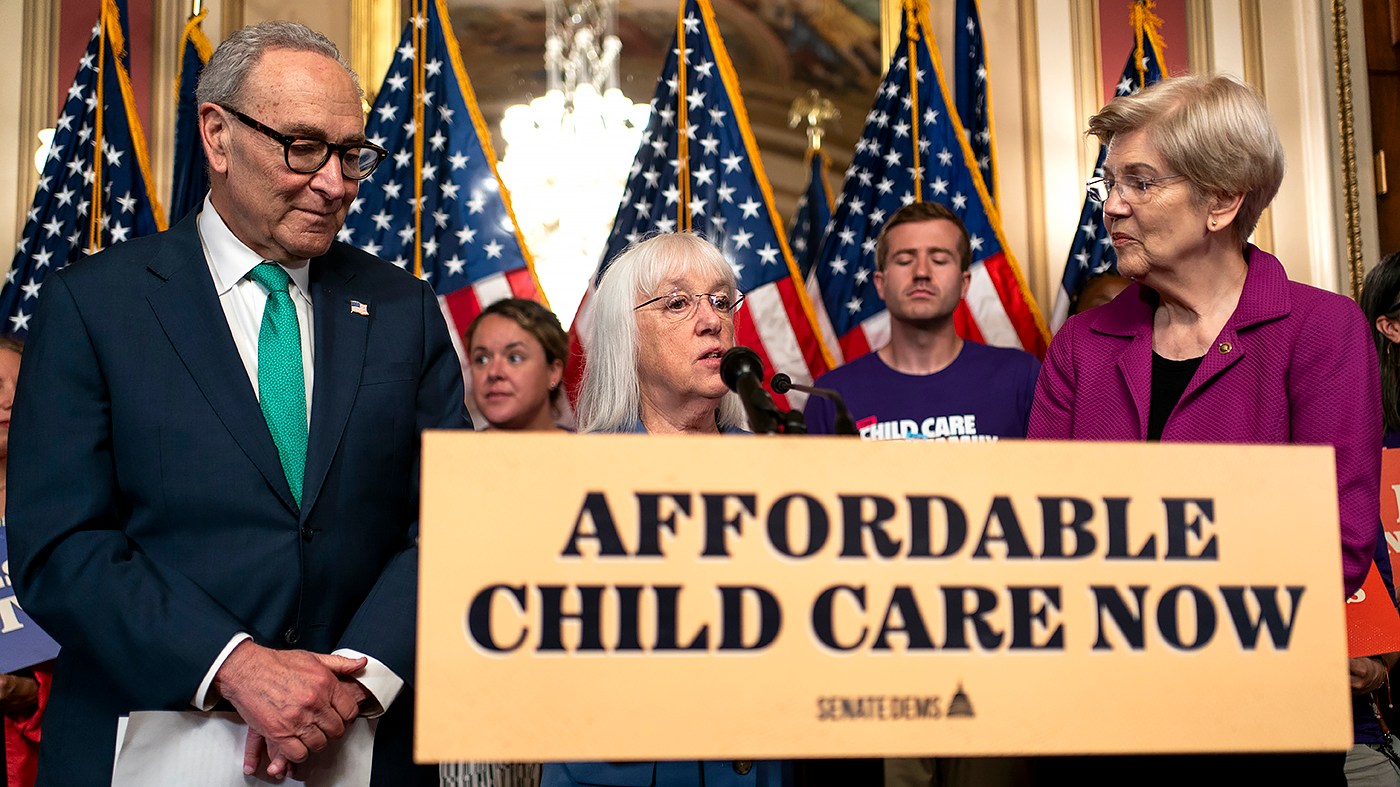
Heading into a potential new political era, Democratic candidates, policymakers and outside groups all agree on one thing: Something needs to be done on childcare.
Should they win a majority in Congress in November, the Democratic affordability agenda includes childcare as one of many everyday costs Democrats want to bring down.
Democrats up and down the ballot have been buzzing about fixing childcare with renewed fervor in recent years.
Nearly every Democratic candidate running for the Senate has a childcare agenda, and the most significant Democratic victories of the off-year elections — the gubernatorial races in New Jersey and Virginia and the New York City mayoral race — leaned heavily on the candidates’ focuses on childcare subsidies and availability.
But there’s daylight between different camps on exactly the right way forward, and the issue is one of a number that leadership will have to shuffle through and prioritize if Democrats take control.
It could also create lanes for the 2028 Democratic presidential primary.
“I absolutely think it’s become a prerequisite for running for president that you need to have a plan to solve for childcare and make sure that families can have safe nurturing care that they need for their kids,” said Julie Kashen, founder and principal of Women’s Economic Futures, a new policy and research initiative focused on childcare.
There’s little doubt that the energy to get something done about childcare is at a high-water point. During the COVID-19 pandemic, Congress allocated billions in emergency supplemental funding to help states manage the childcare sector, but most of those funds expired in 2024.
Kashen said those resources showed what could be if the federal government invested in childcare more permanently.
“The pandemic kind of pulled the invisibility cloak off of this issue that had been there all along, and as a result of that, it became an even hotter topic,” Kashen said. “And then, when the pandemic relief funding went to every state, and states actually innovated with public funding, people really saw what was possible, and that it could really make a difference to making childcare more affordable, more stable.”
Democratic lawmakers in the last year or so have started staking out their wishlists on specific childcare policies. Sens. Elizabeth Warren (D-Mass.) and Patty Murray (D-Wash.) are the Senate co-chairs of a childcare working group, along with Reps. Alexandria Ocasio-Cortez (D-N.Y.) and Bobby Scott (D-Va.) in the House.
Warren and Murray, backed by the caucus, released a framework for childcare affordability in June. Although light on specifics, that framework mentions “building a strong and stable public infrastructure” for childcare and increasing pay and benefits for childcare workers.
“Democrats understand that childcare is fundamental economic infrastructure and an important way we can deliver to lower costs for the American people—affordable and accessible high-quality childcare is a priority for families so childcare will absolutely be a priority for members in the next Congress,” a Senate Democratic aide told The Hill.
Rep. Katherine Clark (Mass.), the Democratic whip whose role will become even more powerful if Democrats win the House majority, has pushed for expansive childcare legislation, including her Child Care is Infrastructure Act , a package of two bills that help communities build more childcare facilities and repay student loans for early childhood educators.
Rep. Suzanne Bonamici (D-Ore.), who is challenging Scott for the top Democratic post on the House Education and Workforce Committee, has also led efforts to support the Head Start educator workforce, among other childcare proposals. So have Rep. Sara Jacobs (D-Calif.) and many others .
Several states and localities have picked up on the momentum in recent years: New York City has begun to roll out universal free childcare programs for 3- and 4-year-olds. Washington, D.C., offers free pre-K for 3- and 4-year-olds in public schools. New Mexico passed a law earlier this year that guarantees no-cost childcare to residents, balanced out by the state’s oil revenues.
Now, advocates are hoping Congress seizes the opportunity to pass a more substantive childcare package that supports both the workforce and the families who need care.
“I do think that any solution must have a supply side answer to it … like you can’t just put money into tax credits and hope for the best,” Kashen said. “We do not have enough childcare for every family that wants it, and even when we do have it, a lot of families can’t afford it. So we need to make sure that we’re investing in making sure there’s good quality childcare, that there’s childcare that works for every family that’s available, so it can’t just be a solution that gives parents more money because they won’t have anywhere to use that money.”
Affordable childcare isn’t a solely Democratic issue: In 1971, Congress passed a bipartisan bill that would have established a national daycare system funded by billions in federal dollars.
Some Republicans in Congress have picked up the torch to push for legislative childcare reforms, including reauthorizing the Child Care and Development Block Grant program, which gives states federal funding to help low-income families get childcare.
Yet President Trump has looked to federal childcare programs as opportunities to dial down federal spending and regulation and eliminate fraud.
The administration wants to roll back regulations on Head Start, a federal childcare program for low-income children. The administration proposed a rule earlier this year that would turn the responsibility of setting Head Start regulations for class sizes, background checks and other requirements over to the states. Administration officials argue the changes would loosen unnecessary federal spending and oversight while opening up more seats in the states.
Democrats and advocates want to be ambitious.
That could mean some form of federal universal childcare, although the term is somewhat nebulous. Some Democratic candidates — including Angie Nixon in Florida, James Talarico in Texas and Troy Jackson in Maine — have backed universal childcare in their campaign platforms.
Democratic strategists, meanwhile, put together Project 2029, an agenda charting a specific policy course for a future Democratic administration on a range of issues.
That framework is twofold : It suggests a free childcare option consisting of publicly funded childcare slots in a range of trusted settings for everyone regardless of income, including Head Start, faith-based providers, public schools, home-based care and other options. Additionally, the framework suggests another option called CareCredit, a financial stipend of $1,000 a month to any family that chooses not to use one of their free slots, administered federally.
Tara McGuinness, executive director of the New Practice Lab at New America, a liberal think tank, helped write the childcare section. She said their vision could pick up bipartisan support because of how much flexibility it gives parents.
“If you listen to parents, we need more than one thing,” McGuinness said. “We don’t have access to paid family medical leave, and many parents, moms and dads, want to have time in those very early years with their own kids. The cash credit could help tackle that, and we do not have enough access to affordable, quality childcare, and we need more public investment in order to do that.”
Daniel Hains, chief policy officer at the National Association for the Education of Young Children, said the political momentum for ambitious legislation on childcare and more examples of state programs as models could be the right conditions to pass a childcare equivalent of the Affordable Care Act. He compared the current state of play with the decades of healthcare reform that came before that bill.
“I think with all of the continued momentum, continued storytelling, I think we’re in a similar place where we have, you know, we did not succeed, in the pandemic, passing the long term transformational investments,” Hains said. “We passed the investments that were needed to keep the sector afloat, and I think there’s still a need for the transformational investments, and policymakers understand that.”
Topics in this story
Gathered from external sources. Rights to this text belong to whoever originally published it.