Opinion - When history reckons with Donald Trump, it won’t forget America’s role
Someday each of us will be asked the question, “What did you do when people were killed on the streets?"
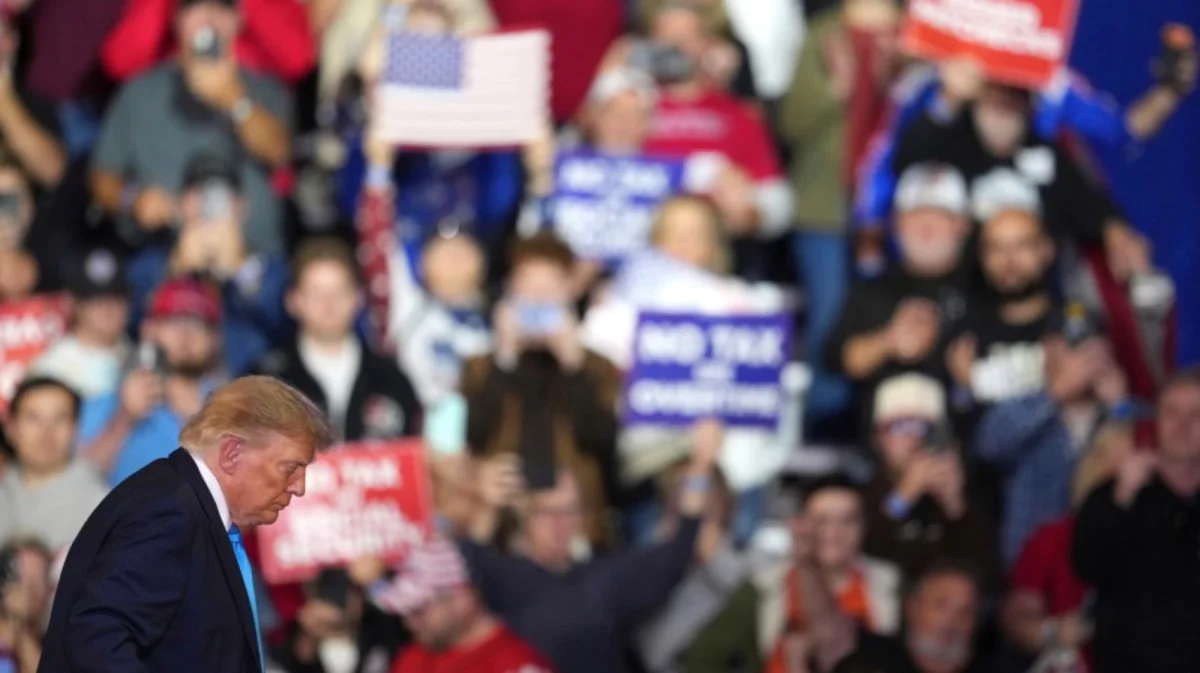
Dylan Corbett, executive director of the Hope Border Institute, recently told the National Catholic Reporter that we are going through " a dark night of the soul as a country ."
Just last month, several children gathered in a courtroom to have their futures decided by a Texas judge. One was a six-year-old who pretended to fly an airplane; another was a three-year-old who played with a microphone. They were among 25 minors facing deportation hearings that day.
Angel was one of them. Just 13 years old, he pleaded that it was "too dangerous" to be returned to Honduras, adding, "My mom and my entire family are here." The judge ruled that Angel did not qualify for asylum and asked whether he wanted either a deportation order or would leave voluntarily. At that, Angel burst into tears crying : "I have no one. I have nothing."
The stories of those young Texas children are not the only examples of the cruelties inflicted upon immigrants by the Trump administration.
Immigration and Customs Enforcement agents have murdered U.S. citizens and patrol our streets. Children wonder whether their parents will be home when they return from school. And many immigrants who have followed the rules are being deported not to their home countries, but to places like South Sudan, Eswatini and Rwanda .
Earlier this year , Renée Good and Alex Pretti became household names when they were publicly executed on the streets of Minneapolis. In Biddeford, Maine, Johan Sebastián Durán Guerrero, a food delivery worker, was killed by an ICE officer in front of his wife and three-year-old daughter. Houston, Texas, saw Lorenzo Salgado Araujo gunned down by ICE agents as he was on his way to a job at a construction site.
During the past year, 37 people have died in ICE custody, many with Hispanic surnames whose identities are not household names but are known to God.
At a Catholic mass held for the World Day of Migrants and Refugees, Washington, D.C., Cardinal Robert McElroy recited the story of the Good Samaritan. In it, Jesus Christ describes a priest and Levite who saw a robbery victim laying on the side of the road and passed by. Only the Samaritan stopped, treated the victim's wounds, and paid for his stay at a nearby inn.
As Cardinal McElroy noted , it's easy to dislike the priest and the Levite, and admire the Good Samaritan.
When migrants are deported, raids on farm workers and Home Depots take place and mothers and children are detained, many of us have assumed the role of the priest and Levite and passed on by.
When the Trump administration dismantled the U.S. Agency for International Development, which has saved millions of lives overseas, many wondered, "What can we do?"
Donald Trump has called himself " the greatest president ever ." Scholars disagree. Steven Levitsky, a professor of government at Harvard University, contends that during Trump's second term in office the U.S. has "slid into some form of authoritarianism."
Americans are equally disenchanted with Trump. An Economist/YouGov poll finds hefty majorities describe him as "arrogant," "opportunistic," "reckless," "dishonest," "corrupt," "hypocritical" and "divisive."
It is easy to characterize the past decade as the era of Trumpism, a word that encompasses the cruelties inflicted by Trump, the degradation of our political institutions and attacks on the rule of law.
Using a word to describe a political era happened once before during the 1950s, when Sen. Joseph McCarthy (R-Wisc.) charged that the U.S. government had been infiltrated by communist sympathizers. Harry Truman declared that McCarthy's only importance was that his name "has taken on a dictionary meaning".
"It is the rise to power of the demagogue who lives on untruth; it is the spreading of fear and destruction of faith in every level of our society."
Truman's definition of McCarthyism can be applied to the word Trumpism. But the danger is that like the 1950s, we will look upon this present moment and blame one man who used his power for nefarious purposes. Someday each of us will be asked the question, "What did you do when people were killed on the streets, or children held in detention, or when other cruelties too numerous to mention were inflicted on others?"
Did you, as Cardinal McElroy said, " pass on by "? Or will you be able to say that you protested, voted or otherwise made your views known?
In his 1953 inaugural address , Dwight D. Eisenhower offered "a little private prayer" to the Almighty: "Give us, we pray, the power to discern clearly right from wrong, and allow all our words and actions to be governed thereby, and by the laws of this land."
He asked for cooperation to be the goal for those who "hold to differing political faiths; so that all may work for the good of our beloved country and Thy Glory."
This too, should be our prayer. A historical reckoning with Trump is coming.
John Kenneth White is a professor emeritus at The Catholic University of America who writes on Substack . His latest book, coauthored with Matthew R. Kerbel, is titled " Democracy on the Edge: The Trump Elections and the Future of American Politics. "
Topics in this story
Gathered from external sources. Rights to this text belong to whoever originally published it.