The Memo: Trump backs controversial Ohio ad, pouring fuel on midterm campaign fires
President Trump intensified the furor over a deeply controversial political ad on Thursday, backing the decision by the GOP’s gubernatorial candidate in Ohio, Vivek Ramaswamy, to run the commercial. In doing so, Trump poured fresh fuel on a bitter midterm campaign that has seen the president deride the Democratic candidate for Senate in Michigan, Abdul…
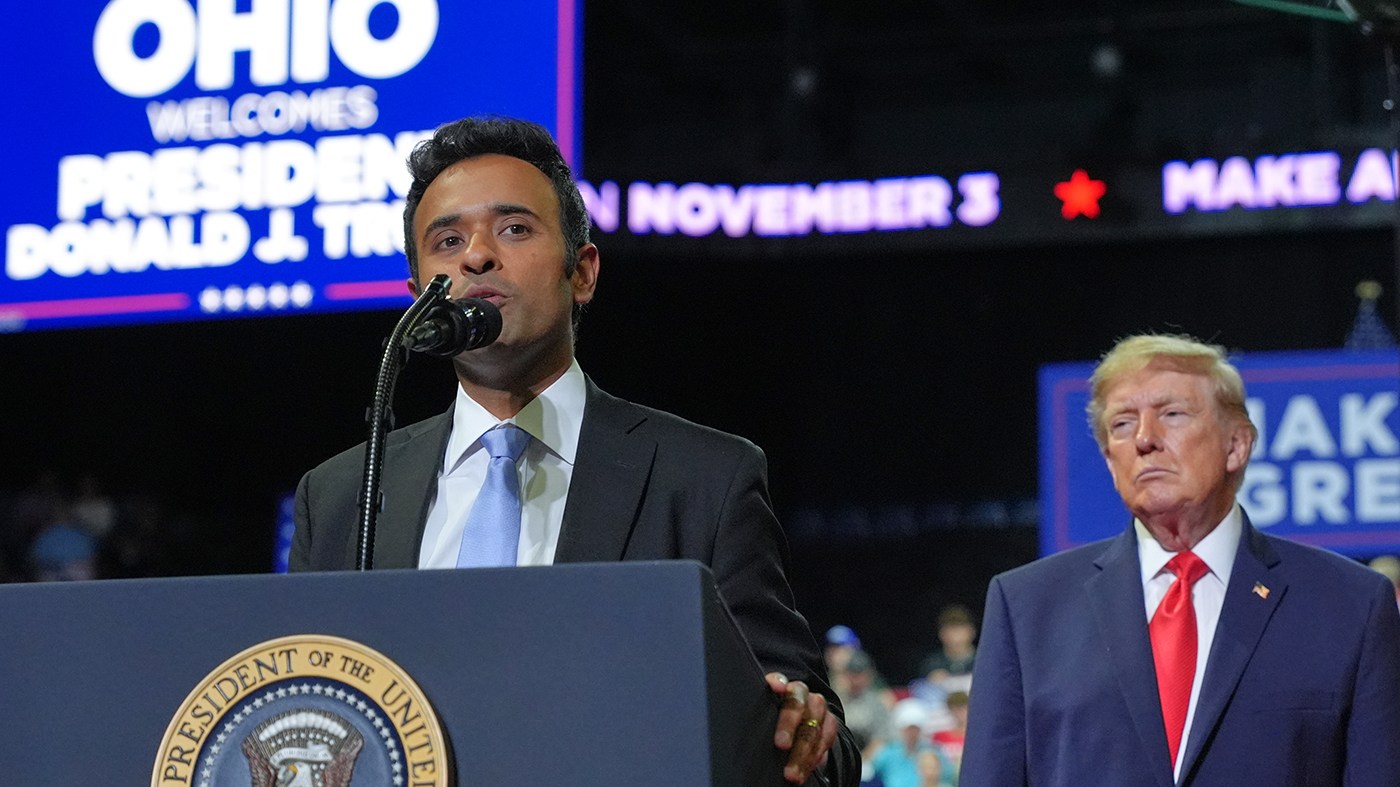
President Trump intensified the furor over a deeply controversial political ad on Thursday, backing the decision by the GOP’s gubernatorial candidate in Ohio, Vivek Ramaswamy, to run the commercial.
In doing so, Trump poured fresh fuel on a bitter midterm campaign that has seen the president deride the Democratic candidate for Senate in Michigan, Abdul El-Sayed, as a “jihadist”; use an anti-trans slur against Annie Andrews, the Democratic Senate candidate in South Carolina; and habitually refer to James Talarico, the Democratic Senate candidate in Texas, as “Talafreako.”
Trump has also referred to El-Sayed by his middle name, Mohamed, in a way that critics contend is a clear appeal to Islamophobia. The tactic has drawn parallels with Trump’s long record of seeking to “other” former President Obama by repeatedly invoking his middle name, Hussein.
Trump has shot back over El-Sayed, contending that, as president, “I can call him whatever the hell I want.”
At a Wednesday rally in South Carolina, Trump again used a slur against Andrews, referring to her as “Tr—y Annie.” Andrews is not trans.
Asked to respond to general criticism of Trump’s campaign trail rhetoric, White House spokesperson Davis Ingle told this column via email: “President Trump doesn’t care about being politically correct, he cares about Making America Great Again. The American people love how authentic, transparent, and effective the President is, which is why he won in a massive landslide victory on November 5, 2024.”
Ingle also contended that, in relation to the midterms, the choice facing voters is between “doubling down on President Trump’s winning, commonsense agenda or the Democrats’ extreme liberal policies and obstruction.”
For the moment, however, it is the Ramaswamy ad that is dominating the national political conversation.
The ad centers upon Donna Arthur, the long-estranged mother of Ramaswamy’s Democratic opponent, Amy Acton.
In Acton’s telling, an extremely troubled childhood included repeated sexual abuse by her stepfather. Her stepfather, Cledith Arthur, was charged for sexual conduct with a minor, and initially pleaded not guilty. He later fled the state with Acton’s mother before he could face a full trial. He died in 2004.
In the ad, Arthur calls her daughter a “liar” with a “serious problem.”
The commercial has caused a firestorm. Even though family members have sometimes appeared in negative political ads before, it’s a rare occurrence — and none has had the deeply traumatic backstory of the Acton matter.
Several Republicans have been critical of the ad, including Ohio Gov. Mike DeWine (R).
DeWine, who is leaving office due to term limits, said running the ad was “wrong” and called the commercial “deeply troubling.” Sen. Jon Husted (R-Ohio), who is in a tight race with Democratic former Sen. Sherrod Brown, has said he would not have run the ad. Former Ohio Gov. John Kasich (R) also condemned the ad, saying during an MS NOW interview on Thursday that “there is nothing appropriate” about the commercial.
“The reaction to all of this has been disgust,” Kasich added.
That has not been the reaction at the highest levels of the Trump administration, however.
Vice President Vance, who previously served as a senator representing Ohio, told reporters on Wednesday that his disgust was focused on those Republicans “who are whining more about that advertisement than they are about what the congressional Democrats and other Democrats want to do to the United States of America.”
Then, Trump weighed in with a lengthy social media pos t on Thursday in which he praised the ad as “very powerful,” and disparaged DeWine as someone who “probably” wants the Democrat to win the race.
“The Press is trying to convince everyone that this Ad is bad, because it’s so good! Who wouldn’t use such an Ad? I would, it’s called, ‘hitting pay dirt,’” Trump continued.
Speaking on Thursday afternoon with reporters, Trump implied he was not aware of Acton’s descriptions of childhood abuse. According to pool reports, the president insisted, “I don’t know what the daughter said.”
More broadly, Republicans have hit out at the language used by some Democrats as the midterm campaign hits its final stretch, though those instances have been generally less visceral and personal than Trump’s attacks.
Sen. Elissa Slotkin (D-Mich.), who is not running for reelection this year, sparked controversy with comments at the University of Chicago last week because of the way she said her party should use its oversight powers if it won control of Congress.
Slotkin said: “I want young people coming out of school to say, ‘Should I go work for the Trump administration?’ … I want them to be like, ‘Lord, that might be buying myself a ton of problems that I don’t want. And so let me avoid participating in that.’ I want that deterrence message sent.”
Republicans contended Slotkin was trying to intimidate young conservatives out of taking on a more active role in politics. Her defenders countered she was merely arguing that wrongdoing should incur consequences.
The Democratic Senate candidate in Maine, Troy Jackson, also drew criticism for telling his Republican opponent, Sen. Susan Collins to “shut up” during a debate earlier this month.
Republicans also object to the language used by prominent Democrats about Trump and his allies generally.
An official account allied with California Gov. Gavin Newsom (D) called White House deputy chief of staff Stephen Miller a “fascist cuck” last year, for example. Georgia Sen. Jon Ossoff (D) was widely seen as using sexual innuendo when he referred to Trump and White House aide Natalie Harp at a rally over the summer.
Those moments have cut both ways, however. The vice president was just as widely criticized for insinuating that Texas Democratic Senate candidate James Talarico is gay at a rally earlier this month.
It’s not exactly the Lincoln-Douglas debates.
But Ryan Skinnell, an expert in political rhetoric and a professor of rhetoric and writing at San José State University, noted that the explosion of social media — and its often cruder sensibilities — is part of the picture.
“In a long history of media, this kind of thing happens basically whenever there is a new medium that pops up. You can see versions of this increasing extremism after the invention of radio, or TV, or even the pulp press,” he said.
At the same time, Skinnell made clear he does not see that historic pattern as exculpatory of those who engage in inflammatory rhetoric — like Trump.
“When he feels threatened. his rhetoric gets more extreme and more aggressive,” Skinnell said of the president.
“When there is a breaking news story that makes him look bad, all of a sudden we see him making really extreme claims. Coming in to an election, the same thing. It’s an attempt to distract from issues like the rising cost of gas. If you say something wildly xenophobic about Abdul El-Sayed, maybe people will get distracted.”
Todd Belt, a professor in the Political Management program at the George Washington University, also highlighted Trump’s rhetoric — but noted it was part of a bigger picture.
“There is a coarsening of our political dialogue,” Belt said. “Over time, we have made politics into more of a bloodsport.”
The Memo is a reported column by Niall Stanage.
Topics in this story
Gathered from external sources. Rights to this text belong to whoever originally published it.