The Memo: Tennessee debacle revives bitter debate over death penalty
The death penalty is back center stage in national politics in the most macabre of circumstances. Christa Pike, 50, who admits to the gruesome 1995 murder of classmate Colleen Slemmer, is in critical condition in the hospital after Tennessee’s attempt to execute her Wednesday evening failed. The attempted execution had only proceeded at the last…
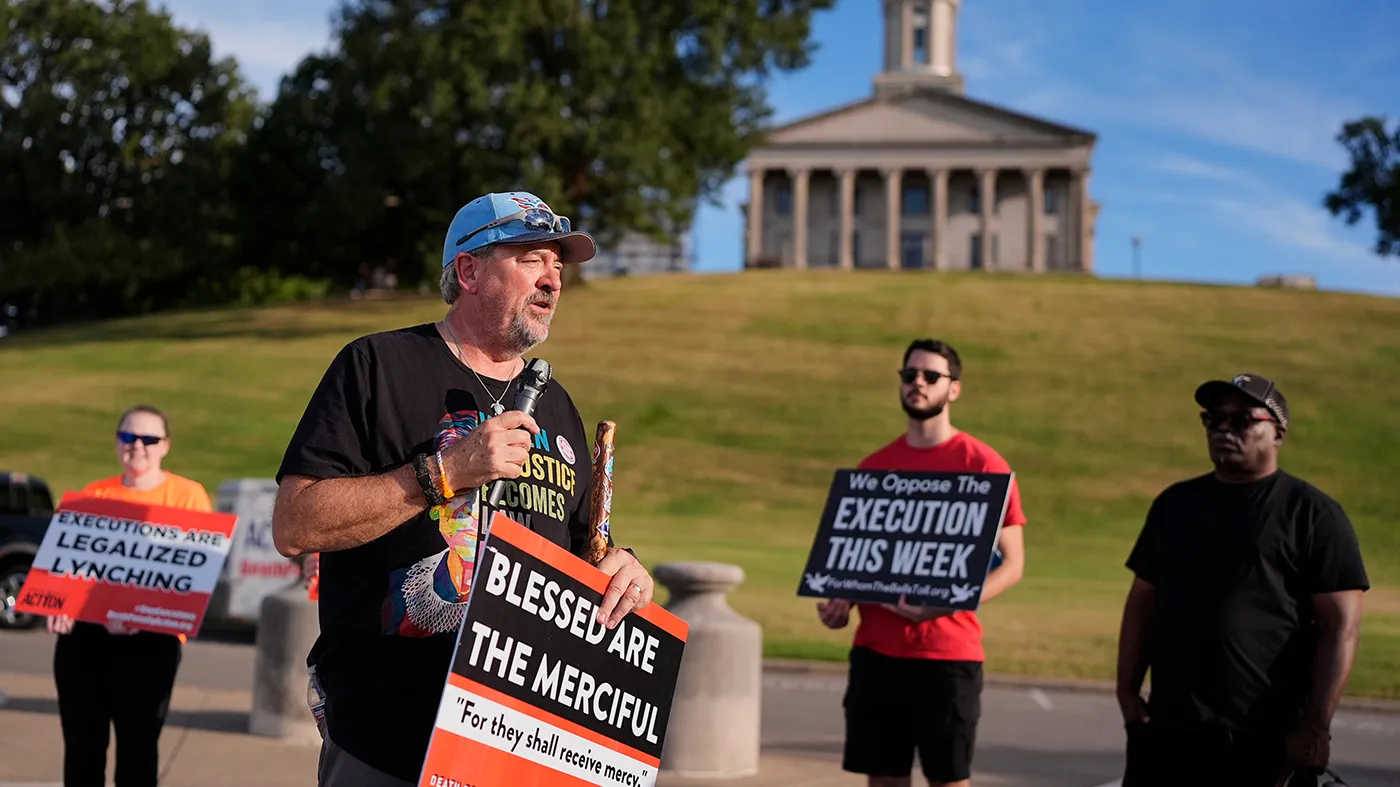
The death penalty is back center stage in national politics in the most macabre of circumstances.
Christa Pike, 50, who admits to the gruesome 1995 murder of classmate Colleen Slemmer, is in critical condition in the hospital after Tennessee’s attempt to execute her Wednesday evening failed.
The attempted execution had only proceeded at the last minute when the Supreme Court cleared the way for it, overruling an earlier block from a federal appeals court.
Pike could be heard snoring even after receiving two doses of pentobarbital, the drug that was supposed to kill her, according to witnesses. She was taken by ambulance to the hospital where, as critics noted, the state that had just attempted to end her life then attempted to save it.
Pike’s attorneys said at a Thursday afternoon news conference that she was receiving “lifesaving medical care” but that they knew little about the specifics of her condition or her prognosis.
The political uproar was immediate after the distress and confusion of Wednesday’s events.
Tennessee Gov. Bill Lee (R) said he was “highly disappointed” about what had taken place. He paused any further attempts to execute Pike for the moment and also announced that the one other execution scheduled in the state before the end of the year has been postponed. Lee has ordered a “comprehensive, third-party review” as to what exactly transpired.
Lee is about to be term-limited out of office, however. Sen. Marsha Blackburn (R-Tenn.) is the GOP’s nominee to succeed him.
Blackburn wrote on social media that the situation with Pike was “tragic,” in part because she “should have been executed long ago.”
As for the failures of Wednesday evening, Blackburn had a suggested remedy: “The answer is simple: bring back the electric chair and deliver justice for these victims swiftly. As your governor, I will do just that,” she wrote .
Blackburn’s Democratic opponent, Jerri Green, a member of the Memphis City Council, countered, “The fact of the matter is: the death penalty has always been inhumane, expensive, and biased.”
Green promised a moratorium on all future executions if elected governor and asserted , “If we say we are pro-life, that means we must be anti-death penalty.”
It would require a political earthquake for Green to get the chance to put her plans into practice, however. Most independent polls of the gubernatorial race put Blackburn up by more than 20 points in a state President Trump carried by 30 points in 2024.
Trump did not address the topic on social media and later said during a gaggle with reporters: “You’re going to have to speak to Tennessee about it.” The White House directed questions to the office of the Tennessee governor.
Such uncharacteristic reticence might, in part, be rooted in a disinclination to get involved in a disturbing controversy that has left all sides unhappy.
At Thursday’s news conference, one of Pike’s attorneys, Stephen Ferrell, alleged she had been “tortured in the execution chamber.” Calling for the commutation of her sentence, he added, “Tennessee should not be torturing its citizens in the name of justice.”
Another attorney for Pike, Randy Spivey, contended that the sequence of events Wednesday evening amounted to “cruel and unusual punishment.”
Campaigners against the death penalty believe the bleak sequence of events can cast new light on their cause.
“A death penalty process run by human beings has flaws at every stage, and what we have done is continuously ignore the flaws,” Laura Porter, the executive director of the U.S. Campaign to End the Death Penalty, told this column.
Porter acknowledged that polling indicates the American public supports the death penalty, albeit by a fairly small majority.
But, she contended, “when they see it up close, they come to the belief that it is not worth keeping. It is not an effective response to violence. This is a moment like that. This is an uncomfortable look at the realities of the death penalty.”
Amy Bergquist of the Advocates for Human Rights, which says it “implements international human rights standards to promote civil society and reinforce the rule of law,” made a similar point about specifics — including, in this case, the “protracted and horrific” abuse Pike herself had suffered in childhood. Pike’s defenders say this was overlooked at the time of her sentencing.
As for the difficulties with lethal injection, Bergquist added: “The whole purpose of what we call ‘lethal injection’ is really to help the public feel more at peace with a practice that is barbaric.”
Polling organization Gallup has the most reliable historical data on public attitudes to the death penalty — and it shows long-running shifts in trajectory.
After a brief moment in the mid-1960s when the death penalty lost majority support, backing for it grew to a peak in the mid-1990s, when crime rates were especially high. In 1994, 80 percent supported the death penalty and just 16 percent were opposed.
There has been a long erosion of support since then, however. Last year, 52 percent of Americans backed the death penalty and 44 percent were opposed.
As for executions themselves, they have been on the rise in the past few years after falling to a low of 11 nationwide in 2021, according to data from the Death Penalty Information Center (DPI). There were 47 executions last year, the highest figure since 2009.
Experts in the area note that one state — Florida — is responsible for much of the recent increase, however. The DPI data shows Florida executed 19 people last year , whereas no other state executed more than five people.
Those who want an end to the practice appear to be fighting an uphill battle, partly because of overall public opinion and partly because politicians have long feared being cast as “soft on crime.”
A generation ago, then-presidential candidate Bill Clinton was governor of Arkansas and returned home from the campaign trail for the execution of Ricky Ray Rector — a man whose mental impairment was severe enough that he said he would save the dessert from his last meal “for later.”
Still, efforts to abandon the practice continue.
In May, Sen. Dick Durbin (D-Ill.) and Rep. Ayanna Pressley (D-Mass.) reintroduced legislation to end the federal death penalty.
Reacting to the Pike case, Durbin wrote on social media Thursday:
“How many more failed executions must take place before this cruel practice is consigned to the dustbin of history? To paraphrase Supreme Court Justice Harry Blackmun: we must no longer tinker with the machinery of death.”
The Memo is a reported column by Niall Stanage.
Topics in this story
Gathered from external sources. Rights to this text belong to whoever originally published it.