What’s in the permitting reform bill?
{beacon} Energy & Environment Energy & Environment The Big Story What’s in the permitting reform bill? This week, a set of bipartisan senators announced a major permitting reform bill aimed at speeding up the buildout of the nation’s infrastructure, especially energy projects, here’s what the bill, known as the Bipartisan American Affordability and Jobs…
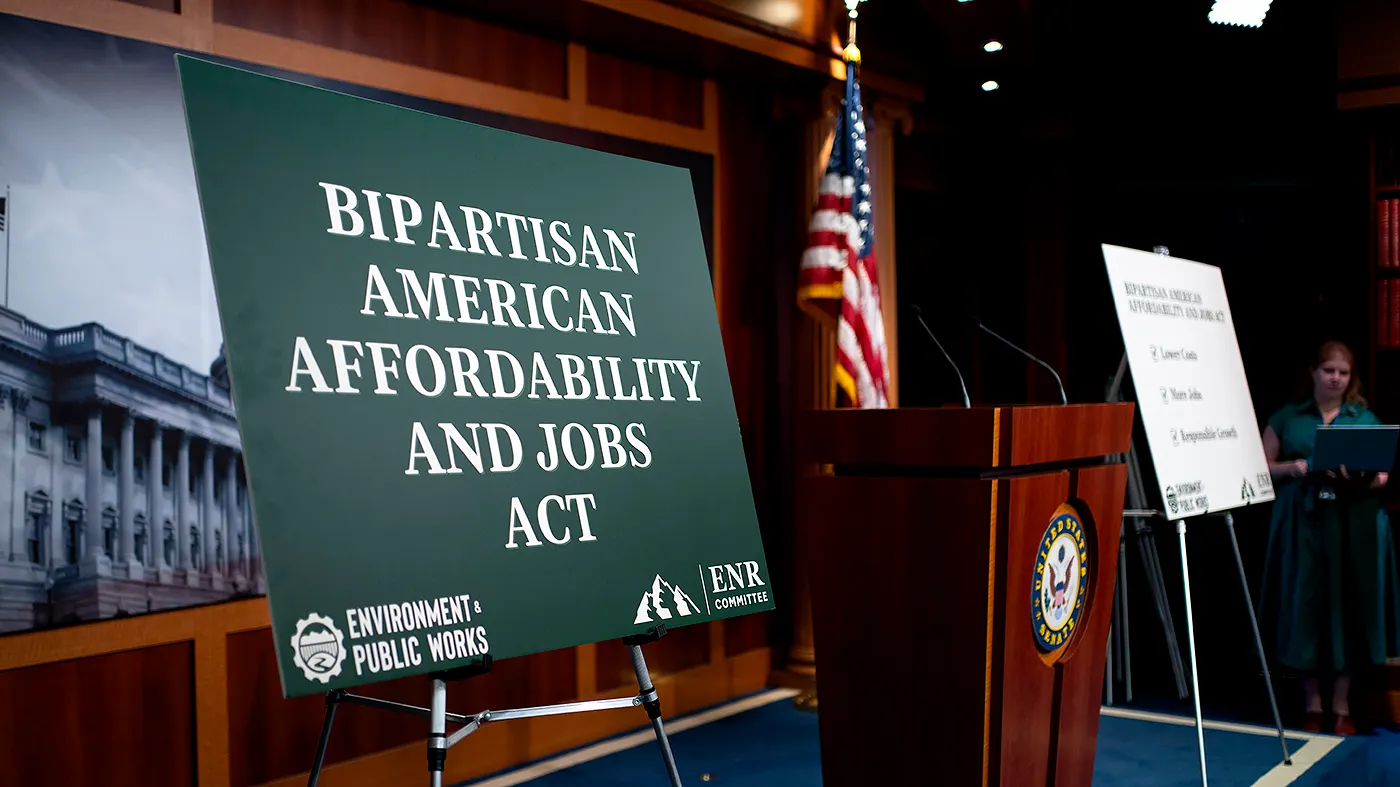
This week, a set of bipartisan senators announced a major permitting reform bill aimed at speeding up the buildout of the nation’s infrastructure, especially energy projects, here’s what the bill, known as the Bipartisan American Affordability and Jobs Act (BAAJA), would actually do:
Limit environmental laws that hold back projects and restrict lawsuits:
A major component of the legislation is changes to the nation’s environmental laws that could make it easier to build projects and make it harder to block them, both with lawsuits and other legal mechanisms.
One of the biggest changes are limits that restrict lawsuits against projects, mandating that they be filed within 150 days of a project’s approval. It also limits lawsuits to only those who weighed in publicly if the project has a public comment period and those who may be directly harmed by a project.
The changes are contentious, with supporters saying the change will cut down on lawsuits that can interrupt a project years after it is approved while opponents say the short window could prevent legitimate complaints.
The bill also has provisions that are expected to make it easier to build and approve power lines in particular, which is key to getting more power onto the grid. Democrats have pushed for such reforms, saying they believe they will particularly bolster renewable energy.
“The bill overall has a particularly strong impact on getting transmission built and otherwise expanding transmission capacity with new technologies,” said Rob Gramlich, president of consulting firm Grid Strategies LLC.
Welcome to The Hill’s Energy & Environment newsletter, I’m Rachel Frazin — keeping you up to speed on the policies impacting everything from oil and gas to new supply chains.
Did someone forward you this newsletter? Subscribe here.
How policy will affect the energy and environment sectors now and in the future:
With gasoline prices hovering near an average of $4.50 a gallon amid the Iran war, calls to suspend federal and state gas taxes are gaining momentum.
The FBI arrested a Department of Energy (DOE) employee Thursday at the Hanford, Wash., nuclear site under suspicion of trying to aid the Iranian-backed Houthi terrorist group in Yemen, according to the Justice Department.
The federal case against a former Olympian accused by the Trump administration of damaging the Lincoln Memorial Reflecting Pool is officially dead after a Washington, D.C., judge ruled Thursday that the Department of Justice (DOJ) cannot try to charge him again in the future.
News we’ve flagged from other outlets touching on energy issues, the environment and other topics :
The Coal Industry Asked for a Rescue. Trump Obliged. ( The New York Times )
US tells France and Germany to release diesel stocks or face US export ban, sources say ( Reuters )
Text messages obtained by The Hill show former special counsel Jack Smith’s staff didn’t reference any basketball team names, adding to the confusion around why Sen. Eric Schmitt (R-Mo.) errantly accused the prosecutor of attending a game in Atlanta in an effort to tie him to a Georgia prosecution of President Trump. Read more
Secretary of State Marco Rubio ordered the Iranian delegation to leave the U.S. immediately Monday after the United Nations General Assembly as negotiations between both countries have stalled. Read more
Check out The Hill’s Energy & Environment page for the latest coverage.
400 N Capitol Street NW Suite 650, Washington, DC 20001
Topics in this story
Gathered from external sources. Rights to this text belong to whoever originally published it.