Hegseth’s future as Pentagon chief at center of lame-duck defense battle
Senate Democrats are quietly floating the ouster of Secretary of Defense Pete Hegseth after the Nov. 3 election as the political price for cooperation on key...
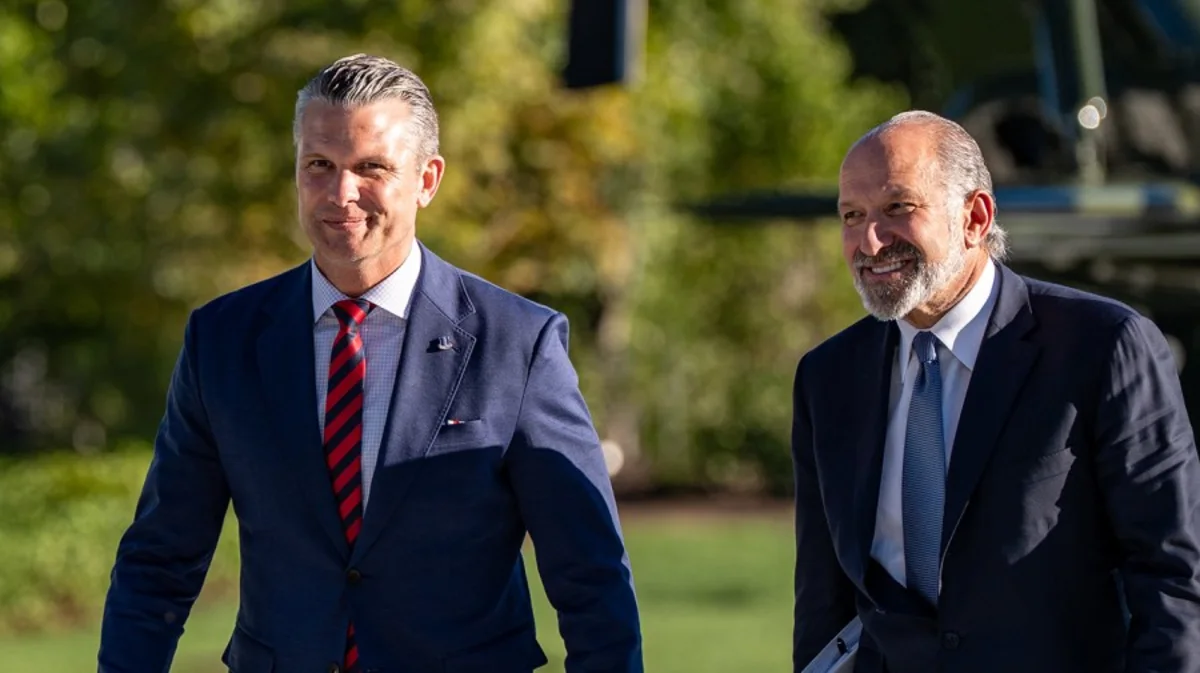
Senate Democrats are quietly floating the ouster of Secretary of Defense Pete Hegseth after the Nov. 3 election as the political price for cooperation on key defense-related issues in the post-election lame duck session, and they may have some GOP support to shake-up the Pentagon's leadership, according to Senate sources.
The Defense Department has set recruiting records under Hegseth's leadership and the Pentagon chief appears to have strong support from President Trump, who likes to brag that Hegseth looks like a military leader from "central casting."
But some Republican senators haven't been happy with Hegseth's leadership, especially his ouster of well-respected military leaders such as Army Secretary Dan Driscoll, Army Chief of Staff Randy George, Navy Secretary John Phelan and four-star Gen. Chris Donahue, the top U.S. military officer in Europe.
Democrats view Hegseth's leadership as a disaster and are looking for leverage to push him out after the midterm election, according to Senate sources, just as they attempted to push former Secretary of Homeland Security Kristi Noem out her job during the prolonged stalemate over funding for her department earlier this year.
Trump eventually fired Noem after key Republican senators, such as Sen. John Kennedy (R-La.), turned against her publicly.
Now Democrats have significant leverage over Hegseth's future at the Pentagon as they're threatening to hold up emergency defense funding the White House requested in June as well as regular funding for the Defense Department, which expires on Dec. 11.
Sen. Tim Kaine (D-Va.), a member of the Senate Armed Services Committee, said that Hegseth's resignation could set the stage for more bipartisan cooperation on must-pass defense bills, such as the National Defense Authorization Act and the annual defense appropriations bill.
Kaine told The Hill before the Senate adjourned for the election that Hegseth's departure would help lower the partisan temperature in the standoff over the defense measures.
Republican sources say that Senate Democrats have already privately floated Hegseth's termination as something that could help muster bipartisan cooperation on filling key vacancies at the Pentagon, such as the positions of Army and Navy secretary left open by the departures of Driscoll and Phelan.
As things now stand, Senate Democrats are threatening to block the defense spending bills and also a waiver that Hung Cao, Trump's nominee to serve as Navy secretary.
Cao needs a special congressional waiver to lead the Navy because federal law requires a seven-year waiting period before former military officers can be confirmed to top Pentagon civilian leadership posts.
Democrats are drawing a hard line on supporting defense funding in the lame-duck session if the military conflict with Iran isn't wrapped up before the end of the year.
"My own view is that if the war is over, then the opportunity for bipartisanship on defense authorization and defense appropriations is there. I think if the war's not over it's going to be extremely difficult," said Sen. Brian Schatz (D-Hawaii), who is poised to take over as Democratic whip in the next Congress.
Schatz said he was speaking about his own personal view of the prospects of a deal on defense spending.
So far, some key Senate Republicans say they don't see Trump agreeing to push Hegseth out of the job to get cooperation from Democrats on the defense authorization and funding measures in the lame-duck session.
"That's a bridge too far," warned a GOP senator, who requested anonymity to discuss the looming negotiations over breaking the logjam on defense legislation after Election Day.
A senior Pentagon official dismissed the criticism of Hegseth's leadership from Democrats and some key Republicans by pointing to his record of accomplishments over the past 20 months.
"Secretary Hegseth has been a transformative leader for the Department of War and, at President Trump's direction, has ushered in a new era of Peace Through Strength," the official said in response to jockeying by Democrats to push Hegseth out of his role.
"Standards and merit are back, our arsenal is stronger than ever before, and morale and recruitment across every service are at all-time highs. Secretary Hegseth has slashed bureaucracy, unleashed innovation, and delivered for our warfighters every step of the way. By every measurable metric, the Department of War is better under Secretary Hegseth's leadership than before," the senior official said. "The entire Department is unified behind the Secretary's vision and will continue working to put our warfighters and America first."
There are growing questions, however, on Capitol Hill whether Trump and Hegseth are fully in sync on several important issues.
Trump recently cancelled Hegseth's plan to run a livestream of the execution of Maj. Nidal Hasan, who was convicted of killing 13 people and wounding more than 30 at a mass shooting at Fort Hood in 2009.
There's also confusion whether Hegseth or other senior Pentagon officials directed a temporary halt to intelligence sharing with Ukraine or ordered the restriction of Ukraine's access to the Starshield satellite-based internet network, without Trump's knowledge and approval.
Four Republican senators — Senate Appropriations Committee Susan Collins (Maine), Sen. John Cornyn (Texas), Sen. Thom Tillis (N.C.) and Sen. Lisa Murkowski (Alaska) — signed a bipartisan letter last week directing the Defense Department inspector general, Platte Moring, demanding he immediately investigate whether any Pentagon officials "directed" or "authorized" changes to intelligence-sharing arrangements or Starlink and Starshield services affecting Ukraine.
Collins has separately faulted Hegseth for not fully anticipating that Iran would be able to shut down most shipping traffic, including nearly a quarter of the world's seaborne oil supply, through the vulnerable Strait of Hormuz in response to U.S. and Israeli attacks.
"For example, the closure of the Strait of Hormuz should have been anticipated. It happened during the Iraq-Iran war and it's an obvious point of leverage but there doesn't seem to have been any plan for it," Collins said last month.
Tillis writes in his new memoir that his decision to cast a deciding vote to confirm Hegseth in January of 2025 is "the biggest regret of my career."
Some Republicans already acknowledge that pushing Hegseth out of his job in the lame-duck session could avoid a messy impeachment battle next year, aside from paving the way for a potential deal on the defense authorization and appropriations bills before Christmas.
"Trump should fire Hegseth to avoid Hegseth's impeachment. It's the honorable thing to do," Rep. Thomas Massie (R-Ky.) posted on X, the social media site, Thursday.
The maverick conservative who lost his primary re-election bid earlier this year when Trump endorsed his opponent noted that Speaker Mike Johnson (R-La.) had to scramble to avoid voting on Hegseth's impeachment before the election.
"The House recessed early to avoid the vote, so I will reintroduce Hegseth articles of impeachment when we return for the lame duck session, regardless of the outcome of the midterm election,"
House Democrats led by Rep. Yassamin Ansari (D-Ariz.) filed six articles of impeachment against Hegseth in April.
Democrats in the lower chamber plan to make a Hegseth a top political target next year if they win the majority in next month's election, something that political handicappers project is likely.
Rep. Melanie Stansbury (D-N.M.) told Semafor that impeaching Hegseth should be one of House Democrats' "top three priorities" next year.
Topics in this story
Gathered from external sources. Rights to this text belong to whoever originally published it.